The Weight of the Brush
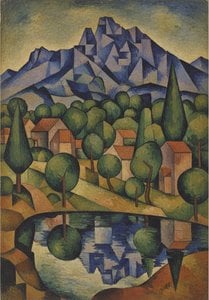
Herbert Barnett lived through a period of shifting perspectives, moving from the quietude of Providence, Rhode Island, to the steady rhythm of Cincinnati, Ohio. His hands were trained in the language of oil and canvas, working with a directness that revealed the process of creation. One can see the initial sketches lingering beneath layers of dark paint, a reminder of the physical labor involved in every stroke. He did not hide the construction of a painting; instead, he allowed the structural bones of the work to remain visible, creating a sense of depth through the very evidence of his making.
His work often turned toward the landscape and the stillness of objects. In his depictions of the Cape Ann coast or the quietude of a country still life, there is a focus on how light and form interact. He looked at the world through a lens influenced by the structural logic of early cubism and the tonal sensibilities of Cézanne. This approach allowed him to break down a subject into contrasting directional planes of color, turning a simple mandolin or a piece of furniture into a study of geometry and light.
A Study in Form and Light
The way Barnett handled his subjects suggests a deep interest in the underlying architecture of the visible world. He found meaning in the mundane, treating a musical instrument or a figure with the same structural seriousness as a vast landscape. His technique relied on several key elements:
- The use of visible, heavy brushwork that documents the movement of the hand.
- A preference for contrasting planes of color to define space.
- The integration of figure and still life through shared geometric logic.
- A focus on the physical presence of objects within a defined environment.
In works like Still Life with Mexican Figure, the composition relies on the tension between the objects and the space they occupy. The paint is applied with a certainty that respects the weight of the subject. He was a man of the academy, eventually serving as the Dean of the Cincinnati Art Academy, a position once held by Frank Duveneck. This role suggests a life spent not only in the act of painting but in the formal study and instruction of the craft itself.
The Quiet Legacy of the Canvas
Barnett’s output was marked by a consistent investigation into how a painter might organize a scene. Whether he was looking at a plowed field in Vermont or a portrait of a mid-century figure, the goal remained the same: to find the structure within the subject. His paintings do not seek to decorate, but to build. He worked with a sense of purpose that favored the reality of the medium over the illusion of the image.
His presence in the American art landscape is felt in the collections of the Smithsonian American Art Museum and the Cincinnati Art Museum. These works remain as records of his specific way of seeing—a way that valued the visible process and the structural integrity of the painted surface. He left behind a body of work that remains grounded in the physical reality of paint on canvas.
Spørgsmål og svar
Kan jeg udforske Herbert Barnetts værker efter emne?
Herbert Barnetts værker kan udforskes efter emne på kunstnerens Emneoversigt-side.
Kan jeg gennemse Herbert Barnetts værker efter farvepalette?
Se Herbert Barnetts værker sorteret efter farvepalette på kunstnerens Efter farvepalet side.
Kan jeg gennemse Herbert Barnetts værker efter stemning?
Stemningsfulde rum for Herbert Barnett er en side, hvor kunstnerens værker er organiseret efter stemning.
Kan jeg besøge et virtuelt museum med Herbert Barnetts værker?
Besøg galleriet virtuelt: 3D-galleri-siden for Herbert Barnett præsenterer kunstnerens værker i et tredimensionelt galleri.