Life and Artistic Career
Ernst Müller-Gräfe was a German painter and graphic artist born in Nobitz, Germany. He received his training at the Lindenau Drawing School of the Art Association in Altenburg and later studied at the Dresden Academy of Fine Arts under Gotthardt Kuehl and Oskar Zwintscher, becoming a master student in 1898. Following his studies, he worked as a freelance artist in Dresden and operated a private painting school. His career included serving as a soldier on the Western Front during the First World War, during which time he continued to create art, such as the drawing Vor Verdun. Gefangener Tunesier.
Müller-Gräfe's diverse body of work encompassed various media, including oil paintings, graphics, woodcuts, drawings, and pastels. He was also known for his designs for posters, book illustrations, and coats of arms, including the state coat of arms of Thuringia and the municipal seals of 56 municipalities. His artistic output included significant interior decorations, such as the staircase in the Lindenau Museum and the memorial chapel at the St. Annen City Church in Annaberg-Buchholz.
Works and Legacy
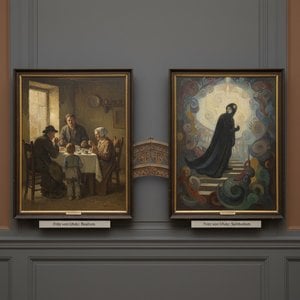
The artist's repertoire included several notable cycles and monumental works. In 1922, he completed a cycle of three large-format expressive individual paintings depicting scenes of happiness, labor, and suffering. Other significant works include the fresco in the Altenburg Crematorium and various murals in Altenburg. His expressive works were later classified as "degenerate" by the National Socialists, leading to the seizure and destruction of many of his paintings, drawings, and prints from various museum collections.
His surviving works and legacy are represented in several institutions, including:
Spørgsmål og svar
Kan jeg besøge et virtuelt museum med Ernst Müller-Gräfes værker?
Ernst Müller-Gräfes værker kan opleves i et 3D-galleri på kunstnerens 3D-galleri-side.
Hvor kan jeg se farveprofilen i Ernst Müller-Gräfes værker?
Farveprofilen for Ernst Müller-Gräfes værker kan ses på kunstnerens Farvepalettens DNA-side.
Hvor kommer Ernst Müller-Gräfe fra?
Ernst Müller-Gräfe blev født i Germany.
Findes der et overblik over alle de motiver, som Ernst Müller-Gräfe har malet?
Siden Emneoversigt kortlægger Ernst Müller-Gräfes kunstværker efter motiv.