
1
The church at Horne, Funen.
Håndmalet oliereproduktion fra $199 39 × 26 cm
Samme størrelse som originalen $246 60 × 40 cm Bestil i original størrelse →

Maleriet, der gjorde Eiler Rasmussen Eilersen berømt, er The church at Horne, Funen. (1855). Landscape on Funen at sunset. (1856) og Landskab fra Frijsenborg Dyrehave. Bygevejrsdag (1864) følger efter i samlernes og museumsgæsternes hjerter. Af de 24 værker af Eiler Rasmussen Eilersen i vores katalog er disse 24 de mest beundrede, hver præsenteret med sit årstal, sit museum og det, der gør værket unikt.
Rangordnet efter vores popularitetsscore, som kombinerer søgninger, besøg og ordrer for hvert værk. Opdateret november 2026. Hvert mesterværk på denne side kan bestilles som en håndmalet oliereproduktion i museumskvalitet eller som et kunsttryk i den størrelse, du vælger.


Det museum, der rummer flest af malerierne på denne side.
| Museum | By | Værker af Eiler Rasmussen Eilersen | Malerier fra denne liste |
|---|---|---|---|
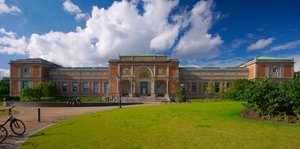 Statens Museum for Kunst |
København | 1 | Landskab fra Frijsenborg Dyrehave. Bygevejrsdag |


The church at Horne, Funen. (1855). Derefter følger Landscape on Funen at sunset. (1856) og Landskab fra Frijsenborg Dyrehave. Bygevejrsdag (1864).
28 år gammel: The church at Horne, Funen. er fra 1855, og Eiler Rasmussen Eilersen blev født i 1827.
The church at Horne, Funen., Landscape on Funen at sunset., Landskab fra Frijsenborg Dyrehave. Bygevejrsdag, The manor Svanholm., View from Hellebæk., Mountain Landscape with View of the Sea, Forest lake with low-flying swallows., View from Dyrehaven, near Copenhagen., Forest view with a lake and some game. og Summer landscape at a river at sunset.. Ranglisten ovenfor angiver årstallet og museet for hver af dem.
Vores katalog indeholder 24 værker af Eiler Rasmussen Eilersen, dateret fra 1855 til 1912.
De fleste af dem findes i Statens Museum for Kunst (København). Tabellen ovenfor lister museerne enkeltvis.
I 1870s: 10 af de 24 værker på denne side stammer fra denne periode, herunder View from Dyrehaven, near Copenhagen..
Det tidligste på denne side er The church at Horne, Funen. (1855), det seneste Landscape from the Pyrenees (1912).
Ja. Hvert maleri på denne side kan bestilles som en håndmalet oliereproduktion i museums kvalitet eller som et kunstprint i den størrelse, du ønsker, direkte fra maleriets egen side.
In the heart of the nineteenth century, a period defined by profound artistic shifts across Europe, there emerged from the quiet landscapes of Denmark a painter of remarkable sensitivity and luminous skill. Eiler Rasmussen Eilersen, born in 1827 in the village of Østerby, possessed an innate affinity for drawing that would eventually blossom into a celebrated career. The son of a local farmer and parish constable, Eilersen’s journey from the rural outskirts of Faaborg to the prestigious halls of the Royal Danish Academy of Fine Arts is a testament to both his raw talent and the vital role of patronage in the lives of nineteenth-century artists. Supported by the philanthropic efforts of the Bille-Brahe family, he was able to transcend his humble beginnings, seeking formal instruction that would eventually allow him to capture the very soul of the Danish countryside.
His path to mastery, however, was not without its tribulations. The turbulent winds of history, specifically the outbreak of the First Schleswig War, momentarily diverted his brush for the sword, as he was drafted into the Danish army for two years of service. Yet, this interruption only seemed to deepen his connection to the land he would later immortalize on canvas. Upon returning to his studies in Copenhagen, Eilersen approached his craft with a renewed and vigorous determination. He began exhibiting his works under the name Rasmussen, quickly earning the admiration of a public captivated by his ability to breathe life into sylvan scenes and rolling meadows. His technique, characterized by a luminous realism, utilized rich colors and considerate brushwork to illuminate the nuanced beauty of regions ranging from the island of Funen to the dense forests of Northern Zealand.
Eilersen’s artistry was deeply rooted in the traditions of the Danish Golden Age, yet he infused these established styles with a personal verve that set his work apart. His vision was not confined merely to the borders of his homeland; through the acquisition of a prestigious travel scholarship from the Royal Danish Academy in 1858, he and his wife, Eleanor Vinning, embarked on an odyssey through Paris, the Pyrenees, and Switzerland. These travels expanded his aesthetic vocabulary, allowing him to integrate the grander, more dramatic light of the European continent into his intimate depictions of Danish nature. This period of exploration refined his ability to manipulate light and shadow, creating landscapes that felt both grounded in reality and touched by a poetic, almost ethereal, quality.
As his reputation grew, so did his presence on the international stage. His membership in the Royal Danish Academy in 1871 marked a significant milestone in his professional ascent, and his participation in grand exhibitions, such as the Exposition Universelle in 1889, brought his talent to the eyes of the global art community. The significance of his work lies in this delicate balance between local devotion and international sophistication. He remained a painter of the Danish landscape at heart, yet his technical prowess and the emotional resonance of his scenes spoke a universal language of beauty.
The legacy of Eiler Rasmussen Eilersen is found in the enduring charm of his canvases, which continue to evoke the tranquil majesty of a bygone era. His life and work represent a vital chapter in Danish art history, characterized by: