The Evolution of a Visionary
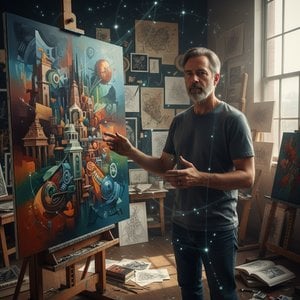
Born in Sydney, Australia, Dick Watkins emerged during a period when the high-flying energy of American-based Abstraction dominated the artistic landscape. His early career was launched amidst this movement, yet he quickly found himself navigating the abrupt conclusion of the Modern era. As the cultural certainty of progress began to fade, Watkins turned his gaze toward the very nature of creation itself. He famously declared himself a copyist, driven by the belief that no truly new creation exists in art, but rather that all works are shaped by existing visual languages.
This realization did not lead him to a narrow path. Instead, it sparked a long and adventurous exploration of many subjects and styles. He refused to be confined by a single personal style, choosing instead to investigate how art relates to the lived experience. His work often acted as a signal for the shifting currents of Western culture, making him a significant and often debated figure in the Australian art scene for over half a century.
A Life of Inquiry
Watkins’s approach to the canvas was defined by a restless curiosity. He sought to understand the mechanics of how we see and how we interpret the world through imagery. His career was marked by several distinct phases of thought:
- The early influence of abstraction and the shifting paradigms of the Modern era.
- A philosophical shift toward the concept of the artist as a translator of visual languages.
- A period of intense exploration across diverse subjects and stylistic modes.
Legacy and Recognition
His contributions to the arts are held within significant institutions, reflecting the weight of his influence on the Australian landscape. His work, such as What the butler saw or The foundations of empirical knowledge, created in 1982, resides in the National Gallery of Victoria, Melbourne. Through his refusal to settle into a comfortable niche, he remained a constant presence in the dialogue of contemporary art, challenging the boundaries of what it means to create in a world already filled with images.
Spørgsmål og svar
Kan jeg udforske Dick Watkinss værker via nøgleord?
Siden Efter nøgleord for Dick Watkins grupperer kunstnerens værker efter nøgleord.
Hvilke stemninger udtrykker Dick Watkinss kunstværker?
Dick Watkinss værker kan udforskes efter stemning på kunstnerens Stemningsfulde rum-side, hvor kunstværkerne er sorteret efter deres registrerede stemninger.
Findes der en kronologisk gennemgang af Dick Watkins?
Dick Watkinss karriere udfolder sig periode for periode på kunstnerens Kronologi-side: en horisontal tidslinje over værkerne, opdelt i kapitler efter karriereperioder.
Hvilken by og hvilket land er Dick Watkins født i?
Dick Watkins blev født i Sydney, i Australia.