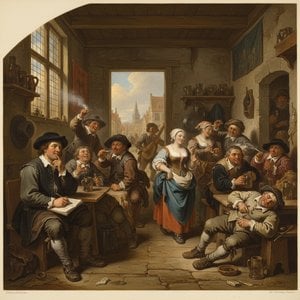
David the Younger Ryckaert: A Flemish Master of Everyday Life
David the Younger Ryckaert (1560-1607) stands as a pivotal figure in 16th-century Flemish painting, renowned for his captivating depictions of village life and biblical narratives. Born in Antwerp, he emerged from a family steeped in artistic tradition – his father, David Rijckaert II, was himself a respected painter, and his uncle, Marten Ryckaert, further cemented the family’s legacy within the art world. Unlike some of his contemporaries who focused solely on grand historical or religious scenes, Ryckaert skillfully captured the nuances of daily existence, imbuing his works with a remarkable sense of realism and human connection.
Ryckaert's artistic journey began under the tutelage of his father, absorbing the foundational techniques and stylistic sensibilities that characterized the Rijckaert family’s oeuvre. However, he quickly developed a distinctive voice, marked by an acute observation of detail and a subtle yet powerful ability to convey emotion. His early works often showcased landscapes and genre scenes – depictions of everyday activities like market days, tavern gatherings, and domestic interiors—reflecting the burgeoning interest in portraying secular subjects alongside religious ones during this period.
The Influence of Antwerp’s Artistic Landscape
Antwerp at the time was a vibrant hub of artistic activity, attracting talent from across Europe. The city's rich trading history and cosmopolitan atmosphere fostered an environment where diverse artistic styles converged. Ryckaert undoubtedly benefited from this dynamic exchange, absorbing influences from masters like Jan van Eyck and Peter Paul Rubens, while simultaneously forging his own unique approach. Rubens himself played a significant role in the artist’s career, commissioning him to contribute to the elaborate decorations for the Joyous Entry of Cardinal-Infante Ferdinand into Antwerp in 1635 – a monumental event that showcased the city's artistic prowess.
The influence of the Guild of Saint Luke, where Ryckaert was eventually elected dean, further shaped his artistic development. The guild’s rigorous standards and emphasis on craftsmanship instilled in him a dedication to technical skill and a deep understanding of artistic conventions. His membership within the guild also provided access to a network of fellow artists, fostering collaboration and intellectual exchange.
A Palette of Domesticity: Themes and Techniques
Ryckaert’s paintings are characterized by their intimate scale and focus on seemingly unremarkable subjects. He frequently depicted village interiors—scenes of peasants engaged in daily tasks, families sharing meals, or children playing – offering a glimpse into the lives of ordinary people. These scenes were not merely illustrations; they were imbued with a sense of warmth, humor, and genuine human connection. His ability to capture the subtle expressions on his subjects’ faces and the details of their clothing demonstrated a remarkable sensitivity to human psychology.
Technically, Ryckaert employed the meticulous detail characteristic of Flemish painting, utilizing oil paints to achieve rich colors, luminous effects, and intricate textures. He skillfully rendered light and shadow, creating a sense of depth and realism that drew viewers into his scenes. His use of perspective was particularly noteworthy, contributing to the illusionistic quality of his paintings.
Notable Works and Lasting Legacy
Among Ryckaert’s most celebrated works is “Peasant with a Dog,” a poignant depiction of rural life that captures the simplicity and dignity of peasant existence. “In the Village” offers another compelling example of his ability to portray everyday scenes with remarkable detail and emotional resonance. His "Painter's Studio" provides insight into the world of an artist, showcasing tools and materials alongside a partially completed work.
Despite his considerable talent and success, Ryckaert’s career was tragically cut short by illness in 1607. However, his legacy endures through his captivating paintings, which continue to be admired for their realism, emotional depth, and insightful portrayal of human life. David Ryckaert III, a contemporary of the younger brother, continued the family tradition, further solidifying the Ryckaert name as a prominent force in Flemish art. His work serves as a testament to the enduring appeal of depicting the ordinary moments that shape our lives.
Spørgsmål & svar
Hvad er fødestedet og fødselsåret for David The Younger Ryckaert?
David The Younger Ryckaert blev født i Antwerp i 1560.
Hvor kan jeg finde statistik om David The Younger Ryckaerts værker?
Siden Statistikker for David The Younger Ryckaert præsenterer statistikker beregnet ud fra kunstnerens værker, som er listet på denne hjemmeside.
Hvordan finder jeg værker af David The Younger Ryckaert i en specifik farvepalette?
Siden Efter farvepalet grupperer David The Younger Ryckaerts kunstværker efter deres farvepaletter.