The Life of Alfred Andre Geniole
Born in the city of Nancy, France, in 1813, Alfred Andre Geniole entered a world that would soon demand much of his creative spirit. He was a man of many hands, working with the precision of a painter, the keen eye of a graphic artist, and the technical skill of a lithographer. His early years were shaped by the guidance of Antoine Jean Gros, a teacher who imparted the discipline required to capture the essence of his subjects. This mentorship provided the foundation upon which he would build a career centered on the observation of the people around him.
As his reputation grew, his life became intertwined with the shifting social landscapes of France. He moved through the various circles of Parisian life, finding inspiration in the faces of the city. His work was not merely a collection of images but a reflection of the era he inhabited. He sought to document the character of his contemporaries, whether they were found in grander settings or in the quiet, everyday moments of urban existence. This dedication to his craft defined his presence in the French art scene for many years.
The path of his life eventually led him toward his final days in Bicêtre. He passed away on January 12, 1861, leaving behind a body of work that captured a specific moment in history. Through his various mediums, he ensured that the likenesses and manners of his time would remain visible to those who study the past.
Artistic Training and Early Career
The foundations of his craft were laid in the studio of Antoine Jean Gros, a painter who had earned his reputation through the creation of monumental historical canvases. Under such guidance, the young artist learned to navigate the complexities of composition and the weight of human form. This early instruction provided him with the discipline required to move beyond mere sketching and into the professional circles of Paris. By 1839, he had made his debut at the Salon de Paris, stepping into the public eye at a time when the city was a whirlwind of social and artistic change.
His early years were marked by a restless movement between different modes of expression. He was not merely a painter of portraits but a man who understood the power of the printed image. In 1841, he began contributing illustrations to Le Charivari, finding a place within the fast-paced world of Parisian publication. This period of his life saw him refining his ability to capture the fleeting gestures and fashions of the urban population. His work during these years reflected a growing interest in the people he saw in the streets, moving from the grand scale of his teacher's historical themes toward the intimate details of contemporary life.
Technique and Artistic Style
Géniole moved through the art world with a versatile hand, finding equal comfort in the precision of lithography and the fluidity of painting. As a genre painter and portrait artist, he possessed a keen eye for the small, telling details of human existence. He did not merely record a face; he sought to capture a subtle psychological insight, looking past the surface to find the character dwelling within his subjects. This ability to marry realism with a sense of the individual's inner life allowed him to portray both the high fashion of the social elite and the humble realities of the working classes with equal sincerity.
His mastery of watercolor was particularly notable, as he used the medium to navigate the complexities of light and texture. Through careful application, he could render the soft sheen of a fabric or the delicate play of shadows across a room. This technical skill extended into his graphic work, where his lithographs achieved a remarkable level of detail. In his series of plates depicting the women of Paris, his lines and washes worked in harmony to document the elegance and social interactions of the era. He captured the way light fell upon a street scene or a private parlor, giving his scenes a sense of immediate presence.
Notable Works and Collections
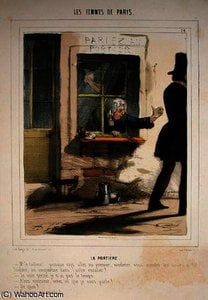
Géniole found his greatest expression in the quiet, bustling corners of Parisian life, where he turned his gaze toward the people who animated the streets. His series Les femmes de Paris remains a significant achievement, consisting of thirty plates that capture the elegance and social interactions of the era. Within these works, one finds a profound sense of character, whether he was depicting the poise of a lady or the industrious spirit of a worker. His lithograph The Cloth Seller is a fine example of this ability, using fine lines to render the textures of fabric and the dignity of the trade.
The artist possessed a particular talent for portraying the common folk of the city, finding beauty in the mundane tasks of daily existence. He rendered The Orange Seller and The Oyster Seller with a keen eye for detail, ensuring that the subjects felt present and real to the viewer. This interest in the working classes extended to his depictions of domestic and street life, such as in The Baker's Art, The Nanny, and The Cleaning Lady. Even in his more social scenes, like The Literary Lioness, his hand remained steady and his observation sharp, capturing a specific moment of social grace or labor.
- The Literary Lioness
- The Orange Seller
- The Oyster Seller
- The Cloth Seller
- The Baker's Art
- The Nanny
Where to See His Works Today
To witness the traces of his hand, one must travel to the heart of Paris. The Musée Jacquemart-André holds his paintings, where his brushwork continues to speak to those who wander through its halls. It is here that his ability to capture the essence of his subjects remains most palpable. His presence in the city of his life ensures that his vision of the era is never entirely lost to time.
Beyond the capital, his influence reaches the coast at the Museum of Modern Art André Malraux – MuMa in Havre. This institution maintains a significant collection of his works, preserving the nuances of his style for modern eyes. For those seeking his presence across the sea, the National Gallery of Art features his work within its selected collections, allowing his portraits to find an audience far from the streets of France. Even in the quiet halls of the Allen Memorial Art Museum, his hand can be found, proving that his reach extended well beyond his own borders.
Spørgsmål og svar
Kan jeg gennemse Alfred Andre Genioles værker efter farvepalette?
Siden Efter farvepalet grupperer Alfred Andre Genioles kunstværker efter deres farvepaletter.
Findes der en kronologisk gennemgang af Alfred Andre Geniole?
Alfred Andre Genioles karriere udfolder sig periode for periode på kunstnerens Kronologi-side: en horisontal tidslinje over værkerne, opdelt i kapitler efter karriereperioder.
Hvor kan jeg se farveprofilen i Alfred Andre Genioles værker?
Alfred Andre Genioles farvebrug på tværs af de værker, der er listet på denne hjemmeside, kan studeres på kunstnerens Farvepalettens DNA-side.
Hvor mange kunstværker af Alfred Andre Geniole er tilgængelige at gennemse?
Du kan gennemse 15 kunstværker værker af Alfred Andre Geniole på siden Alle kunstværker.