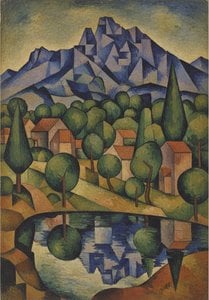
The Luminous Legacy of Alberto Pulicino
To wander through the maritime history of Malta is to encounter the evocative brushstrokes of Alberto Pulicino, an artist whose name remains inextricably linked to the golden age of Maltese topographical painting. Born in Valletta during the mid-eighteenth century, Pulicino emerged as a master of light and perspective, capturing the architectural grandeur and bustling naval vitality of his homeland with unparalleled sensitivity. His life, spanning from 1719 to 1765, coincided with a period of profound significance for the Order of St. John, providing him with a front-row seat to the intricate social and military tapestry of the Mediterranean's most strategic fortress island.
Pulicino’s artistic development was deeply rooted in the tradition of vedute—the highly detailed, large-scale topographical views that were immensely popular among European nobility. While he possessed a keen eye for the structural precision required to render the formidable bastions of Valletta and the sweeping curves of the Grand Harbour, his true genius lay in his ability to breathe life into these stone monuments. He did not merely document fortifications; he captured the atmosphere of the Mediterranean sun as it danced upon the salt-sprayed limestone and the rhythmic movement of vessels navigating the azure waters.
A Visionary of the Maltese Landscape
The technical mastery displayed in Pulicino’s oeuvre reveals an artist deeply attuned to the nuances of light and shadow. His works often feature a sophisticated interplay of luminosity and depth, achieved through a meticulous approach to oil on canvas. Unlike the more rigid topographical engravers of his era, Pulicino infused his landscapes with a sense of drama and movement. He was particularly renowned for his panoramic views, which offered viewers an immersive experience of the Maltese coastline, from the rugged cliffs to the sheltered inlets of the Cottonera.
His influence and reach extended far beyond the shores of Malta. Because of his popularity among the French Knights of the Order of St. John, many of his most significant works were transported to France, where they served as prestigious visual records of the Order's Mediterranean territories. This international circulation helped establish Pulicino not just as a local chronicler, but as a significant figure in the broader European tradition of landscape painting. His ability to marry architectural accuracy with atmospheric emotion allowed his paintings to function simultaneously as historical documents and emotive works of art.
Historical Significance and Enduring Impact
The legacy of Alberto Pulicino is preserved in the breathtaking vistas that continue to fascinate historians and art enthusiasts alike. His contributions to the visual identity of Malta are immeasurable, providing a window into an eighteenth-century world of maritime commerce, military might, and colonial elegance. Through his eyes, we see the Grand Harbour not as a static relic, but as a living, breathing entity, teeming with the energy of a pivotal era.
Today, the importance of his work can be summarized through several key artistic contributions:
- Topographical Excellence: His precise rendering of Valletta’s fortifications remains one of the most reliable visual archives of the period.
- Atmospheric Mastery: The ability to capture the unique Mediterranean light, elevating simple harbor scenes into emotive masterpieces.
- Cultural Documentation: Providing a vital link to the era of the Knights of Malta and the socio-economic importance of the Maltese maritime routes.
- Artistic Lineage: Serving as a precursor to later landscape traditions by blending the precision of topographical art with the burgeoning sensibilities of atmospheric painting.
Spørgsmål og svar
I hvilken historisk periode arbejdede Alberto Pullicino?
Alberto Pullicino var aktiv i Early Modern-perioden. Denne periode placerer kunstnerens virke i en historisk kontekst.
Hvordan er Alberto Pullicinos karriere opdelt i perioder?
Kronologi for Alberto Pullicino er en rullevenlig tidslinje, der præsenterer kunstnerens værker i kronologisk rækkefølge, opdelt i kapitler efter karriereperioder.
Hvor kan jeg opleve Alberto Pullicinos kunstværker i et 3D-galleri?
Besøg galleriet virtuelt: 3D-galleri-siden for Alberto Pullicino præsenterer kunstnerens værker i et tredimensionelt galleri.
Hvor kan man finde Alberto Pullicinos værker grupperet efter teknik?
For at finde alle værker af Alberto Pullicino inden for et bestemt medie, kan du bruge kunstnerens Alle medier side.