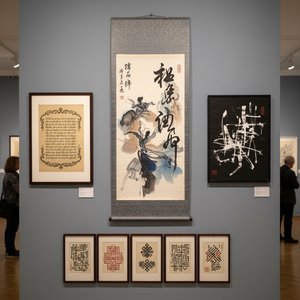
CALLIGRAPHY IN CLERICAL SCRIPT af Yang Xian, håndmalet oliemalerireproduktion udført af en mesterkunstner
Se i rummet Se i AR Skift til printsalg Skift til digitalt billede Del som kort
Detaljer Guide Tilføj til favoritter Download Lignende værker Røntgenundersøgelse Diasshow Spørgsmål og svar Præsentation Statistikker

CALLIGRAPHY IN CLERICAL SCRIPT Håndmalet oliemalerireproduktion

Dimensioner
238.0 x 58.0 cm

Explore the captivating world of Yang Xian's calligraphy & art! Masterful depictions of Chinese culture, philosophy, and nature through intricate brushwork & symbolism.

Kunstværket vist på denne side er beskyttet af ophavsretsloven, hvilket betyder, at vi ikke lovligt kan skabe eller sælge en identisk reproduktion. Denne beskyttelse håndhæves i henhold til internationale aftaler som f.eks. den Bernerkonventionen og af nationale love, herunder de bestemmelser, der er fastlagt i Amerikansk ophavsretslov - Titel 17.

Som et respektfuldt og lovligt alternativ tilbyder vi skræddersyede, håndmalede kunstværker inspireret af originalen. Vores dygtige og professionelle kunstnere studerer omhyggeligt originalens stil, stemning og kunstneriske essens for at skabe et nyt, unikt værk, der fremkalder den samme følelse – samtidig med at det forbliver en original skabelse i egen ret.

Denne metode overholder fuldt ud ophavsretsreglerne, da den ikke indebærer kopiering eller duplikering af det beskyttede kunstværk. I stedet er der tale om en kreativ nytolkning – et nyt maleri, som er inspireret af det oprindelige, men ikke identisk med det.

Håndlavet oliereproduktion

Håndmalet olie på lærred i din valgte størrelse og ramme, udført efter bestilling af vores kunstnere. ( Skift til printsalg Skift til digitalt billede)

Standardstørrelse
speciallavet
CM
INCH

Vælg mellem vores forudindstillede størrelser, der matcher kunstværkets originale proportioner.

bredde
højde

Indtast den bredde og højde, du har brug for, så det passer til din ramme eller din væg. Da dette er håndmalet, kan kunstneren ved en anden form på størrelsen male lidt mere rundt om billedet eller skære lidt væk — det er op til dig. Vi sender dig et digitalt mockup til godkendelse, før maleriet påbegyndes. Billedet, der vises på denne side, viser ikke det endelige resultat — det er kun mockuppet, der gør.

Eksempler på hvad der kan ændres: Udskift ansigt med kundens eget foto; Tilføj kæledyr (f.eks. udskift kat med hund); Inkluder en skjult besked i baggrunden; Ændr baggrundslandskab eller elementer.
Efter bestilling vil WahooArt.com team sende en e-mail til kunden for at indhente instruktioner og fremsende et udkast til gennemgang

Verdensomspændende levering () på 3-4 uger i stedet for de standard 5 uger. (8 november). Ingen kompromiser med kvaliteten.

Gratis ekspresforsendelse til hele verden
Lærred af linned i høj kvalitet
Fuld transportforsikring
Garanti for refusion af told og importafgifter
Garanti for præcis farvegengivelse
100 dages returret ved fabrikationsfejl
100% fuld returret
Mængderabat ved flere køb

Samlet pris

Dkr 1814

CALLIGRAPHY IN CLERICAL SCRIPT

Reproduktionsmetode

Størrelse på reproduktion

-

Samlet pris

Dkr 1814


Kunstnerbiografi

A Life Etched in Ink: The Calligraphy of Yang Xian

The name Yang Xian resonates through the annals of Chinese calligraphy, though disentangling the threads of his life requires navigating a complex historical landscape and acknowledging multiple figures bearing the same name. Our focus lies primarily on Yang Xian (1321–1370), a pivotal official during the early Ming dynasty whose mastery of clerical script—lishu—became intertwined with the political currents of his time. Born Yang Bi, he adopted the courtesy name Xiwu and rose to prominence amidst the tumultuous transition from Yuan to Ming rule. His story is not merely one of artistic skill but a testament to the power of calligraphy as both an aesthetic pursuit and a tool for navigating the treacherous waters of imperial court life.

From Bureaucrat to Brush Master

Yang Xian’s ascent began with his allegiance to Zhu Yuanzhang, the future Hongwu Emperor. Joining Zhu's ranks in 1356 after the capture of Jiankang (modern Nanjing), he quickly demonstrated a keen political acumen. His early successes were rooted in shrewd accusations—notably against Zhang Chang, whom he denounced for harboring loyalty to the fallen Yuan dynasty—actions that earned him favor with his new patron. This initial period reveals a pragmatic side to Yang Xian, suggesting his calligraphy wasn’t born in isolation but developed alongside a career built on astute observation and strategic maneuvering within the imperial bureaucracy. He was appointed Assistant Administrator of the Imperial Secretariat in 1368, swiftly followed by promotion to Vice Chancellor of the Right the following year. It was during this period that Yang Xian truly began to leave his mark as a calligrapher, though his rise wasn’t without controversy.

The Art of Clerical Script and Political Allegiances

Yang Xian's signature style centered on lishu, a script characterized by its bold, angular forms and deliberate structure. Unlike the flowing grace of cursive or standard scripts, clerical script possesses a grounded solidity, reflecting a sense of order and authority. This aesthetic choice wasn’t accidental; it mirrored Yang Xian’s own personality and political stance. He was known for his uncompromising nature, a trait that both propelled him forward and ultimately contributed to his downfall. His calligraphy often served as a vehicle for expressing these convictions, imbued with a forceful energy that resonated with the Hongwu Emperor's desire for strong governance. He famously impeached Vice Chancellor of the Left, Wang Guangyang, on grounds he deemed morally lacking—a demonstration of his willingness to challenge established figures and uphold what he perceived as righteous standards. His works, such as “Calligraphy Couplet in Clerical Script,” exemplify this aesthetic and ideological blend; each stroke is deliberate, conveying a sense of unwavering conviction and refined scholarship.

A Tragic Fall and Lasting Legacy

The very qualities that had elevated Yang Xian—his acute judgment and uncompromising nature—ultimately led to his demise. In 1370, he was appointed Vice Chancellor of the Left, but accusations leveled by Li Shanchang – charges of “false accusations against a minister” and “wanton treachery”—sealed his fate. He was executed, becoming a casualty in the escalating power struggles between the East Zhe faction (to which Yang Xian belonged) and the West Huai faction led by Li Shanchang and Hu Weiyong. His death intensified this rivalry, ultimately leading to the complete dominance of the West Huai faction within the Ming court. Despite his tragic end, Yang Xian’s influence on calligraphy endured. He left behind a body of work that continues to be admired for its technical brilliance and expressive power. His mastery of lishu served as an inspiration to subsequent generations of calligraphers, solidifying his place in the history of Chinese art.

Beyond the Brush: Symbolism and Historical Context

To understand Yang Xian’s work fully, one must consider the broader cultural context of the Ming dynasty. The early years of the Ming were marked by a conscious effort to revive traditional Chinese values after decades of Mongol rule. Calligraphy, deeply intertwined with Confucian ideals of self-cultivation and moral rectitude, played a central role in this revival. Yang Xian’s choice of lishu, a script associated with earlier periods of strong governance, can be seen as part of this broader project—a deliberate attempt to connect the new dynasty with its glorious past. Furthermore, his calligraphy often incorporated Taoist symbolism, reflecting a desire for harmony and balance in both personal life and state affairs. His works weren’t simply beautiful objects; they were imbued with layers of meaning, serving as expressions of philosophical beliefs and political aspirations. While multiple Yang Xians existed throughout Chinese history—including a singer from Taiwan and an economist from Singapore—the Ming dynasty official remains the most significant figure for his contributions to calligraphy and his complex role in shaping the early years of one of China’s most enduring dynasties.

Kort om kunstneren

  • Artistic Movement Or Style: Calligraphy, Clerical Script
  • Date Of Birth: 1321
  • Date Of Death: 1370
  • Full Name: Yang Xian
  • Nationality: Chinese
  • Notable Artworks:
    • Calligraphy Couplet in Clerical Script
    • Calligraphy in Clerical Script