


Håndmalet olie på lærred i din valgte størrelse og ramme, udført efter bestilling af vores kunstnere. ( Køb print Køb billede)
Vælg mellem vores forudindstillede størrelser, der matcher kunstværkets originale proportioner.

Du kan indtaste dine egne mål for at passe til en bestemt ramme eller plads. Hvis den valgte størrelse ikke stemmer overens med det originale billedes proportioner, vil vi enten beskære kunstværket eller udvide maleriet med yderligere håndmalede elementer. En digital skitse sendes til din godkendelse, før produktionen påbegyndes.
Bemærk venligst, at forhåndsvisningen på skærmen ikke afspejler den faktiske beskæring eller udvidelse. Kun skitsen vil nøjagtigt vise den endelige komposition.
Selvom specialmål er mulige, anbefaler vi at vælge en dimension fra den foruddefinerede liste for at bevare de originale proportioner.
Levering i hele verden () på 3/4 uger i stedet for de standard 5 uger. (6 september). Ingen kompromiser med kvaliteten.


A Harlot's Progress, plate 1
Størrelse på reproduktion
William Hogarth's “A Harlot’s Progress,” specifically Plate 1, stands as a cornerstone of English art history and social commentary. Executed in etching and engraving on copper around 1730-31, this print transcends mere visual representation; it’s a meticulously crafted narrative designed to provoke reflection on societal hypocrisy and the perilous path toward moral decline.
The composition itself is deliberately unsettling. A crowded street dominates the background, populated by figures engaged in various activities – a gentleman observing the unfolding drama from horseback, an older woman attempting to offer guidance (perhaps subtly manipulative), and Hackabout herself, vulnerable and exposed. The arched doorway above serves as a visual barrier, emphasizing the isolation of Hackabout’s predicament.
Beyond its narrative content, “A Harlot’s Progress” is laden with symbolic significance. The older woman embodies temptation and exploitation—a critique of societal institutions that fail to protect vulnerable individuals. The horseman represents authority and power, highlighting the disparity between those who uphold moral standards and those who succumb to vice. Hogarth's intention wasn’t merely to depict a scandalous affair; he aimed to expose the corrosive effects of social pressures on individual conscience.
The print’s emotional impact is palpable—a blend of observation, pity, and judgment. It compels viewers to confront uncomfortable truths about human behavior and societal failings. Hogarth's stylistic choices – his meticulous attention to detail, his dramatic use of light and shadow, and his unflinching portrayal of moral decay – cemented “A Harlot’s Progress,” Plate 1 as a seminal work of English art and continues to resonate with audiences today.


1697 - 1764 , Storbritannien

Explore the profound artistry of black and white photography. From historical mastery to the interplay of light and shadow, discover how monochrome captures timeless emotion and form through a sophisticated lens of art history.

Master the nuances of Giclée printing with our expert guide. Discover how pigment-based inks and museum-grade substrates create fade-resistant, high-fidelity art reproductions designed for discerning collectors seeking unparalleled quality and longevity.
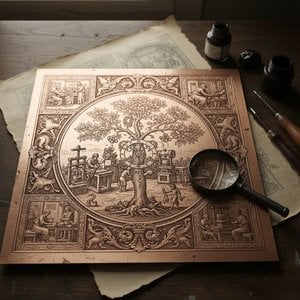
Explore the intricate world of etching and intaglio printmaking. Discover how masters use acid and metal to create profound textures and lines, from Romanticism to modern era, through an expert lens of art history and technical mastery.

 Se i fuld skala
 Del
Del Del
Del
 Detaljer

 Download
 Lignende værker
 Røntgenundersøgelse
 Diasshow

 Se mere




































 Glasmulighed er kun tilgængelig i størrelser under 110 cm


