A Dance of Color and Chaos: De Kooning’s “Composition”
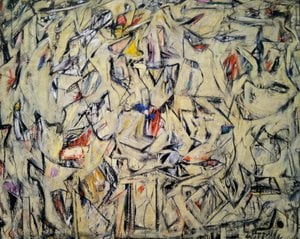
Willem de Kooning's "Composition," painted in the heart of the Abstract Expressionist movement, isn’t merely a painting; it’s an embodiment of restless energy and a profound exploration of form and feeling. Born in Rotterdam in 1904, De Kooning arrived in New York with a determined spirit – a stowaway on a ship, mirroring his artistic ambition to forge a new path entirely separate from the constraints of European tradition. This journey, fueled by a childhood marked by familial discord, profoundly shaped his approach to art: an insistence on raw emotion and a rejection of representational accuracy. “Composition” perfectly encapsulates this ethos, presenting a vibrant tableau where geometric shapes collide with gestural brushstrokes, creating a dynamic visual experience that feels both controlled and utterly spontaneous.
Decoding the Palette and Form
The painting’s immediate impact is dominated by a bold and arresting color scheme – a fiery interplay of reds and yellows punctuated by strategic accents of blue. These aren't colors used to depict reality; they are instruments of expression, deployed with an almost violent intensity. The dominant red, often interpreted as representing passion or even anger, clashes dramatically with the warm yellow, suggesting a volatile tension. Scattered throughout this chromatic drama are carefully placed geometric forms: squares and rectangles, rendered with varying degrees of precision. These shapes aren’t static; they seem to vibrate against each other, creating a sense of movement and instability within the composition. De Kooning masterfully uses these simple forms to disrupt any potential for harmony, forcing the eye to constantly navigate the painting's complex spatial relationships.
The Language of Brushstroke: Expressive Abstraction
What truly distinguishes “Composition” is De Kooning’s distinctive technique – his expressive brushstrokes. These aren’t delicate, controlled marks; they are bold, assertive gestures that reveal the physicality of the painting's creation. Thick impasto layers build up on the canvas, creating a palpable sense of texture and depth. The application of paint feels almost violent at times, as if the artist were wrestling with the image itself. This technique is central to Abstract Expressionism’s core philosophy: prioritizing the process of painting over the finished product. De Kooning wasn't aiming to create a beautiful object; he was channeling his emotions and experiences directly onto the canvas through the act of applying paint.
Echoes of an Era: Context and Legacy
"Composition" emerged during a pivotal moment in art history – the rise of Abstract Expressionism following World War II. This movement, characterized by its emphasis on individualism and emotional intensity, represented a radical departure from the established norms of Western art. De Kooning’s work stands as a cornerstone of this era, profoundly influencing subsequent movements like Pop Art and Minimalism. His willingness to embrace abstraction, coupled with his intensely personal style, paved the way for artists to explore new forms of expression and challenge traditional notions of representation. “Composition” isn't just a painting; it’s a document of its time – a vibrant testament to the anxieties, aspirations, and creative ferment of mid-20th century America.
Bringing De Kooning Home: A Reproduction for Your Space
WahooArt offers meticulously crafted hand-painted reproductions of “Composition,” allowing you to experience the raw power and emotional depth of this iconic artwork in your own home. Each reproduction is created by skilled artists who painstakingly replicate De Kooning’s technique, capturing the vibrancy of the colors and the dynamism of the brushstrokes. Whether adorning a gallery wall or adding a touch of artistic intensity to a contemporary interior, a WahooArt reproduction of “Composition” is more than just a print; it's an investment in art history and a celebration of De Kooning’s enduring legacy.
Spørgsmål & svar
Findes der et diasshow til "Composition" af Willem de Kooning?
"Composition" af Willem de Kooning kan ses som et diasshow på værkets Diaporama-side.
Hvor placerer "Composition" af Willem de Kooning sig i kunsthistorien?
Den kunsthistoriske klassificering af "Composition" af Willem de Kooning er Abstract Expressionism, i Early Modern-perioden.
Hvilken stilart tilhører "Composition"?
"Composition" af Willem de Kooning tilhører Abstract Expressionism-bevægelsen. Denne bevægelse giver den stilistiske kontekst for værket.



 Se i rummet
 Bestil håndmalet reproduktion
 Send
Send Del
Del
 Detaljer
 Studieguide til kunstværker

 Download
 Lignende værker
 Røntgenundersøgelse
 Se diasshow
 Statistik

 Læs mere






































 Glasmulighed er kun tilgængelig i størrelser under 110 cm