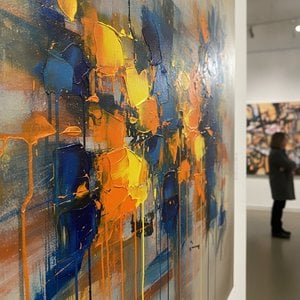
The Vibrant Synthesis of Valerio Adami
Born in Bologna on March 17, 1935, Valerio Adami has emerged as a titan of the contemporary Italian art scene, weaving together a visual language that feels both ancient and strikingly modern. His journey began with the disciplined rigor of the Accademia di Brera in Milan, where between 1951 and 1954, he studied under the esteemed Achille Funi. This classical foundation provided the essential scaffolding upon which he would later drape much more radical, experimental ideas. Seeking to expand his horizons beyond the Italian peninsula, Adami moved to Paris in 1957, a move that proved transformative. In the heart of France, he encountered the surrealist energies of Roberto Matta and Wifredo Lam, encounters that ignited a lifelong fascination with the intersection of dreamlike imagery and structured form.
The evolution of Adami’s style is a captivating narrative of artistic rebellion and refinement. His early works were characterized by an expressionistic intensity, often marked by a certain raw, even violent, energy that drew inspiration from the graphic punch of comic strips. However, as he moved through the 1960s, his aesthetic underwent a profound metamorphosis. He began to move away from purely emotive brushwork toward a style reminiscent of French cloisonnism—a technique where bold, flat regions of color are delineated by sharp, black outlines. This period saw him embrace the aesthetics of Pop Art and the dynamic tension of Futurism, creating works that felt like snapshots of a fragmented, modern reality. By the time he reached the international stage at Documenta III in Kassel, Adami had mastered a way to present highly stylized figures against stark, contrasting planes of color, turning the canvas into a stage for geometric abstraction.
A World Reimagined Through Geometry and Color
Adami’s mature work is a masterful exploration of how we perceive the modern world. He possesses a unique ability to take fragments of contemporary life—objects, landscapes, or human figures—and strip them of their traditional context, reimagining them through a lens of geometric precision. His paintings often present a sense of decontextualized beauty, where a mountain or a solitary figure becomes part of a larger, more complex symbolic arrangement. This approach allows him to touch upon profound themes ranging from the political to the mythological. In the 1970s, his work took on an even deeper layer of complexity as he began to integrate subject matter from European history, literature, and philosophy, effectively turning his canvases into intellectual dialogues.
The technical brilliance of his compositions lies in their ability to balance tension and harmony. One might observe:
- Dynamic Line Work: The use of decisive, black borders that contain and direct the viewer's eye across the composition.
- Chromatic Vibrancy: A palette that utilizes saturated, often unexpected colors to create a sense of Pop Art energy.
- Spatial Fragmentation: The clever use of overlapping planes to defy conventional perspective, much like the Cubist masters.
This technical repertoire allows him to create scenes that can be simultaneously playful and unsettling, such as his more whimsical depictions involving animals or his more somber, desolate landscapes.
Legacy and Artistic Significance
The historical significance of Valerio Adami lies in his role as a bridge between disparate art movements. He did not merely adopt Pop Art or Cubism; he synthesized them into a singular, cohesive vision that remains uniquely his own. His participation in landmark events like the 1968 Venice Biennale and his monumental commissions, such as the mural for Firstar Bank in Wisconsin, underscore his influence on the global art landscape. Even beyond the realm of painting, his creative spirit extended to film and illustration, demonstrating a polymathic approach to the visual arts.
Today, Adami remains a vital figure whose work continues to resonate with the complexities of our era. His ability to capture the fragmented nature of modern existence—the way we experience the world in glimpses, shapes, and intense bursts of color—ensures his place in the canon of 20th and 21st-century art. To look upon an Adami painting is to witness a profound meditation on the structure of reality itself, rendered with a grace that is as intellectually stimulating as it is visually breathtaking.



 Se i rummet
 Skift til printversion
 Send
Send Del
Del
 Detaljer
 Studieguide til kunstværker

 Download
 Lignende værker
 Røntgenundersøgelse
 Se diasshow
 Statistik
 Læs mere






































 Glasmulighed er kun tilgængelig i størrelser under 110 cm


![Abstract Composition [triptych] — Vaclav Vytlacil, Abstract Expressionism](/media/artworks/images-thumb/08/3c/083c0675045645fd42d4e6c6d63f1ced.jpg)