A Pastoral Reverie: Unpacking the Beauty of “Green Fields”
Sir George Clausen’s “Green Fields,” painted around 1906, isn't merely a depiction of a rural landscape; it’s an invitation to step into a moment of profound tranquility. The painting captures a quintessential English scene – rolling hills bathed in the diffused light of an overcast sky, dotted with figures engaged in the rhythms of agricultural life. More than just a pretty picture, “Green Fields” speaks volumes about the enduring connection between humanity and the land, a theme that resonated deeply within Clausen’s oeuvre and the broader artistic currents of his time.
Clausen, born in London in 1852, initially trained within the rigid structures of the Royal Academy Schools. However, he quickly gravitated towards the burgeoning Impressionist movement, absorbing its emphasis on capturing fleeting moments of light and color. This shift is strikingly evident here; the brushstrokes are loose and visible, creating a sense of dynamism and immediacy. The painting isn’t striving for photographic realism but rather attempting to convey the *feeling* of being present in this idyllic setting – the warmth of the sun filtering through the clouds, the scent of damp earth, the quiet hum of rural activity.
Composition and Color: A Symphony of Earth Tones
The composition is carefully orchestrated, guiding the viewer’s eye across a layered landscape. The foreground is dominated by a substantial stack of hay bales – a tactile element that grounds the scene and provides a visual anchor. Moving into the middle ground, we encounter a young man, his back turned to us, seemingly lost in contemplation as he gazes out over the expansive fields. This figure, often interpreted as representing the farmer or laborer, serves as a silent observer of the landscape’s beauty. The background fades gently into a hazy horizon, utilizing atmospheric perspective – a technique where distant objects appear paler and less distinct – to create a convincing sense of depth.
The color palette is dominated by variations of green and brown, reflecting the natural world with remarkable subtlety. Clausen masterfully employs muted greens to depict the fields, avoiding overly bright or saturated hues. The browns and yellows of the hay bales and earth tones provide a grounding contrast, while subtle washes of gray and blue in the sky add depth and mood. The overall effect is one of understated elegance – a celebration of the quiet beauty of the English countryside.
Symbolism and Emotional Resonance
Beyond its purely visual appeal, “Green Fields” carries significant symbolic weight. The scene evokes a sense of peace, solitude, and a deep connection to nature—themes that were particularly resonant in late 19th-century England, a period marked by rapid industrialization and urbanization. The solitary figure gazing into the distance can be interpreted as representing humanity’s yearning for simplicity and connection with the natural world. The painting subtly suggests a longing for a slower pace of life, a respite from the anxieties of modernity.
Further research reveals fascinating details about the painting's creation. A study by the Royal Academy of Arts highlights how Clausen meticulously rendered the texture of the hay bales and the implied movement of the fields through his loose brushstrokes. The song “Four Green Fields” by Tommy Makem, which shares a similar theme of Irish identity and connection to the land, offers a parallel perspective on this enduring motif. The painting’s quiet contemplation mirrors the spirit of that folk ballad.
A Legacy of Impressionistic Pastoral
“Green Fields” stands as a testament to Sir George Clausen's skill as an Impressionist painter and his profound appreciation for the English countryside. It is a work that invites viewers to pause, reflect, and reconnect with the beauty and tranquility of nature—a timeless message rendered in exquisite detail and imbued with a quiet emotional resonance. Reproductions of this captivating artwork offer a window into a bygone era, capturing not just a landscape but also the spirit of a nation.
Spørgsmål og svar
Hvad forestiller "Green Fields", og hvilken stemning formidler den?
"Green Fields" af Sir George Clausen skildrer rural landscape, english countryside, pastoral scene, agricultural life, overcast sky, impressionism, sir george clausen i en Calm stemning. Motiv og atmosfære beskriver tilsammen værket.
Hvilken kunstner og hvilken stil står bag "Green Fields"?
Sir George Clausen skabte "Green Fields" inden for Impressionistic Landscape-bevægelsen.
Hvor harmoniske er farverne i "Green Fields" af Sir George Clausen?
Farveharmonien i "Green Fields" er beskrevet som Discordant Palette.



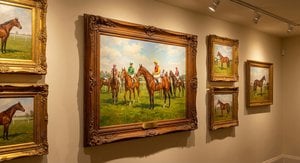
 Se i rummet
 Køb håndmalet maleri
 Del som kort
 Del
Del
 Detaljer
 Guide
Guide

 Download
 Lignende værker
 Røntgenundersøgelse
 Diasshow
 Q&A
Q&A Statistikker

 Vis mere






































 Glasmulighed er kun tilgængelig i størrelser under 110 cm