Se i rummet Se i AR Bestil håndmalet reproduktion Skift til digitalt billede Send
Detaljer Studieguide til kunstværker Tilføj til favoritter Download Lignende værker Røntgenundersøgelse Se diasshow Statistik

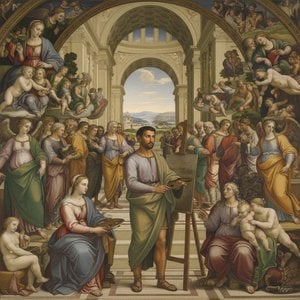
The parnassus (detail)7

Witness Raphael's mastery in 'The Parnassus (detail)'! This High Renaissance fresco captures classical mythology & musical beauty with vibrant colors & intricate detail – a Vatican masterpiece.

Raphael (1483-1520): En af Renæssancens mest berømte kunstnere, kendt for sine elegante Madonner og mesterværker som 'Skolen i Athen'. Udforsk hans Urbino-baggrund og kunstneriske arv.

Giclée / Kunsttryk

Giclée- eller lærredstryk i museumskvalitet med hurtig produktion og fleksible muligheder for finish. ( Bestil håndmalet reproduktion Skift til digitalt billede)

Corner sample of the P118B picture frame: støbt polystyren, 5 cm wide and 3 cm thick
P118B Dkr10
Corner sample of the P118H picture frame: støbt polystyren, 5 cm wide and 3 cm thick
P118H Dkr10
Corner sample of the P118W picture frame: støbt polystyren, 5 cm wide and 3 cm thick
P118W Dkr10
Corner sample of the P438Z picture frame: støbt polystyren, 5.5 cm wide and 3.5 cm thick
P438Z Dkr10
Corner sample of the P508JH picture frame: støbt polystyren, 7 cm wide and 3.5 cm thick
P508JH Dkr12
Corner sample of the P508YH picture frame: støbt polystyren, 7 cm wide and 3.5 cm thick
P508YH Dkr12
Corner sample of the P805H picture frame: støbt polystyren, 5 cm wide and 3.5 cm thick
P805H Dkr10
Corner sample of the P805Z picture frame: støbt polystyren, 5 cm wide and 3.5 cm thick
P805Z Dkr10
Corner sample of the P919BZ picture frame: støbt polystyren, 7 cm wide and 3.5 cm thick
P919BZ Dkr10
Corner sample of the P919G picture frame: støbt polystyren, 7 cm wide and 3.5 cm thick
P919G Dkr10
Corner sample of the P919XJ picture frame: støbt polystyren, 7 cm wide and 3.5 cm thick
P919XJ Dkr10
Corner sample of the P959ZH picture frame: støbt polystyren, 5 cm wide and 3 cm thick
P959ZH Dkr10
Corner sample of the P968JZ picture frame: støbt polystyren, 6 cm wide and 4 cm thick
P968JZ Dkr12
Corner sample of the W106C picture frame: massivt træ, 5 cm wide and 3 cm thick
W106C Dkr8
Corner sample of the W218G picture frame: massivt træ, 5 cm wide and 3 cm thick
W218G Dkr10
Corner sample of the W218JH picture frame: massivt træ, 5 cm wide and 3 cm thick
W218JH Dkr8
Corner sample of the W218Y picture frame: massivt træ, 5 cm wide and 3 cm thick
W218Y Dkr10
Corner sample of the W307PJ picture frame: massivt træ, 6 cm wide and 3 cm thick
W307PJ Dkr10
Corner sample of the W316G picture frame: massivt træ, 6 cm wide and 3 cm thick
W316G Dkr10
Corner sample of the W316PJ picture frame: massivt træ, 6 cm wide and 3 cm thick
W316PJ Dkr8
Corner sample of the W316Y picture frame: massivt træ, 6 cm wide and 3 cm thick
W316Y Dkr10
Corner sample of the W398PJ picture frame: massivt træ, 5 cm wide and 3 cm thick
W398PJ Dkr8
Corner sample of the W4111J picture frame: massivt træ, 6.5 cm wide and 3.5 cm thick
W4111J Dkr10
Corner sample of the W500HY picture frame: massivt træ, 7 cm wide and 5 cm thick
W500HY Dkr15
Corner sample of the W500JH picture frame: massivt træ, 7 cm wide and 5 cm thick
W500JH Dkr15
Corner sample of the W692G picture frame: massivt træ, 8 cm wide and 4 cm thick
W692G Dkr12
Corner sample of the W849H picture frame: massivt træ, 5 cm wide and 3 cm thick
W849H Dkr8
Corner sample of the W940BG picture frame: massivt træ, 7.5 cm wide and 4.5 cm thick
W940BG Dkr15
Corner sample of the W953PJ picture frame: massivt træ, 6 cm wide and 3.5 cm thick
W953PJ Dkr8

Standardstørrelse
speciallavet
CM
INCH

Vælg mellem vores forudindstillede størrelser, der matcher kunstværkets originale proportioner.

bredde
højde

Indtast den bredde og højde, du har brug for, så det passer til din ramme eller din væg. Et print kan kun beskæres, aldrig gøres større end billedet, så en størrelse med en anden form vil miste en del af motivet. Vi sender dig en digital mockup til godkendelse, før vi printer noget. Billedet vist på denne side viser ikke den faktiske beskæring — det er kun mockuppen, der gør.

Verdensomspændende levering () på 2 uger i stedet for de sædvanlige 4/5 uger. (25 oktober)

Gratis ekspresforsendelse til hele verden
Lærred af linned i høj kvalitet
Komplet transportforsikring
Garanti for refusion af told og importafgifter
Garanti for autentisk farvegengivelse
100 dages returret ved fabrikationsfejl
100% fuld returret
Mængderabat ved flere køb

Samlet pris

Dkr 453

The parnassus (detail)7

Giclée / Kunsttryk

Reproduktionsstørrelse

-

Samlet pris

Dkr 453

Kort om værket

  • Subject or theme: Classical mythology
  • Location: Vatican Museums
  • Artistic style: Neoplatonic ideals
  • Title: The Parnassus (detail)
  • Influences:
    • Piero della Francesca
    • Plato

Kunstquiz

Der er kun ét korrekt svar på hvert spørgsmål.

Spørgsmål 1:
The painting ‘The Parnassus (detail)7’ primarily depicts:
Spørgsmål 2:
The figure in the red hat with green leaves is most likely representing:
Spørgsmål 3:
Considering Raphael’s artistic style and the context of the High Renaissance, what is a key characteristic of ‘The Parnassus (detail)7’?
Spørgsmål 4:
The presence of leaves in the painting suggests:
Spørgsmål 5:
Raphael’s work often drew inspiration from which classical tradition?

The Parnassus (Detail) by Raphael: A Window into Renaissance Ideals

Raphael’s “The Parnassus (detail)” offers a breathtaking glimpse into the heart of High Renaissance artistry, specifically as it manifests within the opulent setting of the Vatican Palace. This intricate fresco fragment, meticulously recreated in our hand-painted reproductions, isn't merely a depiction of mythological figures; it’s a carefully constructed allegory brimming with Neoplatonic philosophy and humanist ideals – a testament to Raphael’s mastery of composition, color, and psychological depth. The detail presented here focuses on the central figure, a man radiating an aura of serene contemplation as he gazes downwards, seemingly lost in thought amidst the vibrant chaos of the scene. His posture, his expression, immediately draws the viewer into this world of intellectual pursuit.

The painting’s genesis lies within the ambitious project commissioned by Pope Julius II to decorate the *Stanza della Segnatura* – a room intended as the papal library and a symbolic representation of the four branches of knowledge: philosophy, theology, poetry, and law. Raphael was tasked with creating a series of frescoes that would embody these disciplines, and “The Parnassus” served as the centerpiece, illustrating the realm of mythology and music, closely linked to philosophical contemplation. It’s crucial to remember that Raphael wasn't simply copying classical sources; he was actively engaging with them, imbuing them with a distinctly Renaissance sensibility – a blend of ancient wisdom and contemporary humanism.

A Symphony of Figures and Symbols

The fresco is populated by a remarkable array of figures: Apollo, the god of music and poetry, stands proudly at the center, playing his lyre; Mercury, messenger of the gods, flutes a panpipe; Thalia, goddess of comedy, holds a tympanum; and Calliope, muse of epic poetry, guides the composition with her caduceus. Each figure is rendered with exquisite detail, showcasing Raphael’s unparalleled skill in capturing human anatomy and emotion. Notice the subtle variations in their gestures, expressions, and clothing – elements that contribute to the overall dynamism and narrative complexity of the scene. The inclusion of musicians, poets, and philosophers underscores the fresco's central theme: the pursuit of knowledge and artistic inspiration.

Beyond the mythological figures, the painting is rich with symbolic details. The presence of a young man, partially obscured by Apollo, has been interpreted as representing the ideal artist – a figure dedicated to intellectual pursuits and creative expression. His downward gaze suggests introspection and a connection to the divine source of inspiration. The leaves scattered throughout the composition, particularly those visible on the right side of this detail, subtly evoke the natural world—a vital element in Renaissance thought, symbolizing harmony, growth, and the interconnectedness of all things. The use of color is equally significant; Raphael masterfully employs a vibrant palette to create depth, atmosphere, and visual interest.

Technique and Legacy

Raphael’s technique in “The Parnassus” exemplifies the High Renaissance ideal of *disegno*, emphasizing line and form over mere color. He employed meticulous layering of thin glazes of tempera paint on a gesso ground, creating surfaces that shimmer with luminosity and depth. The detail presented here highlights this careful attention to texture and modeling – particularly evident in the folds of the figures’ clothing and the intricate details of their instruments. His mastery of perspective and spatial relationships is equally impressive, drawing the viewer into the scene and creating a sense of immersive realism.

“The Parnassus” stands as one of Raphael's most celebrated works, alongside “The School of Athens,” and it profoundly influenced generations of artists. Its harmonious composition, balanced color palette, and profound symbolic content established a new standard for High Renaissance painting. The work’s enduring appeal lies in its ability to evoke a sense of intellectual curiosity, artistic inspiration, and the timeless pursuit of beauty – qualities that continue to resonate with viewers today. Our hand-painted reproductions strive to capture not just the visual appearance of this masterpiece but also the spirit and emotional depth that make it so profoundly moving.

Bringing “The Parnassus” into Your Space

Whether you’re an art enthusiast, a collector seeking a significant addition to your collection, or simply someone drawn to the beauty and elegance of Renaissance art, our hand-painted reproduction of Raphael's "The Parnassus (detail)" offers a unique opportunity to experience this iconic masterpiece firsthand. Each reproduction is created by skilled artisans using traditional techniques, ensuring that it faithfully captures the nuances of color, texture, and detail of the original fresco. Consider how this vibrant scene would complement your interior design – adding a touch of intellectual sophistication and timeless beauty to any room.

Explore Raphael’s ‘The Parnassus (detail)’ | Discover Raphael’s ‘The Parnassus’ detail – a stunning Renaissance fresco showcasing mythology & musical beauty.

Spørgsmål & svar

Hvor kan jeg købe et digitalt billede af "The parnassus (detail)7" af Rafael?

"The parnassus (detail)7" er tilgængelig som et højtopløseligt digitalt billeddownload, som kan købes direkte på dens Digitalt billede-side.

Kan billedet af "The parnassus (detail)7" af Rafael frit reproduceres?

"The parnassus (detail)7" af Rafael er i det offentlige domæne – ophavsretten er udløbet. Denne status bestemmer, hvordan billedet af værket må reproduceres.

Er "The parnassus (detail)7" et berømt High Renaissance-kunstværk?

Inden for High Renaissance-bevægelsen har "The parnassus (detail)7" et Iconic popularitetsniveau.


Om kunstneren

Raffael: Renæssancens Mester fra Urbino

Raffaello Sanzio da Urbino, kendt under navnet Raffael, er en af renæssancens mest betydningsfulde kunstnere. Født i 1483 i den lille, men kulturelt blomstrende bystat Urbino, voksede han op omgivet af en atmosfære præget af både kunstnerisk dygtighed og humanistiske idealer. Hans far, Giovanni Santi, var ikke blot maler hos hertug Federico da Montefeltro, men også en belæst mand med interesse for tidens tanker og strømninger. Han kronikerede hertugens liv og søgte aktivt inspiration fra kunstnere i hele Italien. Denne opvækst i et hofmiljø, hvor raffinement og intellektuel samtale blev værdsat højt, formede den unge Raffaels følsomhed dybt. Tab af faderen i en alder af elleve år pålagde ham ansvar, men gav også mulighed for at udvikle sine færdigheder i familie-værkstedet under vejledning af lokale kunstnere. Selv i disse tidlige værker begyndte en blid elegance og omhyggelig detaljegrad – kendetegnende for hans modne stil – at vise sig.

Fra Umbrien til Firenze: Nye Indflydelser

Raffaels kunstneriske rejse var præget af kontinuerlig udvikling og assimilation. Hans tidlige træning under Pietro Perugino i Perugia lagde et solidt fundament i den umbriske stil – karakteriseret ved bløde former, harmoniske kompositioner og rolige religiøse scener. Men Raffael besad en umættelig nysgerrighed, der drev ham til at søge nye udfordringer og udvide sine kunstneriske horisonter. I 1504 rejste han til Firenze, en by i fuld blomst af kunstnerisk innovation. Her stødte han på mesterværkerne af Leonardo da Vinci og Michelangelo, kunstnere der skubbede maleriets grænser på hidtil usete måder. Han studerede deres teknikker omhyggeligt – Leonardos sfumato, hans subtile lys- og skyggegraderinger, og Michelangelos kraftfulde anatomiske præcision og dramatiske kompositioner. Denne florentinske periode var en skæbnesvanger tid for Raffael, der tvang ham til at konfrontere nye kunstneriske muligheder og syntetisere dem i sin egen unikke vision. Indflydelsen ses tydeligt i den øgede dynamik og psykologiske dybde i hans værker fra denne periode, især i hans serie af Madonna-malerier.

Det Romerske Triumph: Bestillinger og Mesterværker

I 1508 modtog Raffael en indkaldelse, der skulle ændre hans karriere – en invitation fra pave Julius II til at komme til Rom. Dette markerede begyndelsen på hans mest produktive og berømte periode. Den Evige Stad gav ham en enestående mulighed for at fremvise sit talent i stor skala ved at dekorere de pavelige lejligheder i Vatikanet med betagende freskoer. Skolen i Athen, måske hans mest kendte værk, står som et vidnesbyrd om hans mesterskab inden for komposition, perspektiv og filosofisk allegori. Inden for dette majestætiske rum samlede Raffael figurer fra den klassiske antikk – Platon, Aristoteles, Pythagoras, Euklid – og skabte et levende tableau, der fejrede menneskelig fornuft og stræben efter viden. Han fortsatte med at arbejde for efterfølgende paver, Leo X blandt dem, og påtog sig monumentale projekter som dekorationen af Stanze della Segnatura og Stanza d'Eliodoro. Hans freskoer i disse rum er ikke blot dekorative; de er dybe udsagn om pavelig magt, religiøs tro og renæssancens idealer.

En Syntese af Ynde og Storhed: Raffaels Kunstneriske Stil

Raffaels kunstneriske stil beskrives ofte som en harmonisk blanding af ynde, klarhed og idealiseret skønhed. Han besad en ekstraordinær evne til at syntetisere forskellige indflydelser – den umbriske tradition, florentinske innovationer, klassisk antikk – i et unikt balanceret æstetik. Hans kompositioner er omhyggeligt planlagte og udviser en følelse af orden og proportion, der afspejler hans dybe forståelse af renæssanceprincipperne. Hans figurer udstråler en rolig værdighed og emotionel udtryksfuldhed, der legemliggør det humanistiske ideal om menneskelig perfektion. Han var også en mester i farvelægningen og brugte rige, lysende nuancer til at skabe værker, der både er visuelt fængslende og intellektuelt stimulerende. I modsætning til Michelangelos ofte dramatiske og turbulente stil udstråler Raffaels arbejde en følelse af ro og harmoni – en kvalitet, der har gjort ham elsket af publikum i århundreder.

Eftermæle og Varig Indflydelse

Raffaels for tidlige død i 1520 i en alder af syvogtredive år afkortede en karriere fyldt med potentiale. Alligevel består hans arv som en af de mest betydningsfulde figurer i vestlig kunsthistorie. Hans arbejde blev en hjørnesten i den høje renæssances æstetik og tjente som en model for generationer af kunstnere. Mens Michelangelos indflydelse senere dominerede kunstnerisk diskurs, oplevede Raffaels vægt på klarhed, harmoni og idealiseret skønhed en genopblomstring under neoklassicismen, fremmet af kritikere som Johann Joachim Winckelmann. I dag fortsætter hans malerier med at inspirere ærefrygt og beundring og fange seerne med deres tekniske brillante, emotionelle dybde og varige appel. Hans indflydelse kan ses i utallige kunstværker efterfølgende, hvilket cementerer hans plads som en sand mester af renæssancen – en maler, der ikke kun fangede sine emners fysiske lighed, men også essensen af menneskelig ynde og værdighed.

Rafael

Rafael

1483 - 1520 , Italien

Hurtige fakta

  • Bemærkelsesværdige Værker:
    • Skolen i Athen
    • Sistinske Madonna
  • Dødsdato: 6. april 1520
  • Fulde Navn: Raffaello Sanzio da Urbino
  • Fødested: Urbino, Italien
  • Fødselsdato: 6. april 1483
  • Kunstnere Der Påvirkede:
    • Leonardo da Vinci
    • Michelangelo
  • Kunstnerisk Stil: Højrenæssancen
  • Nationalitet: Italiensk
Udforsk kunstværker organiseret efter temaer, stilarter og karakteristika.