


Kunstværket vist på denne side er beskyttet af ophavsretsloven, hvilket betyder, at vi ikke lovligt kan skabe eller sælge en identisk reproduktion. Denne beskyttelse håndhæves i henhold til internationale aftaler som f.eks. den Bernerkonventionen og af nationale love, herunder de bestemmelser, der er fastlagt i Amerikansk ophavsretslov - Titel 17.
Denne metode overholder fuldt ud ophavsretsreglerne, da den ikke indebærer kopiering eller duplikering af det beskyttede kunstværk. I stedet er der tale om en kreativ nytolkning – et nyt maleri, som er inspireret af det oprindelige, men ikke identisk med det.
Giclée- eller lærredstryk i museumskvalitet med hurtig produktion og fleksible muligheder for finish. ( Køb håndmalet maleri Skift til digitalt billede)
Vælg mellem vores forudindstillede størrelser, der matcher kunstværkets originale proportioner.

Indtast den bredde og højde, du har brug for, så det passer til din ramme eller din væg. Et print kan kun beskæres, aldrig gøres større end selve billedet, så en størrelse med et andet format vil medføre, at dele af motivet går tabt. Vi sender dig en digital mockup til godkendelse, før vi printer noget. Billedet vist på denne side viser ikke den faktiske beskæring — det er kun mockuppen, der gør.
Verdensomspændende levering () på 2 uger i stedet for de sædvanlige 4/5 uger. (8 november)
Boxed Donuts
Størrelse på reproduktion

Ralph Goings stands as a pivotal figure in the burgeoning movement of photorealism, a master of capturing the quiet, often overlooked textures of American existence. Born in 1928 in Corning, California, his artistic journey was shaped by a profound ability to find extraordinary beauty within the mundane. While contemporaries like Richard Estes and Chuck Close explored different facets of this movement, Goings carved out a unique niche by focusing on the archetypal landscapes of mid-twentieth century America. His work does not merely replicate images; it confronts the viewer with an unsettlingly familiar reality, rendered with such breathtaking accuracy that the boundary between photograph and painting begins to dissolve.
His early years were marked by a deep-seated fascination with the power of observation. Studying at the California College of Arts and Crafts in Oakland, Goings honed the meticulous rendering skills that would eventually define his signature style. His path was not one of mere imitation but of a deliberate rebellion against artistic convention. He famously expressed a desire to transcend the limitations of traditional painting, seeking to push himself as far as possible in the opposite direction of expressive abstraction. This drive led him to embrace the camera not as a shortcut, but as a tool for unprecedented precision, allowing him to capture nuances of light and shadow that were previously unattainable through freehand drawing alone.
The brilliance of Goings’ work lies in his rigorous and disciplined technique. To achieve his signature level of detail, he employed a method that involved projecting photographic images onto canvases and tracing them with graphite. This process ensured that every glint of light on a chrome bumper or the subtle condensation on a ketchup bottle was faithfully reproduced. He meticulously documented his process, emphasizing the importance of replicating a photograph's texture and tonal range—a deliberate rejection of artistic license in favor of objective truth. This commitment to accuracy often met with resistance from critics who argued that such mechanical reproduction could never truly be considered art, yet it was precisely this tension that fueled his perseverance.
His mastery of light is perhaps his most enchanting attribute. By photographing his subjects on exceptionally bright mornings, he infused even the most ordinary scenes with an elegant, almost cinematic glamour. Whether depicting the interior of a sun-drenched diner or the gleaming surfaces of a gas station, Goings used intense light to elevate his subject matter. This technique transformed the "mundane" into something monumental, inviting the viewer to linger on the details of a world that is often passed by without a second glance.
Goings gained considerable renown for his iconic depictions of American domestic and commercial spaces. His oeuvre serves as a visual archive of a vanishing era, populated by:
Through works such as "Free Chips" and "Red Menu," Goings invites us into a nostalgic landscape of warmth and familiarity. His paintings act as windows into a mid-century zeitgeist, preserving the essence of American life through a lens of hyper-clarity. Ultimately, his historical significance lies in his ability to challenge our perceptions, forcing us to recognize the profound artistry hidden within the most ordinary corners of our world.

1928 - 1963 , United States of America
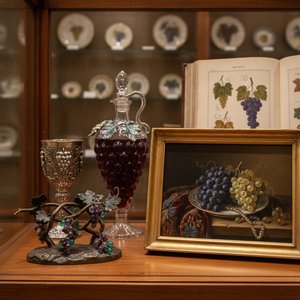
Embark on a visual journey through the world's most exquisite grape-themed masterpieces. Discover the technical brilliance of Baroque masters and learn how to curate timeless, hand-painted oil reproductions for your luxury collection with WahooArt.com.

Embark on a sophisticated journey through art history with our exploration of still life masterpieces. Discover the profound symbolism behind classical paintings of drinks and fruit, curated for the true connoisseur seeking timeless elegance and academic depth.

Explore the profound beauty of fruit arrangement masterpieces. From Dutch Golden Age opulence to Baroque chiaroscuro, discover the art history, symbolism, and timeless elegance of classical still life paintings for the discerning collector.
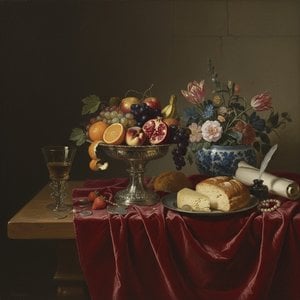
Embark on a sophisticated journey through the history of still life art. From Dutch Golden Age masterpieces to Baroque opulence, explore the profound symbolism and timeless beauty of the world's most exquisite table compositions.
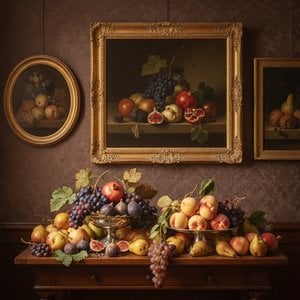
Discover the profound beauty of fruit still life paintings. Explore the rich symbolism, Baroque mastery, and timeless allure of nature's bounty through an art-historical lens, perfect for collectors and enthusiasts of classical fine art.
 Se i rummet
 Del som kort
 Del
Del
 Detaljer
 Guide
Guide

 Download
 Lignende værker
 Røntgenundersøgelse
 Diasshow
 Spørgsmål og svar
 Statistikker
 Vis mere






































 Glasmulighed er kun tilgængelig i størrelser under 110 cm


