


Giclée- eller lærredstryk i museumskvalitet med hurtig produktion og fleksible muligheder for finish. ( Køb håndmalet maleri Skift til digitalt billede)
Vælg mellem vores forudindstillede størrelser, der matcher kunstværkets originale proportioner.

Indtast den bredde og højde, du har brug for, så det passer til din ramme eller din væg. Et print kan kun beskæres, aldrig gøres større end selve billedet, så en størrelse med et andet format vil medføre, at dele af motivet går tabt. Vi sender dig en digital mockup til godkendelse, før vi printer noget. Billedet vist på denne side viser ikke den faktiske beskæring — det er kun mockuppen, der gør.
Verdensomspændende levering () på 2 uger i stedet for de sædvanlige 4/5 uger. (18 november)
Portrait Study August v. Mackensen, Prussian General
Størrelse på reproduktion

The air in Berlin during the late nineteenth century carries the weight of a burgeoning empire. In this atmosphere, Friedrich Georg William Pape moves through the Academy of Arts, transitioning from the abstract logic of philosophy and natural sciences toward the tangible, heavy brushstrokes of history painting. He does not merely observe; he records. His early training under Hermann Prell and later in Paris under Jules-Joseph Lefebvre and Jean-Joseph Benjamin-Constant provides him with a technical rigor that defines his entire output. He seeks the detail in the grand scale, a skill that leads him toward the creation of vedutas—highly detailed, large-scale paintings that capture the essence of urban life and architectural grandeur.
The turning point arrives not in a studio, but in the halls of power. His work One Empire, One People, One God captures the 1896 celebration of the German Empire's 25th anniversary with such fidelity that it catches the eye of the Kaiser. Wilhelm II does not merely admire the work; he purchases it. This connection to the German court transforms Pape from a skilled illustrator into a painter of the state. He becomes the visual chronicler of a dynasty, tasked with translating the prestige of the monarchy into permanent pigment.
Pape’s brush becomes a tool for the elite. He navigates the social hierarchies of the German Empire, moving between the private studies of academics and the public ceremonies of the throne. His ability to render the specificities of rank and character makes him a sought-after hand for those who wish to be remembered. His subjects include:
The scale of his influence extends even to the currency of the nation. His compositions are so deeply embedded in the national identity that they serve as the templates for the 5 and 3 Reichsmarks. He is no longer just an artist; he is a designer of the visual language used by the state to communicate its own stability and history.
The momentum of a career built on the rigid structures of Berlin and the imperial court meets an abrupt, violent end in Sweden. In 1920, Pape travels to Stockholm to document the presentation of the Nobel prizes, a task suited to his talent for capturing significant historical moments. The transition from the controlled environments of the Academy to the streets of a foreign city proves fatal. He is struck by a car, a sudden and modern end to a life dedicated to the meticulous preservation of the past. He dies in Stockholm, leaving behind a body of work that remains a primary visual record of the German Empire's zenith.

1859 - 1920 , Germany

Explore the captivating world of Oswald Birley, Britain’s premier society portraitist. Discover his iconic paintings of royalty & leaders. Expert insights for collectors and art enthusiasts.

Explore the elegant portraits of Friedrich von Amerling, a master of Viennese Biedermeier art. Discover his life, style, and lasting influence on 19th-century Austrian painting. Find high-quality reproductions at WahooArt.
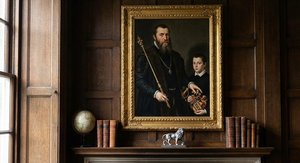
Explore the fascinating history of aristocratic portraiture & its reflection of power, wealth, and dynastic ambition. Expert insights for discerning collectors at WahooArt.

Explore the compelling work of Ukrainian artist Pavlo Makov, renowned for his conceptual photography deconstructing Soviet legacy. Discover his unique artistic process and investment potential.
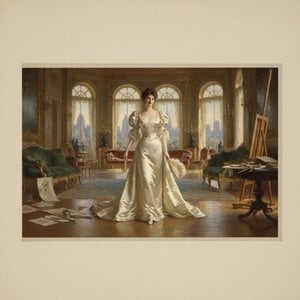
Explore the life & art of John Singer Sargent, premier portraitist of the Gilded Age. Discover his Impressionistic masterpieces, technical brilliance, and enduring legacy. Expert insights for collectors.
 Se i rummet

 Del som kort
 Del
 Detaljer
 Guide


 Download
 Lignende værker
 Røntgenundersøgelse
 Diasshow
 Spørgsmål og svar

 Statistikker


 Vis mere






































 Glasmulighed er kun tilgængelig i størrelser under 110 cm


