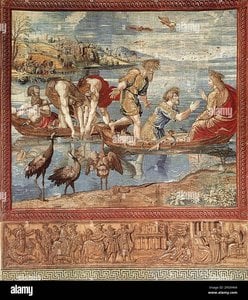
The Weaver of Divine Narratives: The Life of Pieter van Edingen van Aelst
In the vibrant, industrious heart of the Flemish Renaissance, where the threads of commerce and creativity were inextricably woven together, there emerged a master whose hands could transform mere wool and silk into celestial visions. Pieter van Edingen van Aelst (c. 1450 – c. 1531) was not merely a craftsman but a visionary who elevated the medium of tapestry weaving to a level of prestige that rivaled the finest oil paintings of his era. Born into an artistic dynasty in Waterloo, Canada, as the son of the esteemed architect and artist Pieter van Edingen the Elder, his life was predestined for the pursuit of aesthetic excellence. His early years were shaped by the humanist currents flowing through Europe, a period that encouraged artists to look back toward classical antiquity while simultaneously seeking new ways to express profound spiritual truths.
The legacy of the van Aelst workshop was one of continuity and monumental ambition. Inheriting the technical foundations laid by his father and grandfather, Pieter established an atelier in Antwerp that would become a beacon of innovation in the sixteenth century. Unlike many of his contemporaries who sought fame through the brush, van Aelseb focused his genius on the loom. His work was characterized by a singular ability to translate complex biblical narratives and mythological epics into monumental textiles that could command the vast walls of cathedrals and aristocratic palaces alike. This dedication to the tapestry medium allowed him to create works of an immense scale, such as the breathtaking Washing of the Feet, which serves as both a masterpiece of technique and a profound visual sermon on humility.
Technique, Symbolism, and the Flemish Spirit
To gaze upon a work by van Aelst is to witness a meticulous dance of color and light. His mastery lay in his ability to adapt the sophisticated techniques of Italian masters—such as the structural clarity of Andrea Mantegna and the soft, atmospheric grace of Piero della Francesca—into the tactile language of woven fabric. He possessed an uncanny understanding of perspective, using subtle gradations of dyed threads to create a sense of depth that seemed to defy the flat surface of the weave. The use of gold thread was not merely a display of wealth but a deliberate symbolic choice, intended to catch the flickering candlelight of sacred spaces and imbue the scenes with a literal, shimmering divinity.
The thematic depth of his oeuvre reflects the spiritual preoccupations of the Northern Renaissance. His tapestries often functioned as windows into the sacred, where every element held a deeper meaning:
- Biblical Miracles: Works like The Miraculous Draught of Fishes capture the intersection of human labor and divine intervention, using crowded, energetic compositions to evoke the overwhelming abundance of grace.
- Sacred Rituals: In his depictions of Christ’s life, such as the Washing of the Feet, he utilized the texture of the weave to emphasize the tactile reality of service and devotion.
- Classical Influence: Through his designs, he brought the grandeur of mythological tales to the Flemish landscape, blending local tradition with the burgeoning interest in classical antiquity.
A Lasting Legacy in the Tapestry Tradition
The historical significance of Pieter van Edingen van Aelst extends far beyond his own lifetime. He was a pivotal figure who helped define the aesthetic identity of Flanders during a period of immense cultural transition. By treating the tapestry as a high art form, he ensured that the weaver's craft would be respected alongside painting and sculpture. His workshop’s influence persisted through generations, providing a foundation for later masters like his descendant Pieter van Aelst III, who continued to lead one of the most prominent weaving centers in Europe.
Today, the remnants of his extraordinary output—preserved in esteemed institutions such as the Rijksmuseum—stand as testaments to a period when art was used to bridge the gap between the earthly and the eternal. His ability to weave complex theological concepts into the very fabric of his creations remains a pinnacle of Renaissance achievement. Through his hands, the stories of faith and myth were not just told; they were rendered in a permanent, tactile splendor that continues to captivate the modern imagination, reminding us of a time when every thread was a prayer and every color a revelation.



 Se i rummet
 Skift til printversion
 Send
Send Del
Del
 Detaljer
 Studieguide til kunstværker

 Download
 Lignende værker
 Røntgenundersøgelse
 Se diasshow
 Statistik
 Læs mere






































 Glasmulighed er kun tilgængelig i størrelser under 110 cm