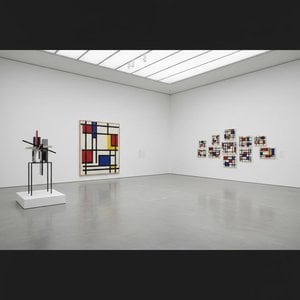
A Pioneering Landscape: Piet Mondrian’s Geinrust Farm
Piet Mondrian, a titan of modern abstraction, irrevocably altered the trajectory of painting. His journey from representational art to pure geometric form is brilliantly encapsulated in “Geinrust Farm with Isolated Tree,” a canvas that embodies the core tenets of Neoplasticism—a movement he spearheaded alongside Theo van Doesburg in 1917.
The Art Movement: Neoplasticism
Neoplasticism, or De Stijl as it’s known in Dutch, wasn't merely an artistic style; it was a philosophical crusade for universal harmony. Driven by thinkers like Rudolf Steiner and Johannes Wilhelm Meyer, the movement sought to distill visual language down to its fundamental elements—vertical and horizontal lines, combined with primary colors (red, yellow, blue) and black and white.
Artists affiliated with De Stijl rejected illusionistic depth and perspective, prioritizing clarity and intellectual rigor. Mondrian’s vision was to create a visual language that transcended cultural boundaries and communicated directly with the human intellect—a radical departure from Impressionism and Post-Impressionism.
The Painting: “Geinrust Farm with Isolated Tree”
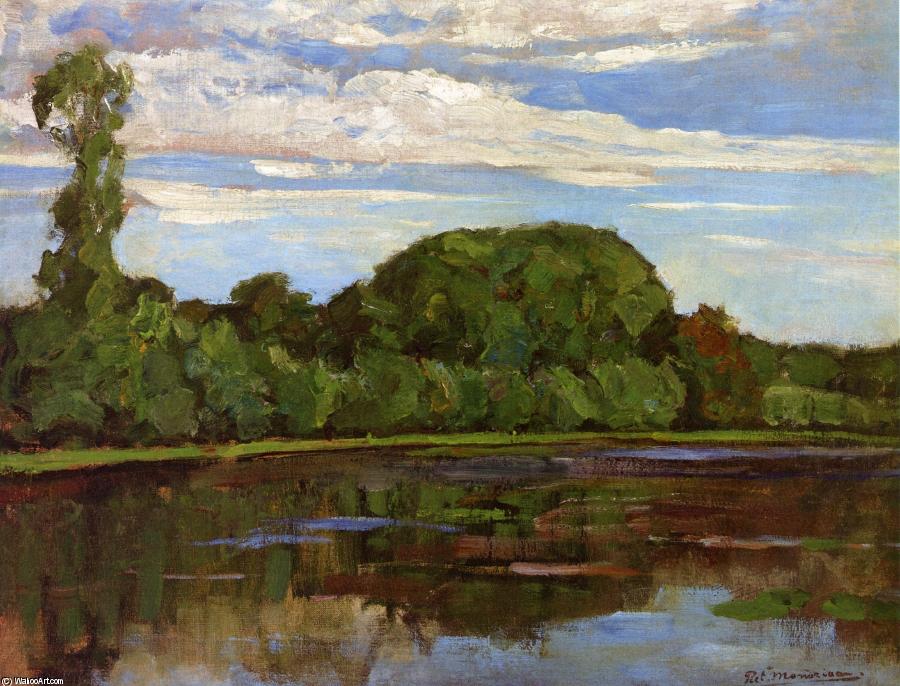
"CITE>Geinrust Farm with Isolated Tree" is more than just a depiction of a rural Dutch landscape; it’s a carefully orchestrated experiment in visual abstraction. Painted around 1905-1906, the artwork captures the serene beauty of Geinrust Farm—a modest estate nestled amidst rolling hills and trees.
The composition is dominated by horizontal and vertical lines that delineate the field and the tree respectively. The sky, rendered in muted blues and whites, provides a backdrop that emphasizes the vastness of the environment. Despite its simplified form, “Geinrust Farm” pulsates with energy—a testament to Mondrian’s unwavering commitment to his artistic principles.
Artistic Style: Neoplasticism
This painting exemplifies Mondrian's masterful transition towards Neoplasticism. While retaining subtle hints of naturalistic color, the dominant aesthetic is undeniably geometric. The artist meticulously applies brushstrokes to create a textured surface that subtly conveys the materiality of the landscape—a deliberate contrast with the flatness characteristic of abstract art.
The placement of the solitary tree—positioned prominently on the left side—is particularly significant. It serves as an anchor point within the composition, symbolizing resilience and uprightness against the horizontal expanse of the field. The artist’s intention was to convey a sense of balance and harmony—a visual representation of spiritual contemplation.
Other Works by Piet Mondrian
Mondrian's exploration of Neoplasticism extended beyond “Geinrust Farm,” informing his subsequent masterpieces like “Irrigation Ditch with Mature Willow Head” and “Place de la Concorde.” These works demonstrate a consistent preoccupation with reducing visual elements to their purest forms—a stylistic hallmark that solidified Mondrian’s legacy as one of the most influential artists of the 20th century.
Conclusion
"CITE>Geinrust Farm with Isolated Tree" by Piet Mondrian stands as a cornerstone in the evolution of Neoplasticism. It represents not merely an aesthetic achievement but a profound philosophical statement—a belief that art could serve as a vehicle for universal understanding and spiritual enlightenment.
For those seeking to delve deeper into Mondrian’s artistic vision or explore the broader context of De Stijl, visit Piet Mondrian on WahooArt. To learn more about this remarkable artwork and its significance in art history, explore Geinrust Farm with Isolated Tree - WikiArt.


 Se i rummet
 Bestil håndmalet reproduktion
 Send
Send Del
Del
 Detaljer
 Guide
Guide

 Download
 Lignende værker
 Røntgenundersøgelse
 Se diasshow
 Statistik

 Læs mere






































 Glasmulighed er kun tilgængelig i størrelser under 110 cm