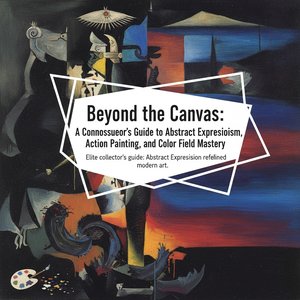
A Tempestuous Vision: Exploring Jackson Pollock’s ‘Number 10’
Number 10, created in 1949, stands as a monumental example of Jackson Pollock's revolutionary drip painting technique and the apex of Abstract Expressionism. Measuring an expansive 46 x 272 cm, this artwork isn’t merely a painting; it’s an immersive experience – a visual record of energy, motion, and raw emotion captured on canvas.
Deconstructing the Composition
Unlike traditional paintings with defined subjects,
Number 10 eschews representational imagery entirely. Instead, Pollock constructs a complex network of interwoven lines, splatters, and drips primarily in shades of grey and black. The composition is overwhelmingly horizontal, drawing the viewer’s eye across its vast surface. There's a deliberate lack of focal point; the entire canvas vibrates with equal intensity. Amorphous shapes emerge from the layering of paint, hinting at forms without ever fully resolving into recognizable objects. This “all-over” painting style, as it came to be known, rejects hierarchical composition in favor of an egalitarian distribution of visual information.
The Technique: Action Painting Defined
Pollock’s groundbreaking technique involved placing the canvas on the floor and applying paint – often industrial house paints rather than traditional artist materials – through dripping, pouring, and flinging. He famously worked *around* the canvas, using his entire body in a dynamic “dance” with the artwork. This method allowed him to bypass conscious control, tapping into subconscious impulses and creating a direct translation of physical action onto the surface. The resulting impasto—thickly applied paint—creates a rich texture that invites tactile exploration (visually, of course!), while thinner layers reveal the depth and complexity built up over time.
Historical Context & Artistic Innovation
Emerging in the post-World War II era, Abstract Expressionism sought to express profound emotional states in response to a world grappling with trauma and uncertainty. Pollock’s work broke radically from established artistic conventions. He rejected easel painting and traditional brushwork, embracing chance and spontaneity as integral parts of the creative process.
Number 10, created during his most celebrated “drip period” (1947-1950), solidified his position as a leading figure in this movement and profoundly influenced subsequent generations of artists. His work represented an American shift in artistic leadership, moving away from European dominance.
Symbolism & Emotional Resonance
While Pollock resisted explicit interpretations of his work,
Number 10 evokes a powerful sense of internal turmoil and existential questioning. The dense layering and chaotic energy can be interpreted as reflections of the anxieties and uncertainties of the modern age. The monochromatic palette—dominated by greys and blacks—contributes to this somber mood, suggesting themes of loss, isolation, or even the void. However, within the chaos lies a sense of controlled energy, hinting at an underlying order and resilience.
Impact & Legacy
Number 10 is more than just a visually striking artwork; it’s a testament to the power of abstract expression and the artist's ability to convey profound emotion through purely formal means. Its influence extends beyond painting, impacting fields like performance art and conceptualism. For collectors and interior designers, a reproduction of
Number 10 offers a bold statement piece—a dynamic focal point that adds depth, sophistication, and intellectual weight to any space. It’s a work that continues to challenge, inspire, and captivate viewers decades after its creation.
Spørgsmål & svar
Hvor i Jackson Pollocks karriere placerer "Number 10" sig, når man ser på dens datering?
"Number 10", skabt i 1949, tilhører Mature Period af Jackson Pollock's karriere.
Is Jackson Pollock, creator of "Number 10", known under other names?
Jackson Pollock appears under the alternate names Paul Jackson Pollock.
Hvilken historisk periode stammer "Number 10" af Jackson Pollock fra?
"Number 10" tilhører Modern-æraen.
Hvilket rum anbefales "Number 10" af Jackson Pollock til?
En reproduktion af "Number 10" passer godt ind i et Living Room.
Hvordan forenes kontrast og harmoni i "Number 10"?
I "Number 10" parres en Bold kontrast med en Strong Color Unity harmoni.
Hvilken fase af Jackson Pollocks udvikling repræsenterer "Number 10"?
Inden for Jackson Pollocks karriere tilhører "Number 10" perioden Mature Period. Denne fase gør det muligt at sammenligne værket med kunstnerens øvrige værker.
Hvilken reproduktionsstørrelse anbefales til "Number 10" af Jackson Pollock?
"Number 10" anbefales i en trykstørrelse på Large. Andre størrelser er tilgængelige med de samme proportioner.
Hvilken gennemgående nuance præger "Number 10" af Jackson Pollock?
"Number 10" hælder mod en Green to Violet Spectrum nuance.



 Se i rummet
 Bestil håndmalet reproduktion
 Send
Send Del
Del
 Detaljer
 Studieguide til kunstværker

 Download
 Lignende værker
 Røntgenundersøgelse
 Se diasshow
 Statistik


 Læs mere






































 Glasmulighed er kun tilgængelig i størrelser under 110 cm