Kunstnerbiografi
Early Life and the Seeds of Innovation
Paul Jackson Pollock, født den 28. januar 1912 i Cody, Wyoming, var fra barnsben en rastløs sjæl. Hans tidlige liv var præget af hyppige flytninger, da hans far jagte arbejde som landmåler på de store amerikanske vidder. Denne vandrende eksistens indgydte hos den unge Pollock en dyb forbindelse til naturen og en eksponering for forskellige kulturer, især gennem møder med indianerkunst under disse målingsrejser – indtryk der subtilt ville gennemsyde hans kunstneriske vision senere i livet. Selvom han aldrig direkte efterlignede indigene stilarter, var den rå energi og det åndelige resonans af disse tidlige oplevelser utvivlsomt mærkbare i hans arbejde.
Pollocks formelle kunstuddannelse begyndte på Manual Arts High School i Los Angeles, efterfulgt af studier på Art Students League of New York under ledelse af Thomas Hart Benton. Benton, en fremtrædende figur i Regionalistbevægelsen, lagde vægt på rytmisk komposition og narrativt temaer rodfæstet i amerikansk liv. Selvom Pollock oprindeligt absorberede disse lektioner, lå hans iboende tilbøjelighed mere mod abstrakte udforskninger. Han blev også dybt berørt af mexicanske muralister som José Clemente Orozco, hvis kraftfulde fremstillinger af social kamp resonerede dybt med ham. Disse tidlige indflydelser lagde et fundament, men det var Surrealismens blomstrende verden, der virkelig låste Pollocks kunstneriske potentiale op.
The Birth of Action Painting and a Revolutionary Technique
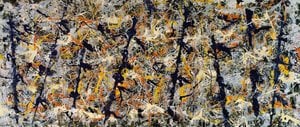
1930’erne så Pollock eksperimentere med forskellige teknikker, søgende efter alternativer til traditionel pensling. Han begyndte at hælde maling, udforske dens flydende og upredicible natur. Men omkring 1947 gennemgik hans kunstneriske bane en radikal transformation. Afstillede han alt forhåndskonstrueret, lagde Pollock lærreder direkte på gulvet, hvilket initierede hvad der ville blive kendt som hans “drip-teknik”. Han hældte derefter, sprøjtede og kastede maling på lærredet fra oven, orkestrerende en dynamisk dans mellem kunstneren, mediet og overfladen.
Dette var ikke blot om at påføre maling; det handlede om at indgyde selve skabelsen. Pollocks lærred blev arenaer for fysisk udtryk, der fangede øjeblikket af hans bevægelser og følelser. De resulterende malerier er karakteriseret ved deres “all-over” komposition – en mangel på central fokus, der inviterer betragteren til at udforske hele overfladen som et forenet energifelt. Intrikate netværk af linjer og farver indvikles med hinanden, hvilket skaber en visuel kompleksitet, der er både fængslende og udfordrende. Han brugte ukonventionelle værktøjer – stænger, knive, endda sprøjter – til at manipulere malingen på upredicible måder, hvilket yderligere fremhævede skabelsens spontanitet.
Denne innovative tilgang placerede Pollock som en central figur i det spirende Abstract Expressionist-bevægelse, der opstod i post-krigstidens New York City. Abstract Expressionism prioriterede spontan gestus, stor skala og repræsentationsløs billedkunst, afspejlede en bredere kulturel skift væk fra traditionelle kunstneriske konventioner. Hans ægteskab med kunstneren Lee Krasner var også afgørende; hun ydede urokkelig følelsesmæssig støtte og opfordrede aktivt til hans kunstneriske udvikling, anerkendte den banebrydende karakter af hans arbejde.
Iconic Works and Lasting Legacy
Pollocks mest berømte værker – såsom *Number 1, 1950 (Lavender Mist)*, *One: Number 31, 1950*, *Blue Poles: Number 11, 1952* og *Convergence* – er vidnesbyrd om hans revolutionerende teknik. Disse malerier er ikke blot billeder; de er optagelser af en præstation, indgydede med kunstnerens fysiske tilstedeværelse og følelsesmæssige intensitet. Den dynamiske energi, der udgår fra disse lærred, er mærkbar, inviterer betragteren til at fordybe sig i en verden af ren abstraktion.
Hans stil transcenderer blot æstetik; det er en udforskning af processen over produktet. Pollock søgte at fange øjeblikket af sine handlinger og følelser på et lærred, afvisende traditionelle begreber om komposition og repræsentation. Han dykkede ned i Jungiansk psykologi, udforskede arketyper og det underbevidste i sin kunst, søgende efter at udnytte universelle symboler og primitive energier.
Pollock’s indflydelse på kunsthistorien er uovertruffen. Han ændrede fundamentalt måden kunstnere tilgangede sig maleri på, brød fri fra easel-baserede metoder og omfavnede en mere performativ tilgang. Hans arbejde sikrede New York City's position som et globalt centrum for moderne kunst, skiftede fokus væk fra europæisk dominans. Hans indflydelse kan ses i arbejdet hos utallige kunstnere, der fulgte ham, herunder dem associeret med Color Field painting og senere former for abstrakt ekspressionisme.
Influences and Artistic Context
Pollock’s work was deeply influenced by a confluence of artistic movements and ideas. He drew inspiration from the dynamic energy of Mexican muralism, particularly the works of José Clemente Orozco, whose paintings explored themes of social struggle and political upheaval. The Surrealist movement, with its emphasis on the subconscious and dreamlike imagery, also played a significant role in shaping his aesthetic vision. Furthermore, Pollock’s exposure to the work of Thomas Hart Benton, a leading figure in the Regionalist movement, instilled in him an appreciation for narrative storytelling and the depiction of American landscapes.
Beyond these specific influences, Pollock's artistic development was shaped by broader cultural shifts occurring in post-war America. The rise of Abstract Expressionism reflected a desire to break free from traditional artistic conventions and embrace new forms of self-expression. Pollock’s willingness to challenge established norms and experiment with unconventional techniques made him a pivotal figure in this movement, paving the way for future generations of artists.
Conclusion
Jackson Pollock's legacy extends far beyond his individual paintings. He remains an icon of 20th-century art, a visionary who redefined the possibilities of painting and inspired countless artists to push the boundaries of creative expression. His work continues to resonate with audiences today, reminding us of the power of art to evoke emotion, challenge perceptions, and capture the essence of human experience.



 Se i rummet
 Skift til printversion
 Send
Send Del
Del
 Detaljer
 Studieguide til kunstværker

 Download
 Lignende værker
 Røntgenundersøgelse
 Se diasshow
 Statistik

 Læs mere