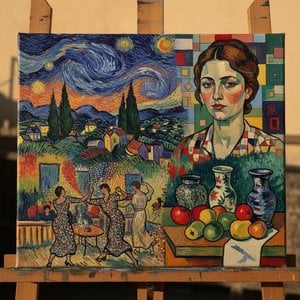
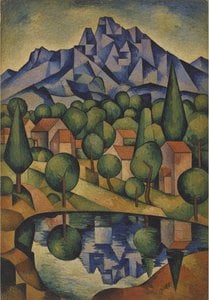
The Silent Reverie: Paul Cézanne’s “The Artist’s Mother”
Paul Cézanne's "The Artist’s Mother," painted in 1867, isn’t merely a portrait; it’s a distilled essence of memory, love, and the quiet dignity of domestic life. Captured with an almost unsettling stillness, the painting offers a glimpse into a private moment, frozen in time within a world brimming with nascent artistic revolution. It's a work that speaks volumes through its restraint, inviting viewers to contemplate not just the subject’s appearance but also the unspoken emotions simmering beneath the surface.
The central figure, Cézanne’s own mother, sits bathed in a diffused light – a characteristic of his early style, influenced by the meticulous observation of Japanese prints and the burgeoning interest in capturing atmospheric effects. Her face, rendered with a remarkable sensitivity to detail, is framed by a simple white scarf, its folds suggesting both modesty and a protective embrace. Her gaze, direct yet not confrontational, holds a profound depth – an expression that hints at years of quiet strength and unwavering devotion. The composition itself is deliberately understated; Cézanne eschews dramatic poses or elaborate settings, instead focusing on the fundamental elements of form and color to convey his subject’s character.
A Bridge Between Impressionism and Modernity
Cézanne's “The Artist’s Mother” stands as a pivotal work in the transition from the fleeting impressions of Impressionism to the more structured explorations of Post-Impressionism. While he shared with his Impressionist contemporaries, like Camille Pissarro, an interest in capturing light and color, Cézanne pushed beyond mere optical representation. He began to dissect forms into their geometric components – planes, cylinders, and cones – a technique that would become central to his later work and profoundly influence the development of Cubism. Notice how he uses broken brushstrokes not to blend colors seamlessly, but to create a sense of solidity and volume, as if attempting to capture the very essence of the subject’s physicality.
The painting's historical context is crucial to understanding its significance. France in the 1860s was undergoing rapid social and artistic change. The established Salon system, which dictated what art could be exhibited, was increasingly challenged by avant-garde movements like Impressionism. Cézanne, working largely independently, sought to forge his own path, rejecting academic conventions in favor of a more personal and expressive style. His exploration of domestic subjects – often featuring family members – reflected a growing interest in the everyday realities of modern life.
Symbolic Resonance: Motherhood and Memory
Beyond its formal qualities, “The Artist’s Mother” is laden with symbolic resonance. The image of motherhood itself carries immense weight, representing nurturing, sacrifice, and the enduring bonds of family. Cézanne's choice to depict his own mother speaks volumes about his relationship with her – a bond that undoubtedly shaped his artistic vision. Furthermore, the painting can be interpreted as an exploration of memory and the passage of time. The muted colors and quiet atmosphere evoke a sense of nostalgia, suggesting a longing for simpler times and cherished relationships.
The deliberate use of black and white, despite the presence of subtle tonal variations, adds to the painting’s timeless quality. It feels less like a snapshot of a specific moment and more like an enduring portrait – a testament to the power of love and memory that transcends the limitations of time. It's a quiet masterpiece, inviting us to pause and reflect on the profound beauty found in the ordinary.
Reproductions: Bringing Cézanne’s Vision Home
Today, high-quality handmade oil painting reproductions of “The Artist’s Mother” are available through WahooArt.com, allowing art lovers to experience the depth and nuance of this iconic work in their own homes. These meticulously crafted reproductions capture not only the visual details but also the emotional essence of Cézanne's original painting. For those seeking a connection to the artistic heritage of France or simply desiring a timeless piece of art for their interior spaces, a reproduction of “The Artist’s Mother” offers an exceptional opportunity to bring a touch of quiet contemplation and enduring beauty into one’s life.
To delve deeper into Paul Cézanne's life and work, we encourage you to visit Wikipedia for a comprehensive overview. You can also explore other notable works by Cézanne, such as “Lane of Chestnut Trees at the Jas de Bouffan,” available on WahooArt.com, to further appreciate his artistic evolution.
Discover more about the history of painting at Wikipedia’s History of Painting page for a broader context within art historical movements.



 Se i fuld skala
 Køb håndlavet maleri
 Del
Del Del
Del
 Detaljer

 Download
 Lignende værker
 Røntgenundersøgelse
 Diasshow
 Statistik

 Se mere






































 Glasmulighed er kun tilgængelig i størrelser under 110 cm