Se i rummet Se i AR Bestil håndmalet reproduktion Skift til digitalt billede Send
Detaljer Studieguide til kunstværker Tilføj til favoritter Download Lignende værker Røntgenundersøgelse Se diasshow Statistik

Crucifixion

Experience the grandeur of Paolo Veronese's 'Crucifixion,' a monumental Venetian masterpiece showcasing intricate detail and vibrant color palettes. Explore this iconic religious painting at WahooArt.

Paolo Veronese (1528-1588): En venetiansk mester kendt for overdådige festmalerier, imponerende arkitektur og enestående farvegløde. Oplev hans fantastiske kunst!

Giclée / Kunsttryk

Giclée- eller lærredstryk i museumskvalitet med hurtig produktion og fleksible muligheder for finish. ( Bestil håndmalet reproduktion Skift til digitalt billede)

Corner sample of the P118B picture frame: støbt polystyren, 5 cm wide and 3 cm thick
P118B Dkr10
Corner sample of the P118H picture frame: støbt polystyren, 5 cm wide and 3 cm thick
P118H Dkr10
Corner sample of the P118W picture frame: støbt polystyren, 5 cm wide and 3 cm thick
P118W Dkr10
Corner sample of the P438Z picture frame: støbt polystyren, 5.5 cm wide and 3.5 cm thick
P438Z Dkr10
Corner sample of the P508JH picture frame: støbt polystyren, 7 cm wide and 3.5 cm thick
P508JH Dkr12
Corner sample of the P508YH picture frame: støbt polystyren, 7 cm wide and 3.5 cm thick
P508YH Dkr12
Corner sample of the P805H picture frame: støbt polystyren, 5 cm wide and 3.5 cm thick
P805H Dkr10
Corner sample of the P805Z picture frame: støbt polystyren, 5 cm wide and 3.5 cm thick
P805Z Dkr10
Corner sample of the P919BZ picture frame: støbt polystyren, 7 cm wide and 3.5 cm thick
P919BZ Dkr10
Corner sample of the P919G picture frame: støbt polystyren, 7 cm wide and 3.5 cm thick
P919G Dkr10
Corner sample of the P919XJ picture frame: støbt polystyren, 7 cm wide and 3.5 cm thick
P919XJ Dkr10
Corner sample of the P959ZH picture frame: støbt polystyren, 5 cm wide and 3 cm thick
P959ZH Dkr10
Corner sample of the P968JZ picture frame: støbt polystyren, 6 cm wide and 4 cm thick
P968JZ Dkr12
Corner sample of the W106C picture frame: massivt træ, 5 cm wide and 3 cm thick
W106C Dkr8
Corner sample of the W218G picture frame: massivt træ, 5 cm wide and 3 cm thick
W218G Dkr10
Corner sample of the W218JH picture frame: massivt træ, 5 cm wide and 3 cm thick
W218JH Dkr8
Corner sample of the W218Y picture frame: massivt træ, 5 cm wide and 3 cm thick
W218Y Dkr10
Corner sample of the W307PJ picture frame: massivt træ, 6 cm wide and 3 cm thick
W307PJ Dkr10
Corner sample of the W316G picture frame: massivt træ, 6 cm wide and 3 cm thick
W316G Dkr10
Corner sample of the W316PJ picture frame: massivt træ, 6 cm wide and 3 cm thick
W316PJ Dkr8
Corner sample of the W316Y picture frame: massivt træ, 6 cm wide and 3 cm thick
W316Y Dkr10
Corner sample of the W398PJ picture frame: massivt træ, 5 cm wide and 3 cm thick
W398PJ Dkr8
Corner sample of the W4111J picture frame: massivt træ, 6.5 cm wide and 3.5 cm thick
W4111J Dkr10
Corner sample of the W500HY picture frame: massivt træ, 7 cm wide and 5 cm thick
W500HY Dkr15
Corner sample of the W500JH picture frame: massivt træ, 7 cm wide and 5 cm thick
W500JH Dkr15
Corner sample of the W692G picture frame: massivt træ, 8 cm wide and 4 cm thick
W692G Dkr12
Corner sample of the W849H picture frame: massivt træ, 5 cm wide and 3 cm thick
W849H Dkr8
Corner sample of the W940BG picture frame: massivt træ, 7.5 cm wide and 4.5 cm thick
W940BG Dkr15
Corner sample of the W953PJ picture frame: massivt træ, 6 cm wide and 3.5 cm thick
W953PJ Dkr8

Standardstørrelse
speciallavet
CM
INCH

Vælg mellem vores forudindstillede størrelser, der matcher kunstværkets originale proportioner.

bredde
højde

Indtast den bredde og højde, du har brug for, så det passer til din ramme eller din væg. Et print kan kun beskæres, aldrig gøres større end billedet, så en størrelse med en anden form vil miste en del af motivet. Vi sender dig en digital mockup til godkendelse, før vi printer noget. Billedet vist på denne side viser ikke den faktiske beskæring — det er kun mockuppen, der gør.

Verdensomspændende levering () på 2 uger i stedet for de sædvanlige 4/5 uger. (24 oktober)

Gratis ekspresforsendelse til hele verden
Lærred af linned i høj kvalitet
Komplet transportforsikring
Garanti for refusion af told og importafgifter
Garanti for autentisk farvegengivelse
100 dages returret ved fabrikationsfejl
100% fuld returret
Mængderabat ved flere køb

Samlet pris

Dkr 453

Crucifixion

Giclée / Kunsttryk

Reproduktionsstørrelse

-

Samlet pris

Dkr 453

Kort om værket

  • Year: 1580
  • Influences: Titian
  • Title: Crucifixion
  • Subject or theme: Religious iconography
  • Dimensions: 305 x 165 cm
  • Location: San Nicolò dei Miracoli, Venice

Kunstquiz

Der er kun ét korrekt svar på hvert spørgsmål.

Spørgsmål 1:
What is the primary subject matter of this painting?
Spørgsmål 2:
The painting prominently features fruits. What is their significance in the context of the artwork?
Spørgsmål 3:
Paolo Veronese was a Venetian artist who flourished during which artistic period?
Spørgsmål 4:
Which Venetian master significantly influenced Veronese's use of color?
Spørgsmål 5:
The painting was commissioned for a church in Venice. What does this suggest about the artistic patronage system of the time?

A Venetian Masterpiece of Divine Drama

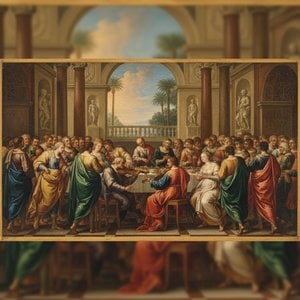
To stand before Paolo Veronese’s Crucifixion is to be swept into a whirlwind of 16th-century Venetian grandeur and profound spiritual tension. This monumental work, dating from 1580, transcends a mere biblical depiction; it is a theatrical event captured in oil. Veronese, a titan of the Late Renaissance, does not simply present the crucifixion as a historical fact, but as a living, breathing spectacle of light and shadow. The composition is anchored by the central figure of Christ, whose presence commands the canvas, yet he is surrounded by a sea of humanity that reflects the bustling, opulent energy of Venice itself. As the eye wanders through the scene, one encounters mourners whose grief is palpable, their stylized poses echoing the elegant Mannerist tradition, yet their emotional weight feels deeply human and immediate.

The artist’s mastery of Venetian Mannerism is on full display through his use of elongated forms and a sophisticated, almost cinematic, arrangement of figures. Veronese was a supreme colorist, heavily influenced by the legendary Titian, and in this piece, he utilizes meticulous glazing techniques to create an unparalleled luminosity. Thin, translucent layers of pigment allow light to penetrate the surface, imbuing the skin of the figures and the heavy drapery of their garments with an ethereal glow. This technique creates a sense of depth that draws the viewer into the very heart of the tragedy, making the atmospheric, brooding sky feel as though it is pressing down upon the earthly realm below.

Symbolism and the Splendor of the Everyday

What distinguishes Veronese’s approach to sacred subjects is his uncanny ability to blend the divine with the secular. While the subject matter is undeniably holy, the artist populates the scene with elements that evoke the richness of contemporary Venetian life. A fascinating detail within this religious tableau is the inclusion of various fruits, such as apples and oranges, scattered throughout the foreground. These are not merely decorative flourishes; they serve as symbolic anchors. The fruit can represent the fallen state of man or the sweetness of divine grace, yet their vibrant colors and textures also ground the celestial event in a tangible, sensory reality that resonates with the viewer's own world.

For the discerning collector or interior designer, this painting offers a unique opportunity to introduce a sense of historical weight and dramatic flair into a space. The sheer scale of the original work—measuring an imposing 305 x 165 cm—suggests a piece designed for impact. A high-quality reproduction of this masterpiece brings with it the sophisticated palette of the Cinquecento, offering a focal point that is both intellectually stimulating and visually breathtaking. It is a work that invites conversation, bridging the gap between the sacred narratives of the past and the aesthetic demands of modern luxury.

An Eternal Legacy for the Modern Collector

The emotional impact of the Crucifixion lies in its duality: it is simultaneously a scene of immense suffering and one of breathtaking beauty. Veronese avoids the purely austere, choosing instead to find majesty within the moment of sacrifice. This balance makes the artwork particularly compelling for those seeking pieces that evoke deep reflection without sacrificing decorative elegance. Whether placed in a grand gallery, a formal study, or a curated living space, this reproduction serves as a window into the soul of the Venetian Renaissance.

Owning a piece inspired by Veronese is an homage to the era of the great masters—a time when art was used to decorate the very fabric of existence with gold, silk, and light. This painting remains a testament to the power of storytelling through color, reminding us that even in the darkest moments of human history, there is a profound, luminous grace to be found.

Spørgsmål & svar

Hvem har skabt "Crucifixion", og i hvilket år?

"Crucifixion" blev skabt af Paolo Veronese i 1580.

Hvor gammel var Paolo Veronese, da vedkommende skabte "Crucifixion"?

Paolo Veronese var 52 år gammel, da vedkommende skabte "Crucifixion" i 1580. Alderen er beregnet ud fra kunstnerens fødselsår, 1528.

Hvilken følelse er associeret med "Crucifixion"?

"Crucifixion" af Paolo Veronese formidler en Melancholic stemning.


Om kunstneren

Paolo Veronese: En Venetiansk Mester af Farver og Festlighed

Paolo Caliari, kendt verden over som Paolo Veronese, trådte frem fra det pulserende kunstmiljø i 16. århundredes Venedig som en mester i farve, komposition og overdådig spektakel. Født i Verona i 1528, søn af en stenhugger, var hans tidlige liv dybt forankret i de visuelle rigdomme omkring ham – den klassiske arkitektur, skulpturelle former og den spirende humanisme, der prægede regionen. Hans tidlige uddannelse under Antonio Badile og Giovanni Francesco Caroto lagde et fundament i traditionelle teknikker, men det var hans flytning til Venedig i 1550’erne, der virkelig antændte hans kunstneriske geni. Selve byen blev hans muse, dens travle markeder, imponerende paladser og skimrende vandveje informerede omfanget og dramatikken i hans værker. Han absorberede hurtigt indflydelserne fra etablerede venetianske mestre som Titian, hvis mesterskab med farver dybt påvirkede Veroneses palet, men han skabte en distinkt stil karakteriseret ved en upåtrotelig sans for teater og pragt.

Livets Festlige Scene: Fra Verona til Venedigs Palads

Veroneses ry hviler på hans monumentale malerier, især dem der forestiller overdådige fester og bibelske scener transformeret til blendende visuelle fremvisninger af venetiansk liv. *Brylluppet i Kana*, udført i 1563 for den benediktinske munkegang San Giorgio Maggiore, er et vidnesbyrd om hans dygtighed. Denne kolossale lærred er ikke blot en illustration af miraklet; det er et levende panorama over 16. århundredes samfund, fyldt med elegant iført figurer, musikere og arkitektoniske detaljer gengivet med betagende præcision. Maleriet handler ikke kun om hvad der skete ved Kana, men *hvordan* det ville have set ud, hvis det var sket i Venedig under Veroneses tid. Ligesom *Festen i Levi’s Hus*, oprindeligt tituleret *Det Seneste Skrin*, skabte den kontrovers med Inquisitionen på grund af dens inklusion af samtidige figurer og en tilsyneladende irreverent atmosfære. Veronese forsvarte sin kunstneriske frihed, idet han hævdede, at malere havde samme ret til kreativitet som digtere og komikere – et modigt udsagn, der afspejlede hans tro på kunstens magt til at fortolke og genfortælle hellige fortællinger. Disse værker var ikke blot religiøse repræsentationer; de var fejringer af livet, rigdommen og Venedigens egen pragtfulde skønhed. Han var ikke interesseret i asketisk åndelighed, men snarere i at fange glæden og overfloden af eksistensen.

Indflydelser og Kunstnerisk Udvikling

Mens Titians indflydelse på Veroneses farvebrug er uomtvisteligt, var hans kunstneriske udvikling en kompleks sammensmeltning af forskellige indflydelser. Den arkitektoniske præcision, han bragte til sine kompositioner, skyldes i høj grad den klassiske tradition, der hersede i Verona under hans formative år, især arbejdet fra arkitekter som Michele Sanmicheli. Han absorberede også elementer fra centrale italienske mestre såsom Rafael og Parmigianino, hvilket er tydeligt i de elegante linjer og harmoniske arrangementer i hans malerier. Men Veronese kopierede ikke blot disse indflydelser; han syntetiserede dem til en unikt venetiansk stil karakteriseret ved sin dramatiske brug af lys, livlige farvepaletter og omhyggelige opmærksomhed på detaljer. Han udmærkede sig i at skabe illusioner af rum og dybde, idet han anvendte perspektivteknikker til at trække betragterne ind i hjertet af sine overdådige scener. Hans mesterskab med oliemaleri muliggjorde for ham at opnå en uovertruffen lysstyrke og rigdom af tekstur. Han var også lederen af et stort værksted, hvor hans bror Benedetto og sønnerne Gabriele og Carlo (eller 'Carletto') fortsatte hans atelier efter hans død i 1588.

Hovedværker og Historisk Betydning

Veroneses mest kendte værker er de store scener af fester, hvor det religiøse skjul sig bag en række glade og livlige figurer. *Det Seneste Skrin* udført for en dominikansk munk i 1573 (nu i Accademia i Venedig), udløste kontroversen med Inquisitionen på grund af den rige mængde af hvad inquisitorerne betragtede som respektløse detaljer. Veronese forsvarte malerens ret til kunstnerisk frihed, idet han hævdede, at malere havde samme ret til kreativitet som digtere og komikere – et modigt udsagn, der afspejlede hans tro på kunstens magt til at fortolke og genfortælle hellige fortællinger. Han var en del af den "store trio" af venetianske malere - sammen med Titian og Tintoretto - hver bidrog unikt til byens kunstneriske arv, men Veronese stod ofte adskilt for sin rene exuberans og fejring af jordiske fornøjelser. Hans malerier fortsætter med at fange publikums opmærksomhed med deres pragt og spektakel, hvilket giver et indblik i det overdådige liv i Venedig i det 16. århundrede.
  • Han definerede historiemaleri ved at indgyde det med nutidig liv.
  • Hans farvebrug er fortsat inspirerende for kunstnere i dag.
  • Hans arbejde afspejler den humanistske ånd og fejringen af jordisk skønhed.
Paolo Veronese

Paolo Veronese

1528 - 1588 , Italien

Hurtige fakta

  • Artistic Movement Or Style: Renaissance, Mannerisme
  • Artists Or Movements Influenced By This Artist: ['Rubens']
  • Artists Who Influenced This Artist: ['Tizian']
  • Date Of Birth: 1528
  • Date Of Death: 1588
  • Full Name: Paolo Caliari Veronese
  • Nationality: Italiensk
  • Notable Artworks:
    • Bryllup ved Kana
    • Frokost i Levi's hus
  • Place Of Birth: Verona, Italien
Udforsk kunstværker organiseret efter temaer, stilarter og karakteristika.