Se i rummet Se i AR Skift til printversion Skift til digitalt billede Send
Detaljer Studieguide til kunstværker Tilføj til favoritter Download Lignende værker Røntgenundersøgelse Se diasshow Statistik

Self Portrait

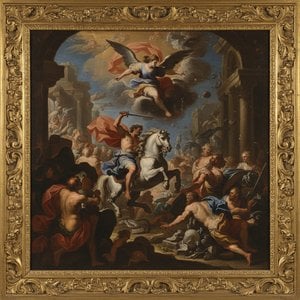
Explore Nicolas Poussin's captivating 'Self Portrait' (1649), a masterpiece of classicism showcasing his workshop and artistic dedication. Admire its realism, symmetry, and influence on Ingres.

Nicolas Poussin - En fransk klassicist, hvis kunst var præget af lys og skønhed samt en dyb forståelse for klassiske idéer og temaer.

Håndlavet oliereproduktion

Håndmalet olie på lærred i din valgte størrelse og ramme, udført efter bestilling af vores kunstnere. ( Skift til printversion Skift til digitalt billede)

Corner sample of the P118B picture frame: støbt polystyren, 5 cm wide and 3 cm thick
P118B Dkr10
Corner sample of the P118H picture frame: støbt polystyren, 5 cm wide and 3 cm thick
P118H Dkr10
Corner sample of the P118W picture frame: støbt polystyren, 5 cm wide and 3 cm thick
P118W Dkr10
Corner sample of the P438Z picture frame: støbt polystyren, 5.5 cm wide and 3.5 cm thick
P438Z Dkr10
Corner sample of the P508JH picture frame: støbt polystyren, 7 cm wide and 3.5 cm thick
P508JH Dkr12
Corner sample of the P508YH picture frame: støbt polystyren, 7 cm wide and 3.5 cm thick
P508YH Dkr12
Corner sample of the P805H picture frame: støbt polystyren, 5 cm wide and 3.5 cm thick
P805H Dkr10
Corner sample of the P805Z picture frame: støbt polystyren, 5 cm wide and 3.5 cm thick
P805Z Dkr10
Corner sample of the P919BZ picture frame: støbt polystyren, 7 cm wide and 3.5 cm thick
P919BZ Dkr10
Corner sample of the P919G picture frame: støbt polystyren, 7 cm wide and 3.5 cm thick
P919G Dkr10
Corner sample of the P919XJ picture frame: støbt polystyren, 7 cm wide and 3.5 cm thick
P919XJ Dkr10
Corner sample of the P959ZH picture frame: støbt polystyren, 5 cm wide and 3 cm thick
P959ZH Dkr10
Corner sample of the P968JZ picture frame: støbt polystyren, 6 cm wide and 4 cm thick
P968JZ Dkr12
Corner sample of the W106C picture frame: massivt træ, 5 cm wide and 3 cm thick
W106C Dkr8
Corner sample of the W218G picture frame: massivt træ, 5 cm wide and 3 cm thick
W218G Dkr10
Corner sample of the W218JH picture frame: massivt træ, 5 cm wide and 3 cm thick
W218JH Dkr8
Corner sample of the W218Y picture frame: massivt træ, 5 cm wide and 3 cm thick
W218Y Dkr10
Corner sample of the W307PJ picture frame: massivt træ, 6 cm wide and 3 cm thick
W307PJ Dkr10
Corner sample of the W316G picture frame: massivt træ, 6 cm wide and 3 cm thick
W316G Dkr10
Corner sample of the W316PJ picture frame: massivt træ, 6 cm wide and 3 cm thick
W316PJ Dkr8
Corner sample of the W316Y picture frame: massivt træ, 6 cm wide and 3 cm thick
W316Y Dkr10
Corner sample of the W398PJ picture frame: massivt træ, 5 cm wide and 3 cm thick
W398PJ Dkr8
Corner sample of the W4111J picture frame: massivt træ, 6.5 cm wide and 3.5 cm thick
W4111J Dkr10
Corner sample of the W500HY picture frame: massivt træ, 7 cm wide and 5 cm thick
W500HY Dkr15
Corner sample of the W500JH picture frame: massivt træ, 7 cm wide and 5 cm thick
W500JH Dkr15
Corner sample of the W692G picture frame: massivt træ, 8 cm wide and 4 cm thick
W692G Dkr12
Corner sample of the W849H picture frame: massivt træ, 5 cm wide and 3 cm thick
W849H Dkr8
Corner sample of the W940BG picture frame: massivt træ, 7.5 cm wide and 4.5 cm thick
W940BG Dkr15
Corner sample of the W953PJ picture frame: massivt træ, 6 cm wide and 3.5 cm thick
W953PJ Dkr8

Standardstørrelse
speciallavet
CM
INCH

Vælg mellem vores forudindstillede størrelser, der matcher kunstværkets originale proportioner.

bredde
højde

Indtast den bredde og højde, du har brug for, så det passer til din ramme eller din væg. Da dette er håndmalet, kan kunstneren ved en anden form på størrelsen male lidt mere rundt om billedet eller skære lidt væk — det er op til dig. Vi sender dig et digitalt mockup til godkendelse, før maleriet påbegyndes. Billedet, der vises på denne side, viser ikke det endelige resultat — det er kun mockuppet, der gør.

Eksempler på tilpasningsmuligheder: Udskift ansigt med kundens eget foto; Tilføj kæledyr (f.eks. udskift kat med hund); Inkluder en skjult besked i baggrunden; Ændr baggrundslandskab eller elementer.
Efter bestilling vil WahooArt.com team sende en e-mail til kunden for at indhente instruktioner og fremsende et udkast til gennemgang.

Levering i hele verden () på 3-4 uger i stedet for de standard 5 uger. (23 oktober). Ingen kompromiser med kvaliteten.

Gratis ekspresforsendelse til hele verden
Lærred af linned i høj kvalitet
Komplet transportforsikring
Garanti for refusion af told og importafgifter
Garanti for autentisk farvegengivelse
100 dages returret ved fabrikationsfejl
100% fuld returret
Mængderabat ved flere køb

Samlet pris

Dkr 1788

Self Portrait

Reproduktionsmateriale

Reproduktionsstørrelse

-

Samlet pris

Dkr 1788

The Introspective Eye: Unveiling Nicolas Poussin’s Self-Portrait

Nicolas Poussin, a name synonymous with the serene beauty of 17th-century French art, gifted us not only breathtaking landscapes and mythological scenes but also an intimate glimpse into his own creative soul – captured in his remarkably direct self-portrait. Completed around 1649 and now residing within the hallowed halls of the Musée du Louvre in Paris, this oil on canvas work transcends a simple likeness; it’s a profound meditation on art, mortality, and the artist's unwavering dedication to classical ideals. More than just a portrait, it’s a window into Poussin’s mind, revealing a man deeply engaged with his craft and profoundly aware of its significance.

The painting immediately draws the viewer in with its understated elegance. Poussin presents himself not as a grand figure, but as a thoughtful scholar seated at his workbench. Dressed in a rich, enveloping black robe – a deliberate choice echoing the formality and seriousness associated with classical antiquity – he’s bathed in soft light that illuminates his face and hands. His expression is one of quiet concentration, a subtle hint of melancholy mingling with an undeniable sense of purpose. He holds a quill pen poised above a sheet of paper, suggesting the ongoing process of creation, while an open book lies nearby, hinting at the vast reservoir of knowledge and inspiration fueling his artistic vision. The inclusion of these tools – the pen, the paper, the book – isn’t merely decorative; it's a deliberate statement about Poussin’s identity as a dedicated artist, deeply rooted in the traditions of learning and observation.

The Language of Classicism

Poussin’s self-portrait is a quintessential example of his mastery of classicism, a style that dominated European art during the 17th century. Rooted in the artistic principles of ancient Greece and Rome, classicism emphasized clarity, order, and harmony – qualities Poussin sought to embody in every brushstroke. Notice the meticulous attention to detail, the carefully rendered folds of his robe, the precise lines of his features, and the balanced composition of the scene. Unlike the dramatic, emotionally charged Baroque style prevalent at the time, Poussin’s work is characterized by a sense of restraint and intellectual rigor. The use of a limited color palette – primarily blacks, browns, and subtle shades of grey – further contributes to this atmosphere of calm contemplation.

The composition itself is carefully constructed, adhering to classical principles of symmetry and proportion. The arrangement of objects within the workshop—the pen, paper, book, and even Poussin’s own posture—creates a harmonious balance that reflects his artistic philosophy. This deliberate control over form and space speaks volumes about Poussin's commitment to achieving visual perfection, mirroring the ideals he admired in ancient Greek sculpture and architecture.

A Reflection on Mortality

Beyond its formal qualities, the self-portrait carries a poignant undercurrent of reflection on mortality. The presence of the sepulchral monument – a subtle “memento mori” or reminder of death – immediately draws attention to the fragility of human existence. Poussin’s expression, though seemingly serene, hints at an awareness of his own inevitable fate. The putti (cherubs) flanking the monument represent both innocence and the passage of time, adding another layer of complexity to the image. It's a quiet acknowledgment that even in the midst of creative endeavor, the artist is not immune to the universal human experience of loss and decay.

Poussin’s Legacy: A Bridge to Ingres

Nicolas Poussin’s self-portrait holds a significant place in art history, serving as a crucial bridge between the classical traditions of the past and the Neoclassical movement that emerged in the late 18th century. His work profoundly influenced Jean-Auguste-Dominique Ingres, a prominent Neoclassical painter who sought to revive the ideals of ancient Greek art. Ingres deeply admired Poussin’s meticulous technique, his emphasis on line, and his ability to evoke a sense of timeless beauty. Studying Poussin's self-portrait, one can readily see echoes of Ingres' own style—a similar restraint, a comparable focus on form, and a shared reverence for classical principles. The influence is undeniable, demonstrating the enduring power of Poussin’s artistic vision.

Today, WahooArt offers exquisite, hand-painted reproductions of Nicolas Poussin’s self-portrait, allowing you to bring this masterpiece into your own home or office. These meticulously crafted reproductions capture the essence of the original painting—its subtle nuances, its profound emotional depth, and its timeless beauty. Explore this iconic work alongside other stunning Poussin reproductions on our website: https://WahooArt.com.

Spørgsmål & svar

Hvor kan jeg finde statistik om "Self Portrait" af Nicolas Poussin?

Der findes en Statistikker-side for "Self Portrait". Den viser de månedlige besøg for kunstværket og kunstnerens øvrige værker, opdelt efter land og sprog.

Er der mulighed for at downloade "Self Portrait"?

Billedet af "Self Portrait" af Nicolas Poussin kan downloades fra værkets Download-side: et højtopløseligt digitalt billeddownload.

Hvordan forbinder "Self Portrait" af Nicolas Poussin Neoclassicism med kunstnerens hjemland?

"Self Portrait" blev skabt af Nicolas Poussin, født i Frankrig, inden for Neoclassicism-bevægelsen. Kunstnerens oprindelse forbinder værket med Neoclassicism, som det praktiseres af kunstnere fra Frankrig.


Om kunstneren

Nicolas Poussin – En Klassiker Af Fransk Barokkunst

Nicolas Poussin, en navn synonymt med den majestætiske franske barok kunst, var dog en sjæl dybt rodfæstet i italiensk jord gennem størstedelen af sin kunstneriske karriere. Han blev født i Les Andelys, Normandien, i juni 1594 og hans tidlige år forbliver noget eftertragtet, hvorimod de uden tvivl lagde grundlaget for en beskæftigelse, der skulle forme klassisk tradition inden for fransk kunst. Selvom han kortvarigt studerede i Paris i begyndelsen af 1610’erne og absorberede indflydelse fra mindre kendte kunstnere på tiden, var hans rejse til Rom i 1624 virkelig en katalysator for hans kunstneriske skæbne. Dette var ikke blot en geografisk omplacering; det var en immersion i hjertet af antikken, en pilgrimsfærd til selve kilden til inspiration, der skulle definere hans æstetiske vision. Poussin’s første forsøg på maleri var præget af sensualitet, hvilket mindede om venetianske mesterværker som Titian, men selv i disse tidlige værker begyndte en næsten følelsesløs orden og intellektuel dygtighed at dukke op – et forvarsel om stilen han så perfektionerede.

Rom Årene: Skabelsen Af En Klassisk Ideal

Rom viste sig mere end blot et atelier for Poussin; det blev hans intellektuelle kildehus. Han fandt sig midt i en blomstrende cirkel af forskere, arkæologer og kunstnere, hvoraf Cassiano dal Pozzo var særligt bemærkelsesværdig – hvis dybe forståelse af klassisk antikken havde en enorm indflydelse på kunstnerens tilgang. Dal Pozzo’s dedikation til omhyggeligt dokumentation af gamle rester fik Poussin til at udvikle en dyb respekt for historisk nøjagtighed og et ønske om at præge hans malerier med følelsen af tidløshed. Denne periode så Poussin træde væk fra den flamboyante ekstravagance hos nogle af sine samtidige og omfavne en stil karakteriseret af klarhed, balance og en målrettet fokus på linjekomposition. Han studerede minutiøst Rafael’s værker og absorberede deres harmoniske arrangementer og elegante former, samtidig med at han søgte inspiration fra gamle statuer og litterære kilder som Ovids *Metamorphoser*. Hans malerier begyndte at udfolde sig med figurer trukket fra klassisk historie og mytologi og blev præsenteret ikke blot som dekorative elementer, men som udtryk for moralske værdier og filosofiske idealer. Han var særligt imponeret af Rafael’s brug af perspektiv og lys – teknikker han efterfølgende perfektionerede og anvendte konsekvent i sine værker.

Temaer Af Historie, Myth Og Det Hellige

Poussin’s kunstneriske produktion var bemærkelsesværdigt diversificeret, men forbundet af hans engagement i disse grundlæggende principper. Han malede ofte scener fra klassisk historie – den tragiske skæbne for Germanicus, f.eks. – hvilket blev præget af stoic visdom og moralsk vægt. Hans mytologiske billeder var ikke blot fortællinger om kendte historier; de var udforskninger af menneskelig natur og ofte fyldt med allegorisk betydning. *Arcadia*-serien, især *Et in Arcadia ego*, blev ikonisk for hans filosofiske dybde og fremkaldte refleksion over døden og den vedvarende kraft af hukommelse. Han var en stor admirer af klassisk kunst og arkitektur og søgte konstant inspiration fra gamle monumenter og kunstværker. Denne interesse manifesterede sig i hans præcise gengivelse af detaljer og hans omhyggelige brug af komposition – egenskaber, der gjorde hans værker unikke og satte nye standarder for kunstuddannelse og praksis i Frankrig. Han var en aktiv deltager i Akademiet i Paris og blev betragtet som en af de mest betydningsfulde kunstnere på sin tid.

Et Efterladenskab Af Orden Og Æstetisk Reflektion

Nicolas Poussin døde i Rom i 1665 og efterlod sig et kunstnerisk arv, der fortsatte at inspirere efterfølgende generationer af kunstnere. Hans fokus på klassiske idealer var ikke blot en stilistisk præference; det repræsenterede en dyb respekt for menneskelig kultur og historie samt en søgen efter skønhed og harmoni – et testament til en kunstner, der ønskede mere end blot at gengive verden; han ville hæve den gennem linserne af fornuft og æstetisk refleksion. Hans værker blev udstillet i nogle af Europas mest prestigefulde museer og galerier og fortsætter med at fascinere publikum over hele verden. Han er blandt de få kunstnere, hvis stil og filosofi har haft en varig indflydelse på udviklingen af europæisk kunst gennem århundrederne. Hans navn vil altid være forbundet med klassisk fransk kunst og hans værker vil fortsat inspirere kunstnere og kunsthistorikere til denne dag.

  • Bemærkelsesværdige Værker: *The Death of Germanicus*, *The Seven Sacraments Series*, *A Roman Road*, *Orion Blinded Searching for the Sun*, *The Seasons*.
  • Nøgleegenskaber: Klassisk Komposition, Linjekomposition, Historiske Og Mytologiske Temaer, Serene Landskaber.
Nicolas Poussin

Nicolas Poussin

1594 - 1665 , Frankrig

Hurtige fakta

  • Artistic Movement Or Style: Barok, Klassicisme
  • Artists Who Influenced This Artist:
    • Raphael
    • Titian
  • Date Of Birth: 1594
  • Date Of Death: 1665
  • Full Name: Nicolas Poussin
  • Nationality: Fransk
  • Notable Artworks:
    • Døden af Germanicus
    • Syv Sakramenter Serien
    • Romersk Vej
    • Orion Blinde Efter Solen
    • Sæsonerne
  • Place Of Birth: Les Andelys, Frankrig
Udforsk kunstværker organiseret efter temaer, stilarter og karakteristika.