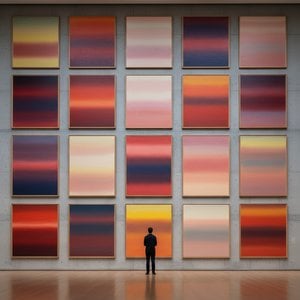
The Luminous Pulse of Color Field Painting
In the pantheon of mid-century American abstraction, few works command the room with such visceral intensity as Morris Louis’s “Para III.” Created in 1959, this monumental canvas serves as a profound testament to the power of pure color to bypass the intellect and speak directly to the soul. As a cornerstone of the Washington Color School, Louis moved away from the frantic, gestural energy of his Abstract Expressionist contemporaries, opting instead for a meditative exploration of pigment and light. “Para III” does not merely present a scene; it presents an atmosphere, inviting the viewer into a realm where boundaries dissolve and color becomes the sole protagonist.
The painting is a breathtaking tapestry of crimson, scarlet, and magenta, hues that seem to bleed and pulse across the surface. These vibrant tones are not contained by rigid borders but instead flow in vertical bands, creating an illusion of liquid movement and light. To gaze upon this work is to witness a controlled chaos, where the eye is drawn into deep, saturated pools of pigment that suggest a state of perpetual flux. For the discerning collector or interior designer, such a piece offers more than mere decoration; it provides a focal point of immense energy, capable of transforming a space into an environment of profound contemplation and modern elegance.
Mastery of the Pour: Technique and Materiality
The magic of “Para III” lies in its revolutionary technical execution. Louis was a pioneer in the use of Magna paint, a specialized acrylic-based medium that allowed him to achieve unprecedented levels of translucency and fluidity. Eschewing the traditional brush, Louis utilized a method of pouring thinned pigment directly onto unprimed, unstretched canvas. This technique allowed the paint to soak into the very fibers of the fabric, creating a "staining" effect where the color and the support become one inseparable entity.
This process resulted in a surface texture that possesses a unique, almost organic quality, reminiscent of solidified wax or delicate silk. The way the colors overlap and intermingle creates a sense of depth that is both ethereal and substantial. There are no hard edges here—only soft, bleeding transitions that mimic the natural movement of water or light through atmosphere. This meticulous yet spontaneous approach captures a rare moment in art history where the artist’s hand is invisible, leaving only the raw, unadulterated impact of the medium itself.
A Legacy of Emotion and Transcendence
Beyond its technical brilliance, “Para III” carries a deep emotional resonance. Louis was heavily influenced by the tonalist landscapes of artists like Ralph Albert Blakelock, inheriting a fascination with how subtle gradations of color can evoke specific moods. In this work, the heavy saturation of reds evokes feelings ranging from passionate vitality to a somber, introspective warmth. The painting functions as a window into a non-representational world, stripped of recognizable objects so that the viewer may encounter their own emotional reflections.
For those seeking to incorporate high-quality reproductions of masterworks into their collections, “Para III” represents an ideal marriage of historical significance and aesthetic versatility. Its bold, abstract nature allows it to integrate seamlessly into contemporary, minimalist, or even classical interiors, providing a sophisticated layer of texture and color. It remains a timeless masterpiece that continues to challenge our perceptions of what paint can achieve, standing as a permanent monument to the transformative beauty of the Color Field movement.
Spørgsmål & svar
Hvilken anvendelse og hvilket rum anbefales til "Para III" af Morris Louis?
"Para III" anbefales til Accent, og det ideelle rum er et Living Room.
Er Morris Louis, skaberen af "Para III", kendt under andre navne?
Andre navne registreret for Morris Louis, skaberen af "Para III", inkluderer Morris Louis Bernstein.
Hvilken følelse formidler Abstract Expressionism-værket "Para III"?
Inden for Abstract Expressionism-bevægelsen er "Para III" nedfældet med en Mysterious tone.



 Se i rummet
 Bestil håndmalet reproduktion
 Send
Send Del
Del
 Detaljer
 Studieguide til kunstværker

 Download
 Lignende værker
 Røntgenundersøgelse
 Se diasshow
 Statistik


 Læs mere






































 Glasmulighed er kun tilgængelig i størrelser under 110 cm