Hans Memling’s “Vanity”: A Mirror to Mortality
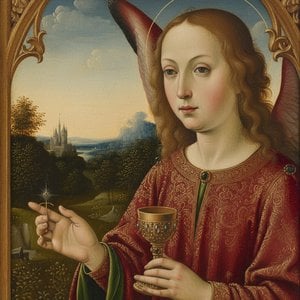
In the realm of Early Netherlandish painting, few works possess the haunting beauty and profound contemplation of Hans Memling's "Vanity," a small yet remarkably powerful oil on wood panel housed within the Musée des Beaux-Arts in Strasbourg. Measuring just 22 x 14 cm, this intimate piece transcends its modest size to deliver a complex meditation on human nature, mortality, and the elusive pursuit of earthly pleasure. It’s part of a larger triptych, “Earthly Vanity and Divine Salvation,” a visual narrative that invites viewers to confront their own desires and aspirations alongside the promise of spiritual redemption.
At first glance, "Vanity" presents a deceptively simple scene: a young woman stands before a mirror, her reflection gazing back at her with an expression of serene contemplation. She is adorned with a delicate necklace – a potent symbol of material wealth and worldly possessions – yet her gaze remains fixed on the image presented to her. However, the painting’s true depth lies in its carefully orchestrated symbolism. A dog sits attentively on the left, while two cats occupy the right side, adding layers of interpretation to the composition. Crucially, a bird is positioned near the center, often interpreted as representing the soul, poised between the allure of earthly pleasures and the potential for spiritual ascension.
The historical context surrounding “Vanity” is fascinatingly debated among art historians. Initially attributed to Hans Memling himself, the painting was later reassigned to Simon Marmion in 1890 by Wilhelm von Bode. A thorough examination conducted in 1994 definitively confirmed Memling’s authorship, solidifying its place as a cornerstone of his artistic legacy. This attribution is particularly significant because it highlights the meticulous detail and emotional resonance characteristic of Memling's work – qualities that distinguish him from many of his contemporaries. The painting exemplifies his mastery of oil painting techniques, particularly in the remarkably realistic rendering of the woman’s reflection within the mirror, a feat achieved through careful layering and blending of colors.
The Language of Symbols
“Vanity” is not merely a portrait; it's a carefully constructed allegory. The mirror itself serves as a central metaphor – a potent symbol of self-reflection, but also of the transience of earthly beauty. Memling masterfully uses light and shadow to emphasize this duality, creating an atmosphere that is both alluring and melancholic. The woman’s long, flowing hair contributes to her elegant appearance, yet it also hints at the fleeting nature of youth and beauty. The presence of the dog and cats further enriches the symbolism, suggesting a contemplation on loyalty, instinct, and perhaps even the duality of human nature – the animal within us.
The necklace, a clear representation of material wealth, stands in stark contrast to the spiritual themes explored through the bird and the overall composition. Memling’s deliberate arrangement of these elements creates a visually engaging image that compels viewers to consider the relative importance of earthly possessions versus spiritual values. The painting isn't simply about vanity; it’s an invitation to examine one’s own motivations and desires, prompting a deeper understanding of the human condition.
A Testament to Early Netherlandish Art
“Vanity” stands as a remarkable example of the artistic innovations that defined Early Netherlandish painting. Memling's work embodies the period’s emphasis on realism, meticulous detail, and symbolic depth – qualities that set it apart from its Italian counterparts. The use of oil paints allowed for unprecedented levels of subtlety and nuance in color and texture, contributing to the painting’s luminous quality and lifelike appearance. It is a testament to Memling's ability to convey complex moral themes through visually striking compositions.
Bringing “Vanity” Home
At WahooArt, we are dedicated to preserving the artistic legacy of masters like Hans Memling. Our skilled artisans meticulously recreate "Vanity" in exquisite detail, ensuring that every nuance and subtlety of the original is faithfully reproduced. Whether you’re an art enthusiast, a collector seeking a unique addition to your collection, or simply someone drawn to the beauty and contemplation of this timeless masterpiece, our hand-painted reproductions offer an unparalleled opportunity to own a piece of history. Explore the full reproduction here.
Furthermore, you can delve deeper into the world of “Earthly Vanity and Divine Salvation” through this comprehensive article: Wikipedia Article. And for a closer look at Memling’s life and work, visit the Hans Memling: Vanity page on WahooArt.
Spørgsmål & svar
Hvilken følelse formidler Early Netherlandish Painting-værket "Vanity"?
Inden for Early Netherlandish Painting-bevægelsen er "Vanity" nedfældet med en Melancholic tone.
Hvor kan jeg finde kunstværker, der ligner "Vanity" af Hans Memling?
Værker, der ligner "Vanity", er listet på kunstværkets Lignende værker-side.
Hvordan relaterer farverne i "Vanity" af Hans Memling sig til værkets følelsesmæssige udtryk?
I "Vanity" ledsages en Melancholic følelse af Earthy farver.



 Se i rummet
 Skift til printversion
 Send
Send Del
Del
 Detaljer
 Studieguide til kunstværker

 Download
 Lignende værker
 Røntgenundersøgelse
 Se diasshow
 Statistik


 Læs mere






































 Glasmulighed er kun tilgængelig i størrelser under 110 cm