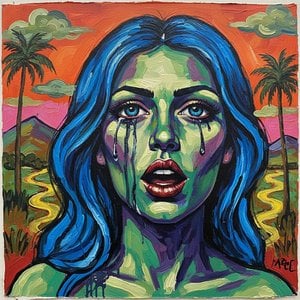
Kunstværket vist på denne side er beskyttet af ophavsretsloven, hvilket betyder, at vi ikke lovligt kan skabe eller sælge en identisk reproduktion. Denne beskyttelse håndhæves i henhold til internationale aftaler som f.eks. den Bernerkonventionen og af nationale love, herunder de bestemmelser, der er fastlagt i Amerikansk ophavsretslov - Titel 17.
Som et respektfuldt og lovligt alternativ tilbyder vi skræddersyede, håndmalede kunstværker inspireret af originalen. Vores dygtige og professionelle kunstnere studerer omhyggeligt originalens stil, stemning og kunstneriske essens for at skabe et nyt, unikt værk, der fremkalder den samme følelse – samtidig med at det forbliver en original skabelse i egen ret.
Denne metode overholder fuldt ud ophavsretsreglerne, da den ikke indebærer kopiering eller duplikering af det beskyttede kunstværk. I stedet er der tale om en kreativ nytolkning – et nyt maleri, som er inspireret af det oprindelige, men ikke identisk med det.
Håndmalet olie på lærred i din valgte størrelse og ramme, udført efter bestilling af vores kunstnere. ( Skift til printsalg
Skift til digitalt billede)
Vælg mellem vores forudindstillede størrelser, der matcher kunstværkets originale proportioner.
Indtast den bredde og højde, du har brug for, så det passer til din ramme eller din væg. Da dette er håndmalet, kan kunstneren ved en anden form på størrelsen male lidt mere rundt om billedet eller skære lidt væk — det er op til dig. Vi sender dig et digitalt mockup til godkendelse, før maleriet påbegyndes. Billedet, der vises på denne side, viser ikke det endelige resultat — det er kun mockuppet, der gør.
Verdensomspændende levering () på 3-4 uger i stedet for de standard 5 uger. (30 oktober). Ingen kompromiser med kvaliteten.
Cocktail Party- Three
Størrelse på reproduktion
In the vibrant, swirling energy of Cocktail Party- Three, created in 1967, we encounter the masterful hand of Maxwell Bennett Bates at the height of his expressive powers. This oil on canvas is not merely a depiction of a social gathering; it is a profound exploration of human interaction through the lens of Canadian modernism. The scene unfolds as a crowded, dynamic assembly where figures overlap and intertwine, creating a sense of movement that feels almost breathless. As one gazes upon the composition, there is an immediate sensation of being swept into the thick of a social event—an art gallery opening or a lively soirée where the air is heavy with conversation, observation, and the subtle tension of shared space.
Bates, a pivotal figure who brought European modernist sensibilities to the Canadian prairies, utilizes a style that leans heavily toward figurative expressionism. The painting eschews the polite boundaries of realism in favor of a bold, Fauvist-inspired palette. Intense, saturated colors collide across the canvas, driving the viewer's eye through a labyrinth of simplified forms and flattened perspectives. There is no singular light source to guide us; instead, a generalized, atmospheric glow illuminates the subjects, casting shadows that serve more to define emotional weight than physical depth. This deliberate distortion of space creates an immersive, almost dreamlike quality, where the boundaries between individuals and their environment begin to blur.
The Texture of Human ConnectionTechnically, the work is a triumph of texture and tactile energy. Bates employs thick, visible brushstrokes that build up layers of pigment, lending a sculptural quality to the figures. This impasto-like application does more than just create depth; it mirrors the psychological complexity of the subject matter. The heavy application of paint captures the "broken up" forms and shifting planes that became Bates's signature, allowing the viewer to feel the physical presence of the crowd. Every stroke contributes to a sense of dynamism, suggesting that the figures are caught in a fleeting moment of transition—a snapshot of life that is simultaneously chaotic and deeply structured.
Beyond the surface beauty lies a deeper layer of symbolic resonance. Within this crowded social landscape, one can detect themes of alienation and the complexities of human relationships. While the characters are physically close, many appear lost in their own private thoughts, observing others or retreating into internal monologues. This creates a poignant contrast between the outward vibrancy of the "cocktail party" and the inward solitude of the individual. For the collector or interior designer, this piece offers more than just a splash of color; it provides a sophisticated narrative anchor for a room, inviting contemplation on the nature of community and the beautiful, messy reality of social existence.
Whether displayed in a contemporary gallery setting or as a centerpiece in a curated residential collection, Cocktail Party- Three serves as a testament to Bates's ability to distill the essence of an era. It is a work that demands attention, rewarding the observer with every subsequent viewing through its intricate interplay of color, form, and emotion.
Den anbefalede trykstørrelse til "Cocktail Party- Three" af Maxwell Bennett Bates er Large.
Farverne i "Cocktail Party- Three" af Maxwell Bennett Bates har en Balanced intensitet.
Til et Restaurant anbefales "Cocktail Party- Three" i en trykstørrelse på Large.
Maxwell Bennett Bates was a man of dual disciplines, navigating the structured world of architecture and the emotive, swirling realms of expressionist painting with equal mastery. Born in Calgary, Alberta, his artistic journey began much earlier than his professional architectural career, with works like In the Kitchen emerging when he was only fifteen years and a few months old. As the son of William Stanley Bates, a prominent architect responsible for landmarks such as the Burns Building, Maxwell was immersed in the principles of design from a young age. He eventually followed this path, working within his father's architectural firm and contributing to significant structures like St. Mary's Cathedral.
However, it was through the canvas that Bates truly found his voice, bringing a profound European modernist sensibility to the Canadian prairies. His education at the Provincial Institute of Technology and Art in Calgary provided a foundational technical skill, but his spirit sought broader horizons. In 1931, he moved to England, a period of immense personal and artistic growth where he lived a life of struggle and discovery, even supporting himself as a vacuum salesman while exhibiting his work at the Wertheim Gallery. During this time, he associated with influential figures such as Barbara Hepworth and Victor Pasmore, absorbing the burgeoning modernist currents that would later define his painterly language.
Bates's artistic evolution was marked by a departure from the polite boundaries of realism. His work is often characterized by a vibrant, swirling energy that explores human interaction through the lens of Canadian modernism and figurative expressionism. In masterpieces such as Cocktail Party- Three, one can witness the height of his expressive power. The composition does not merely depict a social gathering; it creates a symphony of movement where figures overlap and intertwine in a breathless dance. Drawing inspiration from Fauvist-inspired palettes, he utilized intense, saturated colors that collide across the canvas to drive the viewer's eye through a labyrinth of simplified forms.
The technique employed by Bates was deeply tactile. He favored thick, visible brushstrokes and an impasto-like application of pigment that lent a sculptural quality to his subjects. This heavy texture served as a mirror to the psychological complexity of his themes, where flattened perspectives and a lack of a singular light source created an immersive, dreamlike atmosphere. In his hands, the boundaries between individuals and their environment began to blur, capturing the very essence of human connection and the subtle tensions of shared space.
Throughout his life, Bates's work resonated far beyond the borders of Alberta. His experiences as a prisoner of war in Thuringia during World War II added a layer of profound depth to his perspective, a period he later captured in his writing. As his career progressed, his art found homes in prestigious institutions across Canada and beyond, including:
His contributions to the Canadian art landscape were formally recognized through honors such as the Order of Canada and his membership in the Royal Canadian Academy of Arts. Whether through the architectural precision of a cathedral or the emotive, broken-up forms of an expressionist oil painting, Maxwell Bennett Bates remains a pivotal figure who bridged the gap between structural discipline and the raw, unbridled energy of modern art.

1906 - 1980 , Canada