Entrance to Subway (Subway Station.Subway Scene)
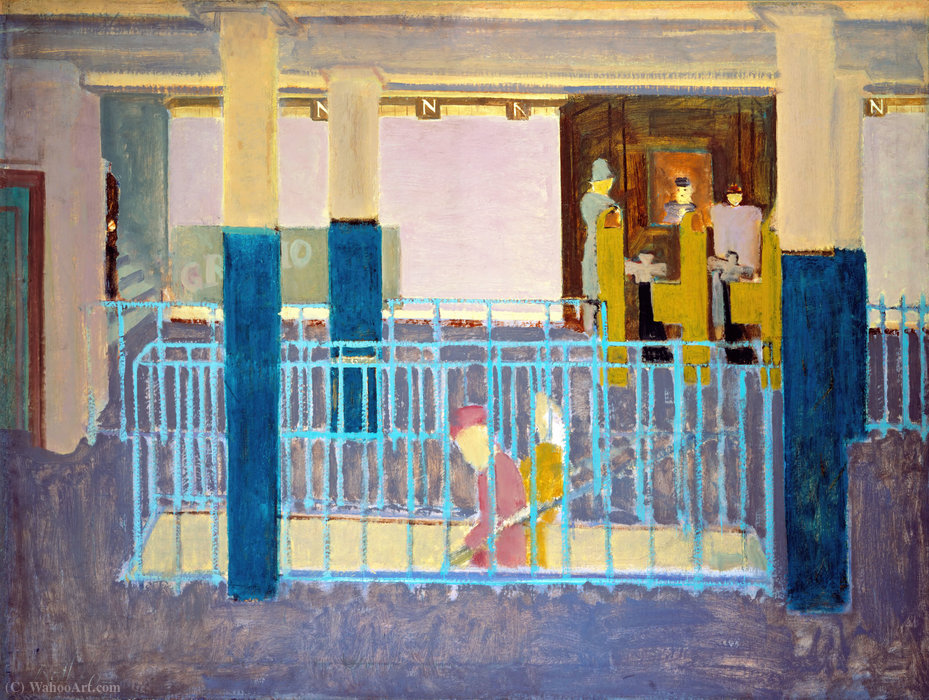
Mark Rothko's "Entrance to Subway" isn’t merely a depiction of a New York City subway station; it’s an immersion into the collective experience of urban life, a poignant meditation on anonymity and the fleeting nature of human connection. Painted in 1938 during a period of intense social and political upheaval – a time when the anxieties of war were beginning to surface – this large-scale oil painting captures not just a physical space but also an emotional landscape. Rothko, a key figure in the Abstract Expressionist movement, deliberately eschewed traditional representational techniques, opting instead for a bold simplification of form and color to evoke profound feelings within the viewer.
The dominant hues of blue and yellow immediately establish a dynamic atmosphere, far removed from the muted tones often associated with depictions of urban decay. These colors aren’t simply applied; they bleed into one another, creating a sense of movement and suggesting the constant flow of people through the station. The composition is anchored by two prominent benches – one centrally positioned, the other subtly placed on the right – offering momentary points of rest amidst the bustling scene. Notice how Rothko uses geometric forms—the rectangular shapes of the benches and the implied lines of the platform—to create a sense of structure within an otherwise amorphous space. These elements aren’t meant to define the scene precisely, but rather to provide a framework for the viewer's interpretation.
- Style: Abstract Expressionism
- Medium: Oil on Canvas
- Dimensions: Unknown
- Date: 1938
It’s crucial to understand Rothko's artistic philosophy during this period. He wasn’t interested in creating images that could be easily identified or understood; rather, he sought to evoke primal emotions – a sense of awe, mystery, and perhaps even melancholy – through the pure experience of color. He famously stated, “Colors are performers,” suggesting that his paintings were meant to act upon the viewer's subconscious, triggering a deeply personal response.
- Symbolism: The benches represent moments of respite amidst the chaos of urban life, symbolizing human connection and contemplation.
- Historical Context: Created during the Great Depression and escalating tensions leading up to World War II, the painting reflects anxieties about societal change and displacement.
Rothko’s technique is characterized by its deliberate lack of detail and emphasis on color fields. He applied paint in broad, sweeping strokes, allowing the colors to overlap and blend organically. This process—often described as “all-over” painting—means that there's no single focal point; instead, the viewer’s eye is invited to wander across the entire surface of the canvas, absorbing the interplay of hues and textures. The thickness of the paint itself contributes to the work’s tactile quality, inviting a physical engagement with the artwork.
- Technique: Rothko utilized “all-over” painting—a technique where color is applied uniformly across the entire canvas—creating an immersive experience for the viewer.
- Color Palette: The dominant colors are blue and yellow, which generate a dynamic atmosphere and convey feelings of movement and contemplation.
Interestingly, Rothko’s early career involved figurative work, depicting portraits and urban scenes. However, he gradually moved away from representational art, seeking a more direct means of expressing his emotions. This shift aligns with the broader trends of the Abstract Expressionist movement, which rejected traditional artistic conventions in favor of exploring new forms of expression.
- Influence: Rothko’s work has inspired artists like Yayoi Kusama, who explore themes of infinity and self-obliteration through immersive installations.
WahooArt is proud to offer meticulously crafted, hand-painted reproductions of “Entrance to Subway.” These aren’t simply prints; they are faithful interpretations of Rothko's original masterpiece, capturing the vibrancy of color, the texture of paint, and the emotional depth of the artwork. Each reproduction is created by skilled artists who have a deep understanding of Rothko’s technique and philosophy.
Explore the details and dimensions on WahooArt. For those seeking to delve deeper into Rothko’s life and work, we encourage you to visit
Yayoi Kusama's website or explore the extensive resources available on Wikipedia:
Wikipedia.
Spørgsmål & svar
Hvilket medie er "Entré til metro" af Mark Rothko udført i?
Mark Rothko brugte Akryl på lærred-teknikken til "Entré til metro". Teknikken definerer det originale værks materielle karakter.
Hvordan beskrives farvepaletten i "Entré til metro" af Mark Rothko?
Farvepaletten i "Entré til metro" af Mark Rothko beskrives som Neutrale nuancer. Det er en kompakt beskrivelse af værkets farver.
Hvem er ophavsmanden til "Entré til metro", og i hvilken stilart?
Mark Rothko skabte "Entré til metro" inden for Abstract Expressionism-bevægelsen.


 Se i rummet
 Bestil håndmalet reproduktion
 Send
Send Del
Del
 Detaljer
 Studieguide til kunstværker

 Download
 Lignende værker
 Røntgenundersøgelse
 Se diasshow
 Statistik

 Læs mere






































 Glasmulighed er kun tilgængelig i størrelser under 110 cm