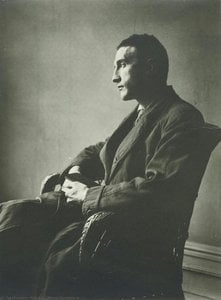
A Bicycle Sonata: Duchamp’s Provocative Meditation on Art and Leisure
Marcel Duchamp's To Have the Apprentice in the Sun, created in 1914, is not merely a depiction of a man riding a bicycle; it’s a carefully constructed paradox, a deliberate disruption of conventional artistic expectations. This seemingly simple image—a figure on sheet music against the backdrop of a piano—resonates with layers of meaning that speak to Duchamp's core philosophy: challenging the very definition of art and questioning its relationship to everyday life. The year 1914, a period marked by immense global upheaval, provides a crucial context for understanding Duchamp’s work – a world on the brink of war, prompting artists to reconsider established norms and explore new modes of expression.
The Composition: Music, Movement, and the Unconventional Subject
The artwork immediately arrests the viewer with its unusual subject matter. A man, dressed in a helmet – a detail that subtly suggests both protection and a certain vulnerability – is engaged in the act of cycling on what appears to be a sheet of music. The positioning is deliberate; the bicycle isn’t simply placed beside the piano, but actively occupies the space *of* the music itself. This fusion of the mechanical and the musical creates an intriguing tension. Duchamp masterfully utilizes black and white, lending the image a stark, almost photographic quality that emphasizes the geometric forms and the figures' placement. The lack of color further directs attention to the composition’s inherent structure and the interplay between the bicycle and the music.
- The Bicycle: Represents movement, progress, and perhaps even a rejection of traditional artistic conventions.
- Sheet Music: Symbolizes art, creativity, and the established order of artistic practice.
- Piano: Suggests harmony, structure, and the potential for both beauty and rigidity.
Dadaist Roots and a Rejection of Representation
Created during Duchamp’s involvement with the Dada movement, To Have the Apprentice in the Sun embodies Dada's core tenets: anti-art, absurdity, and a rejection of traditional artistic values. Dada artists sought to dismantle established hierarchies and expose the arbitrary nature of aesthetic judgment. Duchamp’s work directly reflects this ethos by presenting an image that defies easy interpretation. It isn’t a portrait, a landscape, or a still life; it's a conceptual arrangement designed to provoke thought rather than provide visual pleasure in the conventional sense. The bicycle, a symbol of modernity and industrial progress, is juxtaposed with the music, representing the artistic realm, creating an unsettling yet compelling dialogue.
Symbolism and Duchamp’s Philosophical Inquiry
Beyond its Dadaist context, the image operates on a deeper symbolic level. The “apprentice” – a term suggesting someone in training or learning – could be interpreted as representing the artist himself, grappling with the challenges of forging his own artistic path. The act of riding a bicycle *on* music suggests an attempt to integrate the mundane and the extraordinary, the practical and the aesthetic. Duchamp wasn’t simply depicting a scene; he was engaging in a philosophical inquiry into the nature of art, its relationship to reality, and the role of the artist within society. The helmet worn by the cyclist adds another layer – is it protection from the world, or a shield against the judgment of established artistic norms?
To Have the Apprentice in the Sun remains a powerfully evocative work, demonstrating Duchamp’s genius for disrupting expectations and inviting viewers to reconsider their assumptions about art. A reproduction captures not only the image's striking composition but also the spirit of intellectual rebellion that defines this pivotal moment in modern art history.



 Se i rummet
 Skift til printversion
 Send
Send Del
Del
 Detaljer
 Studieguide til kunstværker

 Download
 Lignende værker
 Røntgenundersøgelse
 Se diasshow
 Statistik


 Læs mere


![Genre Allegory [george Washington] — Marcel Duchamp, Surrealism](/media/artworks/images-thumb/90/d9/90d9ce324280fe5002abd42626b6c52f.jpg)