The Eloquence of Portraiture: Isaac Smith by John Singleton Copley
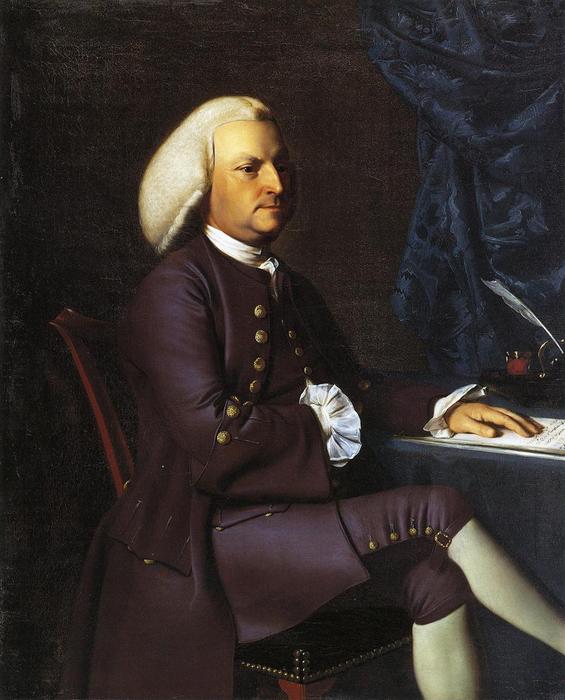
John Singleton Copley’s “Isaac Smith,” painted in 1769, isn't merely a likeness; it’s a carefully constructed window into the burgeoning world of colonial Boston and the aspirations of its wealthy elite. This portrait, now residing within the hallowed halls of the Yale University Art Gallery, exemplifies Copley’s mastery of capturing not just physical appearance but also the subtle nuances of character and social standing – a hallmark of his most celebrated works. The painting immediately draws the eye to Mr. Smith, seated with an air of quiet contemplation, his posture radiating both dignity and a hint of reserved intelligence. He is rendered in rich, dark attire, accented by the crisp white of his ruffled shirt and powdered wig, indicative of the fashionable standards of the era. Copley’s meticulous attention to detail—the texture of the velvet, the sheen of the buttons, the delicate folds of the fabric—demonstrates a profound understanding of materials and their visual impact, reflecting the artist's commitment to realism.
Copley’s style during this period was deeply rooted in Neoclassicism, an artistic movement that sought inspiration from the art and ideals of ancient Greece and Rome. This influence is evident in the portrait’s balanced composition, its emphasis on clear lines and precise forms, and its restrained palette. However, Copley wasn't simply replicating classical models; he infused his work with a distinctly American sensibility, capturing the spirit of a society undergoing rapid transformation. The painting speaks to the growing confidence and prosperity of colonial Boston, a city rapidly becoming a center of trade and finance. The background, deliberately muted and suggestive rather than detailed, directs focus entirely onto Smith, reinforcing his importance within the scene.
A Window into Colonial Society
“Isaac Smith” offers a fascinating glimpse into the social dynamics of 18th-century Boston. The portrait’s commission itself speaks volumes about the values and priorities of its patron – a wealthy merchant seeking to solidify his position within the community through visual representation. The inclusion of the book on the table subtly hints at Mr. Smith's intellectual pursuits, suggesting an engagement with learning and culture that was increasingly valued during this period. The painting wasn’t just about vanity; it served as a powerful tool for social signaling – a declaration of wealth, status, and refined taste.
Furthermore, the portrait reflects the growing importance of portraiture in colonial America. As the colonies developed their own artistic traditions, portrait painting became increasingly popular among the wealthy elite, providing a means to commemorate themselves and their families. Copley’s portraits were highly sought after, not only for their technical skill but also for their ability to capture the essence of their subjects – their personalities, aspirations, and social standing. The meticulous rendering of Smith's features—his thoughtful gaze, his slightly furrowed brow—suggests a man of considerable intellect and quiet strength.
The Artist’s Hand: Technique and Detail
Copley’s technique in “Isaac Smith” is characterized by an extraordinary level of detail and precision. He employed the sfumato technique, subtly blending colors to create soft transitions and a sense of atmospheric depth. This approach is particularly evident in the rendering of Smith's clothing, where Copley masterfully captures the textures and folds of the fabric with remarkable accuracy. The artist’s use of light and shadow further enhances the portrait’s realism, creating a three-dimensional effect that draws the viewer into the scene.
The painting is executed in oil on canvas, a medium favored by Copley for its ability to capture subtle nuances of color and texture. He utilized a layering technique, applying thin glazes of paint over previous layers to build up depth and richness. This meticulous approach required considerable skill and patience, reflecting Copley’s dedication to his craft. The brushstrokes are remarkably controlled, contributing to the overall sense of composure and refinement that permeates the portrait.
A Timeless Masterpiece
“Isaac Smith” remains a compelling testament to John Singleton Copley's artistic genius and a valuable window into colonial American society. Its enduring appeal lies not only in its technical brilliance but also in its ability to evoke a sense of timeless elegance and quiet dignity. Today, reproductions of this iconic portrait continue to captivate art enthusiasts worldwide, offering a glimpse into the world of 18th-century Boston and the remarkable talent of one of America’s most celebrated artists. Consider acquiring a high-quality reproduction – a tangible connection to a pivotal moment in American artistic history.
Spørgsmål & svar
Findes der værker, der ligner "Isaac Smith"?
Værker, der ligner "Isaac Smith" af John Singleton Copley, er samlet på værkets Lignende værker-side.
Hvor i John Singleton Copleys karriere placerer "Isaac Smith" sig, når man ser på dens datering?
Med sin datering fra 1769 tilhører "Isaac Smith" John Singleton Copleys Mature Period.
Hvor kan man i dag se "Isaac Smith" af John Singleton Copley udstillet?
Du kan se det originale værk "Isaac Smith" på Yale Universitets Kunstmuseum, Hartford, USA.
Is John Singleton Copley, creator of "Isaac Smith", known under other names?
Other names recorded for John Singleton Copley, creator of "Isaac Smith", include John Singleton Copley den ældre.
Hvad er "Isaac Smith" lavet af, og i hvilken stil?
I "Isaac Smith" mødes Oil On Canvas-teknikken med Neoclassicism-bevægelsen.
Hvilket printformat og hvilken orientering anbefales til "Isaac Smith" af John Singleton Copley?
Størrelse Medium, Portrait orientering: dette er den anbefalede printopsætning til "Isaac Smith" af John Singleton Copley.
Hvilken teknik og størrelse har den originale "Isaac Smith" af John Singleton Copley?
Mediet for "Isaac Smith" af John Singleton Copley er Oil On Canvas, og de registrerede mål er 101 x 127 cm.
Kan jeg se "Isaac Smith" som et diasshow i fuld skærm?
Diaporamaet af "Isaac Smith" kan ses på værkets Diaporama-side.


 Se i rummet
 Skift til printversion
 Send
Send Del
Del
 Detaljer
 Studieguide til kunstværker

 Download
 Lignende værker
 Røntgenundersøgelse
 Se diasshow
 Statistik


 Læs mere