


Kunstværket vist på denne side er beskyttet af ophavsretsloven, hvilket betyder, at vi ikke lovligt kan skabe eller sælge en identisk reproduktion. Denne beskyttelse håndhæves i henhold til internationale aftaler som f.eks. den Bernerkonventionen og af nationale love, herunder de bestemmelser, der er fastlagt i Amerikansk ophavsretslov - Titel 17.
Denne metode overholder fuldt ud ophavsretsreglerne, da den ikke indebærer kopiering eller duplikering af det beskyttede kunstværk. I stedet er der tale om en kreativ nytolkning – et nyt maleri, som er inspireret af det oprindelige, men ikke identisk med det.
Giclée- eller lærredstryk i museumskvalitet med hurtig produktion og fleksible muligheder for finish. ( Køb håndmalet maleri Skift til digitalt billede)





























Vælg mellem vores forudindstillede størrelser, der matcher kunstværkets originale proportioner.

Indtast den bredde og højde, du har brug for, så det passer til din ramme eller din væg. Et print kan kun beskæres, aldrig gøres større end selve billedet, så en størrelse med et andet format vil medføre, at dele af motivet går tabt. Vi sender dig en digital mockup til godkendelse, før vi printer noget. Billedet vist på denne side viser ikke den faktiske beskæring — det er kun mockuppen, der gør.
Verdensomspændende levering () på 2 uger i stedet for de sædvanlige 4/5 uger. (8 november)
Orange Impulse
Størrelse på reproduktion
A red circle with a yellow center anchors the composition, acting as a focal point amidst a field of shifting shapes. Surrounding this central form, various colors and dark, black elements create a sense of tension and contrast. The arrangement suggests a sudden release of energy, a visual pulse captured in 1955. The work moves away from literal representation, favoring a language of pure color and form to communicate movement and cosmic force.
The application of pigment creates a sense of depth, inviting a close examination of the interplay between the organic and the geometric. Through this abstraction, the canvas attempts to translate the intangible rhythms of life into a tangible visual experience.
Created during a period of significant transformation in Canadian modernism, this work reflects a departure from traditional landscape painting. It aligns with the mid-century movement toward spiritualized abstraction, where the artist seeks to express the essence of time and space rather than the physical world.
The piece exemplifies the shift toward a universal, modernist dialogue, moving beyond regionalism to explore the internal mechanics of emotion and motion. It remains a significant example of the era's push to redefine the boundaries of North American art through non-representational expression.
Luminansen registreret for "Orange Impulse" af James Williamson Galloway Macdonald er Soft Shadow.
Anvendelse (Focal) og placering (Coworking) er de to anbefalinger, der er angivet for "Orange Impulse" af James Williamson Galloway Macdonald.
"Orange Impulse" af James Williamson Galloway Macdonald formidler en Energetic følelse i en overordnet Bold stemning.

James Williamson Galloway Macdonald, known affectionately to the art world as Jock Macdonald, stands as a monumental figure in the evolution of Canadian modernism. Born in the rugged, atmospheric landscape of Thurso, Scotland, in 1897, his early life was steeped in the dramatic textures of his homeland. This foundational connection to nature would later become the heartbeat of his abstract explorations. After honing his technical prowess at the prestigious Glasgow School of Art, Macdonald embarked on a transformative journey across the Atlantic in 1926. Arriving in Canada, he did not merely join an existing art scene; he arrived to ignite a revolution, bringing with him a sophisticated understanding of European avant-garde movements such as Cubism and Surrealism that would eventually dismantle the boundaries of representational painting in North America.
As his career unfolded, Macdonald’s work underwent a profound metamorphosis, moving away from the literal depiction of the world toward a deeper, more spiritualized abstraction. He became a master of capturing the intangible, seeking to translate the very essence of movement, time, and cosmic energy onto the canvas. His palette was as diverse as his imagination, utilizing traditional oils and watercolors alongside experimental industrial materials like Duco and Lucite. This willingness to embrace new media allowed him to achieve a unique sense of depth and luminosity. In masterpieces such as Orange Impulse, one witnesses a vibrant explosion of red and yellow shapes that pulse with the dynamic energy of mid-century modernism, inviting the viewer into a realm where color itself becomes a language of pure emotion.
Macdonald’s contribution to art history extends far beyond his individual canvases; he was a pivotal educator and a catalyst for collective change. Through his influential teaching positions at the Vancouver School of Decorative and Applied Arts and the Ontario College of Art, he nurtured a new generation of Canadian artists, encouraging them to look inward and toward the abstract. As a prominent member of the Painters Eleven, he helped establish a movement that challenged the dominance of landscape painting in Canada, pushing the national identity toward a more universal, modernist dialogue.
His thematic preoccupations often revolved around the organic rhythms of life, frequently utilizing motifs such as birds and aquatic forms to explore the concept of space, time, and motion. Whether it is the whimsical, mid-century charm found in Music Hour, where a vibrant yellow fish serves as a captivating centerpiece, or the more somber, textured reflections in works like Rust of Antiquity, Macdonald’s oeuvre remains a testament to the power of abstraction to touch upon the profound. His ability to blend the organic with the geometric created a visual vocabulary that continues to resonate, ensuring his place as a pioneer who redefined the limits of Canadian art.

1897 - 1960 , United Kingdom

Oplev de 10 mest ikoniske værker inden for geometrisk abstraktion! Fra Kandinsky til Mondrian – lær historierne bag disse banebrydende kunstnere og deres farverige malerier. Find museumskvalitets reproduktioner & inspiration til din indretning på WahooArt.dk.
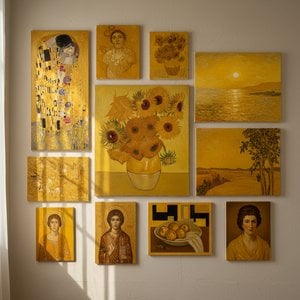
Oplev de 10 mest berømte malerier domineret af okkergule nuancer! Fra Van Gogh til Monet – dyk ned i kunsthistorien og lær om teknikken bag disse tidløse mesterværker. Find din perfekte reproduktion på WahooArt.com.

Oplev de 10 mest ikoniske værker inden for Abstrakt Ekspressionisme – Jackson Pollock, Mark Rothko og mere. Lær historien bag kunstnerne & teknikken. Find museumskvalitets reproduktioner på WahooArt.com.

Oplev Mark Rothkos 25 mest ikoniske malerier – en dybdegående rejse i abstrakt ekspressionisme og farvefeltmaleri. Lær historien bag værkerne & find inspiration til din indretning med WahooArt.dk. Udforsk samlingen online!

Oplev Kandinskys 25 mest ikoniske værker! Dyk ned i abstrakt kunst, ekspressionisme og farvernes sprog. Find luksus reproduktioner af berømte malerier som 'Komposition VIII' på WahooArt.com – inspiration til din vægkunst & indretning.
 Se i rummet
 Del som kort
 Del
Del
 Detaljer
 Guide
Guide

 Download
 Lignende værker
 Røntgenundersøgelse
 Diasshow
 Spørgsmål og svar
 Statistikker


 Vis mere









 Glasmulighed er kun tilgængelig i størrelser under 110 cm


