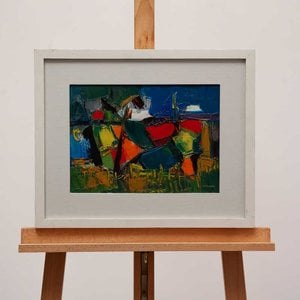
Italo Valenti: A Journey Through Abstract Forms and Dreamlike Landscapes
Born in the bustling heart of Milan in 1912, Italo Valenti’s artistic journey was one marked by a restless spirit, a deep engagement with European avant-garde movements, and an increasingly personal exploration of color, form, and emotion. His life unfolded across Italy and Switzerland, each location contributing to the evolution of his distinctive style – a captivating blend of geometric abstraction, figural suggestion, and a profound sensitivity to nature’s rhythms.
Valenti's early years were steeped in the artistic traditions of Venice and Milan, providing him with a solid foundation. He spent formative years absorbing the influence of masters like Paolo Uccello and Raffaello Sanzio, while simultaneously seeking inspiration from the Impressionists and Post-Impressionists he encountered during his travels to Paris and Belgium. These early experiences weren’t merely academic; they ignited within him a desire to break free from traditional representational art, a yearning to express inner realities through innovative means.
The 1930s witnessed Valenti's immersion in the “Corrente” group – a dynamic collective of artists and writers dedicated to exploring social and political themes. This period solidified his commitment to abstraction, though he retained a strong connection to figurative elements, often employing them as vehicles for conveying deeper meanings. His paintings from this era are characterized by bold colors, sharp geometric shapes, and a palpable sense of drama – reflections of the turbulent times in which he lived.
The Swiss Years and a Shift Towards Lyricism
A pivotal moment in Valenti’s career arrived in 1953 when he relocated to Switzerland, specifically Locarno. This move proved transformative, marking a significant shift away from the overtly political concerns of his earlier work. Surrounded by a vibrant artistic community – including figures like Ben Nicholson and Jean Arp – he began to experiment with new techniques and approaches, embracing a more lyrical and introspective style.
During this period, Valenti’s palette became richer and more nuanced, and his compositions grew increasingly fragmented and evocative. He moved away from rigid geometric forms, favoring instead the suggestion of shapes, the interplay of light and shadow, and the creation of dreamlike landscapes. His work began to resemble a series of interconnected fragments – glimpses into a subconscious realm where reality and imagination blurred.
Key Artistic Elements and Influences
Valenti’s artistic style was remarkably distinctive, shaped by a confluence of influences and a deep understanding of formal principles. He masterfully employed bold colors—often juxtaposing vibrant hues with muted tones—to create dynamic visual effects. Geometric shapes – triangles, trapezoids, rhombuses – served as the building blocks of his compositions, arranged in ways that evoked both order and chaos.
Furthermore, Valenti’s work was deeply informed by nature. He frequently incorporated elements of architecture, landscapes, and celestial phenomena into his paintings, imbuing them with a sense of timelessness and mystery. The influence of Cézanne is particularly evident in his use of perspective and the way he rendered three-dimensional forms on a two-dimensional surface.
Beyond these formal elements, Valenti’s work was also shaped by his engagement with various philosophical currents, including theosophy and Jungian psychology. He sought to tap into the collective unconscious, exploring themes of myth, symbolism, and the relationship between the individual and the universe. The dreamlike quality of his paintings reflects this interest in the realm of the subconscious.
Legacy and Recognition
Despite facing challenges throughout his career – including a debilitating stroke in 1985 – Italo Valenti left an enduring legacy on Italian art. His innovative approach to abstraction, his masterful use of color and form, and his profound sensitivity to the human condition continue to inspire artists today.
His paintings are held in numerous museums and private collections across Italy and beyond, including the Museo della Consolazione in Altomonte. Valenti’s work stands as a testament to the power of art to transcend boundaries, to explore the depths of the human psyche, and to offer new perspectives on the world around us. His exploration of geometric abstraction combined with evocative imagery cemented his place as a significant figure in 20th-century Italian art.
To learn more about Italo Valenti and his work, please visit Italo Valenti on WahooArt.com. You can also explore the works of other Italian artists, such as Giulio Cesare Amidano and Giovanni Battista Tiepolo.



 Se i rummet
 Skift til printversion
 Send
Send Del
Del
 Detaljer
 Studieguide til kunstværker

 Download
 Lignende værker
 Røntgenundersøgelse
 Se diasshow
 Statistik


 Læs mere






































 Glasmulighed er kun tilgængelig i størrelser under 110 cm