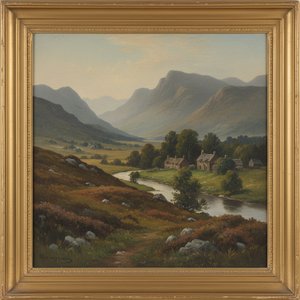
Henri de Toulouse-Lautrec: A Parisian Visionary
Born Henri Marie Raymond de Toulouse-Lautrec-Montfa on November 24, 1864, in the heart of southern France, Henri de Toulouse-Lautrec’s life was inextricably linked to the vibrant and often turbulent world of late 19th-century Paris. His aristocratic lineage – descended from both the Counts of Toulouse and the Vicomtes of Lautrec – initially positioned him within a privileged sphere, yet a childhood marred by a severe bone infection that resulted in stunted legs profoundly shaped his artistic trajectory and perspective. This physical difference became not a barrier but a lens through which he observed and depicted the human condition with remarkable empathy and honesty.
Lautrec’s early years were spent largely at the family estate, where he developed a keen interest in art, initially pursuing studies at the École des Beaux-Arts in Paris. However, traditional academic training proved ill-suited to his restless spirit and unconventional approach. He quickly gravitated towards the burgeoning artistic circles of Montmartre, immersing himself in the bohemian atmosphere of cabarets, dance halls, and brothels – a world that would become the central subject of much of his work. This immersion wasn’t merely observational; it was deeply felt, fueled by a desire to capture the raw energy and emotional complexities of Parisian life.
The World of Montmartre: Subject and Style
Lautrec's artistic vision was inextricably tied to the streets and social spaces of Montmartre. He wasn’t interested in idealized representations or historical narratives; instead, he sought to document the everyday lives of Parisians – prostitutes, dancers, artists, musicians, and gamblers – with a startlingly direct and often unflinching gaze. His subjects weren't merely depicted; they were brought to life through his masterful use of line, color, and composition.
His style evolved rapidly, drawing inspiration from various sources. Initially influenced by the Impressionists’ focus on capturing fleeting moments and light, Lautrec soon developed a distinctly personal approach. He employed bold outlines, flattened perspectives, and vibrant, often jarring colors to create images that were both visually arresting and emotionally charged. The influence of Post-Impressionism – particularly artists like Paul Cézanne, Vincent van Gogh, and Paul Gauguin – is evident in his use of color and expressive brushstrokes, but Lautrec’s work possessed a unique energy and immediacy that set it apart.
Lautrec's technique was remarkably versatile. He excelled at both painting and printmaking, producing stunning posters for the Moulin Rouge and other popular venues. His lithographs are characterized by their dynamic compositions, expressive lines, and bold colors – perfect vehicles for capturing the frenetic energy of Parisian nightlife. He also skillfully utilized drawing and draughtsmanship to create detailed studies of his subjects, revealing a deep understanding of anatomy and gesture.
Brothels and Bohemian Life: A Complex Relationship
Lautrec’s fascination with the world of prostitution and the bohemian lifestyle in Montmartre is perhaps the most controversial aspect of his artistic career. He spent considerable time observing and documenting the lives of women working in brothels, creating a series of iconic images that offer both a glimpse into their experiences and a critical commentary on societal attitudes towards sexuality and morality.
It’s important to note that Lautrec's relationship with this world was complex and multifaceted. He wasn’t simply an exploitative observer; he seemed genuinely interested in the lives of these women, capturing their dignity and resilience alongside their vulnerability. His work can be interpreted as a form of empathy—a desire to understand and represent a marginalized segment of society that was often ignored or demonized.
His most famous works from this period include *La Blanchisseuse* (The Washerwoman), *Jane Avril*, and *Ephemere*. These paintings are not merely depictions of beautiful women; they are portraits of individuals struggling to survive in a challenging environment, imbued with a sense of melancholy and longing.
Later Years and Legacy
Despite his artistic success, Lautrec’s life was marked by physical suffering and emotional turmoil. The childhood injury continued to cause him pain, and he struggled with alcoholism and depression throughout much of his adult life. He also faced social prejudice due to his appearance, which contributed to feelings of isolation and insecurity.
In 1901, at the age of 36, Toulouse-Lautrec died in Paris from pneumonia – a tragic end for an artist who had so brilliantly captured the spirit of his time. However, his legacy endured. His work continues to fascinate and inspire artists and audiences alike, offering a unique and unforgettable portrait of Parisian life in the late 19th century.
Lautrec’s influence extends far beyond the realm of art history. He is considered a pioneer of modern illustration and poster design, and his images have been widely reproduced and adapted across various media. His willingness to challenge social conventions and depict marginalized communities with honesty and empathy has made him a significant figure in the ongoing conversation about representation, identity, and the power of art.



 Se i rummet
 Køb håndmalet maleri
 Del som kort
 Del
Del
 Detaljer
 Guide
Guide

 Download
 Lignende værker
 Røntgenundersøgelse
 Diasshow
 Q&A
Q&A Statistikker
 Vis mere






































 Glasmulighed er kun tilgængelig i størrelser under 110 cm