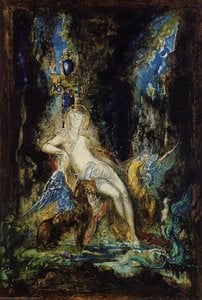
Gustave Moreau’s *Galatee*: A Descent into Symbolist Mystery
Gustave Moreau's *Galatee*, painted during his most intensely productive period, offers a profound and unsettling glimpse into the heart of Symbolism – a movement that sought to transcend mere representation and tap directly into the realm of emotion, dream, and spiritual experience. Completed around 1872, this enigmatic work immediately distinguishes itself from the burgeoning naturalism and impressionistic trends dominating the Parisian art scene. Moreau wasn’t interested in depicting a conventional narrative; instead, he constructed a carefully orchestrated tableau designed to evoke a powerful, almost overwhelming, sense of mystery and psychological depth.
- Subject Matter: The central figures – a reclining woman and a standing man – are rendered with an arresting ambiguity. The woman, identified as a ‘galatee’ (a mythological figure associated with the goddess Galatea), lies in a state of apparent vulnerability, her posture suggesting both repose and a subtle unease. The man's presence is equally ambiguous; his hand resting on her shoulder could be interpreted as protection, dominance, or perhaps even a sinister gesture.
- Setting & Atmosphere: Moreau masterfully employs a muted palette – predominantly browns, ochres, and deep blues – to create an atmosphere of twilight and shadow. The indistinct background, hinting at water and distant figures, further contributes to the painting’s sense of detachment and dreamlike quality.
Technique & Style: A Masterclass in Symbolist Detail
Moreau's technique is characterized by meticulous detail and a deliberate avoidance of smooth brushwork. He built up layers of paint, creating a textured surface that adds to the painting’s tactile quality and reinforces its symbolic weight. The figures are rendered with an almost sculptural precision, their forms imbued with a sense of timelessness and classical influence – a hallmark of Moreau's artistic sensibility. His use of color is particularly noteworthy; he employs subtle gradations and shimmering effects to create a luminous, otherworldly atmosphere. This meticulous approach reflects his desire to capture not just the appearance of things but also their underlying spiritual essence.
- Composition: The composition itself is deliberately unbalanced, with the figures positioned off-center and the background shrouded in shadow. This creates a sense of unease and instability, mirroring the psychological complexities explored within the painting.
- Brushwork: Moreau’s deliberate brushstrokes contribute to the overall texture and depth of the image, adding to its visual richness and enhancing the symbolic meaning.
Symbolism & Historical Context
*Galatee* is deeply rooted in the Symbolist movement's fascination with mythology, religion, and the subconscious. Moreau drew heavily on classical iconography, particularly representations of Galatea, a nymph associated with beauty, art, and inspiration. The presence of other figures – a third person further back and a bird perched above the woman – adds to the painting’s layered symbolism, suggesting a ritualistic or dreamlike scenario. Painted during a period of intense intellectual ferment in Paris, *Galatee* reflects the Symbolists' rejection of materialism and their embrace of subjective experience as a pathway to spiritual truth. Moreau was profoundly influenced by writers like Edgar Allan Poe and Charles Baudelaire, whose works explored themes of darkness, beauty, and the irrational.
Emotional Impact & Artistic Legacy
Moreau’s *Galatee* is not a painting that offers easy answers or comforting resolutions. Instead, it confronts the viewer with unsettling questions about desire, power, vulnerability, and the nature of reality itself. The painting's enduring appeal lies in its ability to evoke a profound sense of mystery and psychological tension. It remains a powerful example of Gustave Moreau’s unique artistic vision – a testament to his skill as a master of Symbolist technique and his unwavering commitment to exploring the darkest corners of the human psyche. Its evocative imagery continues to captivate audiences, solidifying Moreau's place as one of the most important figures in the history of modern art.
Spørgsmål & svar
Hvilken følelse er associeret med "galatee"?
Den emotionelle stemning, der er registreret for "galatee" af Gustave Moreau, er Mysterious. Den opsummerer den følelse, som værket udtrykker.
Er "galatee" af Gustave Moreau et lyst eller et mørkt kunstværk?
"galatee" har en overordnet lysstyrke på shadow, og dens luminans er Soft Shadow.
Hvor kan jeg finde statistik om "galatee" af Gustave Moreau?
Siden Statistikker for "galatee" af Gustave Moreau præsenterer statistikker over offentlige besøg: månedlige besøg af dette kunstværk, en sammenligning med kunstnerens mest sete værker og hvor de besøgende kommer fra.



 Se i rummet
 Skift til printversion
 Send
Send Del
Del
 Detaljer
 Studieguide til kunstværker

 Download
 Lignende værker
 Røntgenundersøgelse
 Se diasshow
 Statistik

 Læs mere






































 Glasmulighed er kun tilgængelig i størrelser under 110 cm