x
Woodblock Print
Other
German Expressionism
33.0 x 30.0 cm
Franz Marc MuseumHåndmalet olie på lærred i din valgte størrelse og ramme, udført efter bestilling af vores kunstnere.
Vælg mellem vores forudindstillede størrelser, der matcher kunstværkets originale proportioner.
Du kan indtaste dine egne mål for at passe til en bestemt ramme eller plads. Hvis den valgte størrelse ikke stemmer overens med det originale billedes proportioner, vil vi enten beskære kunstværket eller udvide maleriet med yderligere håndmalede elementer. En digital skitse sendes til din godkendelse, før produktionen påbegyndes.
Bemærk venligst, at forhåndsvisningen på skærmen ikke afspejler den faktiske beskæring eller udvidelse. Kun skitsen vil nøjagtigt vise den endelige komposition.
Selvom specialmål er mulige, anbefaler vi at vælge en dimension fra den foruddefinerede liste for at bevare de originale proportioner.
Levering i hele verden () på 3/4 uger i stedet for de standard 5 uger. (3 juli). Ingen kompromiser med kvaliteten.
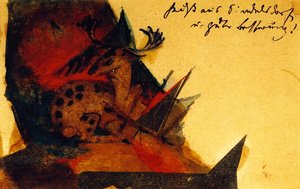
Tiger
Størrelse på reproduktion
Franz Marc’s “Tiger,” a striking woodcut print from 1912, isn’t merely a depiction of an animal; it’s a profound meditation on the interconnectedness of nature and the spiritual realm. Created during a period of intense personal and artistic exploration for the German Expressionist painter, this work embodies Marc's lifelong fascination with animals as symbols of primal instinct, intuition, and ultimately, a connection to something larger than the human ego. The image immediately commands attention – a powerful, almost overwhelming presence of the tiger rendered in stark black ink against a subtly textured cream-colored background. It’s a visual statement that transcends simple representation, inviting viewers into a world where form and feeling are inextricably linked.
Marc's mastery lies in his deliberate manipulation of line – a defining characteristic of woodcut printing. The bold, graphic lines delineate the tiger’s muscular form with an almost brutal honesty, yet they are simultaneously softened by the artist’s expressive hand. Notice how he employs hatching and cross-hatching to suggest texture and volume, creating a sense of depth without relying on traditional shading techniques. This technique isn't about replicating reality; it’s about conveying the *essence* of the tiger – its power, its wildness, its vital energy – through the controlled application of line. The deliberate flatness of the image, a consequence of the woodcut process, contributes to a feeling of immediacy and raw emotion, pulling the viewer directly into the heart of the scene.
“Tiger” is deeply rooted in Marc’s spiritual beliefs. He viewed animals as embodiments of divine qualities – courage, strength, instinct, and a connection to the earth. The tiger itself represents primal energy, untamed spirit, and the forces of nature. The surrounding elements—birds circling overhead, a snake slithering through the undergrowth—further amplify this symbolism, creating a microcosm of the natural world teeming with life and interconnectedness. Marc’s choice of monochrome – black ink on cream paper – is crucial to understanding the work's emotional impact. It strips away any distractions, focusing solely on form, line, and the inherent drama of the subject matter. The limited palette evokes a sense of timelessness and universality, suggesting that this primal scene transcends specific time or place.
“Tiger” is a quintessential example of German Expressionism, a movement characterized by its subjective interpretation of reality and its emphasis on emotional expression. Unlike academic art that sought to represent the world accurately, Expressionists aimed to convey their inner feelings and perceptions through distorted forms, jarring colors (though Marc’s work avoids color), and emotionally charged imagery. Marc's exploration of spirituality within his art is a hallmark of this movement. He wasn’t interested in simply depicting a tiger; he was trying to capture its *spirit*, its essence – the feeling it evokes within him. The image resonates with a sense of both power and vulnerability, reflecting Marc’s own complex relationship with nature and the human condition. It's a work that invites contemplation, prompting viewers to consider their own connection to the natural world and the deeper mysteries of existence.
1880 - 1916 , Tyskland
Fortæl os om dit projekt, og vores kunsteksperter vil give dig 3 personlige kunstforslag.
Vi kuraterer 3 valgmuligheder kun til dig – Gratis!