Franz Marc’s “Red Dog”: A Vision of Spiritual Harmony
Franz Moritz Wilhelm Marc (1880 – 1916), born in Munich, Germany, stands as one of the most influential figures in German Expressionism. His artistic journey began with a fascination for landscape painting under his father's tutelage but swiftly pivoted toward a deeper exploration of spirituality—a quest to distill the fundamental truths of existence into visual form.
Marc’s breakthrough came during his time at the Academy of Fine Arts in Munich, where he encountered Vincent van Gogh’s expressive canvases. This encounter profoundly impacted him, fostering an unwavering conviction that art possessed the capacity to transcend mere representation and evoke genuine spiritual experience. He believed that by capturing the essence of nature—particularly animals—artists could communicate a profound understanding of life's interconnectedness.
Style and Technique: The Language of Color
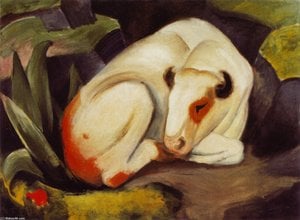
"Red Dog," painted in 1911, exemplifies Marc’s distinctive style – a cornerstone of Expressionism. Rejecting academic realism, he embraced bold color palettes and simplified forms to convey emotion rather than precise detail. Marc utilized tempera paint on canvas, a technique favored for its luminosity and ability to achieve vibrant hues. The artist meticulously applied thick layers of pigment, creating textured surfaces that mirrored the rugged beauty of the mountainous landscape.
Historical Context: Embracing Symbolism Amidst Uncertainty
Marc’s artistic endeavors unfolded against the backdrop of a turbulent era marked by social unrest and intellectual ferment. Expressionism emerged as a reaction to the perceived failings of bourgeois culture, seeking to express inner turmoil and confront existential anxieties. “Red Dog” reflects this spirit of rebellion, rejecting conventional aesthetic standards in favor of an uncompromising commitment to conveying psychological depth.
Symbolic Resonance: The Animal as Embodiment of Spirit
The painting’s central figure—a red dog—is laden with symbolic significance. Dogs have long been associated with loyalty, companionship, and instinctual wisdom within Western culture. Marc deliberately chose this animal to represent the primal forces of nature and, crucially, to embody spiritual harmony. The dog's upward gaze symbolizes aspiration toward transcendence, mirroring Marc’s own belief that art could illuminate the hidden realities of existence.
Emotional Impact: A Momentary Glimpse Beyond Form
"Red Dog" transcends mere visual depiction; it invites contemplation and evokes a powerful emotional response. The dominant reds and oranges convey warmth, energy, and passion—reflecting Marc’s fervent desire to capture the vibrancy of life itself. Viewing this artwork is akin to stepping into a realm where form serves as conduit for feeling, prompting viewers to consider questions of beauty, truth, and the enduring power of artistic expression.



 Se i fuld skala
 Skift til print
 Del
Del Del
Del
 Detaljer

 Download
 Lignende værker
 Røntgenundersøgelse
 Diasshow
 Statistik


 Se mere






































 Glasmulighed er kun tilgængelig i størrelser under 110 cm