Køb et højopløst, optimeret digitalt billede i en kvalitet, der er langt overlegen i forhold til online-forhåndsvisningen.
Hver fil er omhyggeligt forberedt af vores interne specialister ved hjælp af avancerede værktøjer og ekspertmæssig manuel retuschering. Vi sikrer, at hvert billede har enestående klarhed, præcis farvegengivelse og fine detaljer.
Den endelige fil leveres via e-mail inden for 72 timer og er optimeret til øjeblikkelig brug i professionelle, redaktionelle og trykte miljøer. Det er den samme kvalitet, som førende designstudier, forlag og gallerier har tillid til.
Download en højopløselig fil til personlig fremvisning, print og kreative projekter. ( Skift til printversion
Bestil håndmalet reproduktion)
Når du vælger WahooArt.com, får du ikke blot et billede – du modtager et professionelt optimeret digitalt kunstværk, skabt med præcision og sikret med en tilfredshedsgaranti. Her er alt, hvad din ordre automatisk indeholder:
Din højtopløselige digitale billedfil sendes til din e-mail inden for 72 timer efter bestilling – klar til øjeblikkelig brug.
Dit kunstværk optimeres professionelt ved hjælp af avancerede AI-værktøjer og manuel redigering, hvilket sikrer maksimal detaljegrad, klarhed og farvenøjagtighed.
Har du ved en fejl slettet eller mistet din fil? Ingen bekymring – vi sender den igen til enhver tid, helt gratis.
Nyd dit kunstværk med det samme uden told, afgifter eller leveringsgebyrer – digitale downloads er altid skattefrie.
Vi sikrer, at dit digitale billede gengiver de originale farver så præcist som muligt ved hjælp af professionelle værktøjer og farvestyring.
Hvis du ikke er tilfreds med dit digitale billede, vil vi revidere det eller refundere 100% inden for 100 dage – uden spørgsmål.
Ik tilfreds? Få fuld refusion inden for 100 dage efter modtagelse af din digitale fil – uden spørgsmål.
Køb 3 billeder, spar 10% - Køb 5, spar 15% - Køb 10+, spar 20%. Ideelt til kreative projekter, gallerier og bureauer.
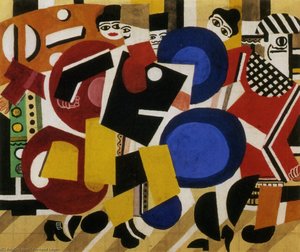
Fernand Léger's "The Level Crossing (Final State)," painted in 1919, isn’t merely a depiction of a railway crossing; it’s a vibrant manifesto of the burgeoning Tubism movement and a bold declaration of modernity. Emerging from the fertile ground of Argentan, Normandy – a region deeply rooted in agricultural tradition – Léger embarked on an artistic journey that propelled him to the heart of Parisian avant-garde circles. Unlike many artists retreating into abstraction as a refuge, Léger sought to actively *integrate* the dynamism and stark forms of the machine age into his visual language. This painting exemplifies that ambition with remarkable force, capturing not just the physical structure of the crossing but also the underlying rhythms and geometries of industrial life.
The work’s genesis lies in Léger's fascination with the burgeoning world of machinery – a subject he viewed as possessing an inherent beauty and power. He meticulously studied locomotives, factories, and other mechanical marvels, translating their angular forms and repetitive patterns into his art. “The Level Crossing” is thus a distillation of this observation, rendered in a strikingly simplified style. The dominant shapes are not organic or representational; instead, they’re cylindrical volumes, interlocking cones, and sharp-edged rectangles – elements that evoke the precision and efficiency of industrial design. This deliberate reduction to essential forms creates a sense of both immediacy and abstraction, drawing the viewer into a world where recognizable objects dissolve into pure geometric relationships.
“The Level Crossing” is a quintessential example of Tubism, a style developed by Léger alongside Robert Delaunay. Unlike Cubism’s fragmentation of form, Tubism sought to capture the *essence* of objects through simplified, cylindrical shapes – often referred to as “tubes.” These tubes aren't merely geometric forms; they possess an inherent sense of movement and energy, mirroring the relentless motion of machinery. Léger employed a bold palette of primary colors—yellows, reds, blues—interspersed with black and white, creating a dynamic visual rhythm that pulsates across the canvas. The use of flat planes and unmodulated color further emphasizes the two-dimensionality of the work, contributing to its overall sense of immediacy and dynamism.
Crucially, Léger wasn’t simply replicating mechanical forms; he was imbuing them with a new kind of beauty. He sought to elevate the mundane – the railway crossing, a symbol of industrial progress – into an object of aesthetic contemplation. The painting's composition is carefully balanced, creating a sense of visual harmony despite its fragmented and geometric nature. The central red pole acts as a focal point, drawing the eye through the complex arrangement of shapes and colors. It’s a deliberate gesture, directing the viewer’s gaze across the scene and reinforcing the painting’s overall message.
Beyond its formal qualities, “The Level Crossing” is rich in symbolic meaning. The railway crossing itself represents the intersection of two worlds: the rural past and the rapidly advancing industrial future. Léger's depiction suggests a transition – a moment of both disruption and potential. The simplified forms and bold colors evoke a sense of excitement and optimism about the possibilities of modernity, while the geometric structure also hints at the underlying order and logic of the machine age. The painting’s emotional impact is surprisingly powerful, conveying not just the visual spectacle of industrial progress but also a feeling of dynamism, energy, and even a touch of alienation.
Furthermore, the work can be interpreted as a commentary on the human condition within this new technological landscape. The figures, though abstracted, retain a sense of humanity, suggesting that individuals are both shaped by and contribute to the forces of industrialization. “The Level Crossing (Final State)” is therefore not just a depiction of a physical space; it’s a profound meditation on the relationship between humans, machines, and the evolving world around us – a timeless masterpiece that continues to resonate with viewers today.
"The level crossing (final state)" af Fernand Léger tilhører Tubism-bevægelsen. Denne bevægelse giver den stilistiske kontekst for værket.
"The level crossing (final state)" stammer fra 1919. Datoen placerer værket i Fernand Léger's karriere og dets tidsalder.
Siden Statistikker for "The level crossing (final state)" af Fernand Léger præsenterer statistikker over offentlige besøg: månedlige besøg af dette kunstværk, en sammenligning med kunstnerens mest sete værker og hvor de besøgende kommer fra.
"The level crossing (final state)" blev skabt af Fernand Léger, født i Frankrig, inden for Tubism-bevægelsen. Kunstnerens oprindelse forbinder værket med Tubism, som det praktiseres af kunstnere fra Frankrig.
Da "The level crossing (final state)" blev skabt i 1919, var Fernand Léger – født i 1881 – 38 år gammel.
"The level crossing (final state)" tilhører Tubism Period i Fernand Léger's karriere. Denne klassificering relaterer værket til kunstnerens udvikling.
Kunstneren bag "The level crossing (final state)" er Fernand Léger. Værket er katalogiseret under Fernand Légers navn.
1881 - 1955 , Frankrig