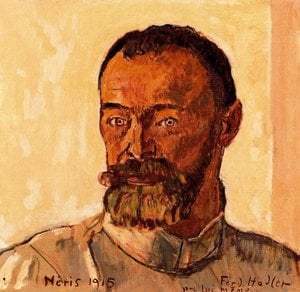
The Raw Essence of Labor: Ferdinand Hodler’s “Lumberjack, Study”
Ferdinand Hodler's "Lumberjack, Study," painted in 1910, isn’t merely a depiction of a man wielding an axe; it’s a profound meditation on the human condition, rendered with the characteristic Symbolist precision that defined the artist’s career. Born in Bern, Switzerland, Hodler’s life was deeply intertwined with themes of loss and mortality – experiences he channeled into his art through a lens of quiet observation and evocative symbolism. This particular work, executed during a period of intense artistic experimentation for Hodler, captures a moment of potent physicality alongside an underlying sense of melancholy, inviting the viewer to contemplate the dignity and inherent struggle within everyday labor.
- Subject Matter: The central figure is a powerfully built lumberjack, poised in the act of swinging his axe. The focus isn’t on heroic action, but rather on the concentrated effort and raw physicality of the task at hand.
- Style & Technique: Hodler employs a distinctive “parallelism” technique – a simultaneous depiction of multiple viewpoints within a single composition. Here, we see the lumberjack from several angles simultaneously, creating a sense of dynamism and capturing the essence of his movement. The brushstrokes are loose and expressive, contributing to the work’s immediate impact.
A Window into Symbolist Thought
Hodler was a key figure in the Swiss Symbolist movement, an artistic current that sought to express inner emotions and ideas rather than simply representing external reality. Symbolism rejected academic realism, favoring suggestive imagery and evocative color palettes. In “Lumberjack, Study,” this is evident in the muted tones of the landscape – a hazy sky and indistinct trees – which serve not as literal representations but as symbolic anchors for the figure’s emotional state. The darkness surrounding the lumberjack hints at the hardships and uncertainties of his life, while the upward swing of the axe can be interpreted as an aspiration towards something beyond the immediate toil.
The choice of a lumberjack as subject is itself significant. It represents a connection to the land, to physical labor, and to a fundamental human need for survival – themes that resonated deeply with Symbolist artists grappling with questions of identity and purpose in a rapidly changing world.
Historical Context & The Bernese Landscape
Bern, Hodler’s birthplace, provided a constant source of inspiration. The rolling hills and forests surrounding the city were frequently depicted in his work, imbued with a sense of timelessness and spiritual resonance. “Lumberjack, Study” reflects this connection to the landscape, grounding the figure within a recognizable yet subtly idealized Bernese setting. The painting was created during a period of significant social change in Switzerland – the rise of industrialization and urbanization were challenging traditional ways of life. Hodler’s work can be seen as both a reflection of these changes and a nostalgic yearning for simpler times.
Emotional Resonance & A Legacy of Quiet Intensity
Despite its seemingly straightforward subject matter, “Lumberjack, Study” possesses a remarkable emotional depth. The lumberjack's face is largely obscured, inviting the viewer to project their own feelings and interpretations onto the figure. There’s a palpable sense of solitude and resilience in his posture – a quiet dignity born from hard work and perhaps, a touch of melancholy. Hodler masterfully captures this complex interplay of strength and vulnerability, creating an image that continues to resonate with viewers today. Reproductions of this powerful study offer a glimpse into the soul of a remarkable artist and a poignant reflection on the human experience.
Spørgsmål & svar
Hvor placerer "Lumberjack, study" sig i forhold til Ferdinand Hodlers samlede værk?
"Lumberjack, study" tilhører Ferdinand Hodlers Symbolism-periode, hvis dokumenterede temaer inkluderer symbolic realism, hodler's swiss style", alpine influence, humanity & nature, melancholy mood, study of strength, early 20th art, exploration of form.
Hvad handler "Lumberjack, study" om, og hvilken atmosfære formidler den?
"Lumberjack, study" viser lumberjack figure, axe and wood theme, symbolic drawing”,, swiss artist style”,, vintage illustration”, “black & white art”, “hodler’s study”, og den stemning, der er indfanget, er Dramatic.
Hvordan beskrives farvepaletten i "Lumberjack, study" af Ferdinand Hodler?
Farverne i "Lumberjack, study" udgør en Neutrals palet. Denne klassificering beskriver de dominerende farvefamilier.
Hvilken placering passer til formatet på "Lumberjack, study" af Ferdinand Hodler?
Formatet Square til "Lumberjack, study" af Ferdinand Hodler anbefales til en Living Room. Format og rumstørrelse er tilsammen vejledende for placeringen af en reproduktion.
Er "Lumberjack, study" tilgængelig som et fine art-print?
Et print af "Lumberjack, study" af Ferdinand Hodler kan bestilles direkte på denne side: et fine art-print på bomuldscanvas eller arkivbestandigt lærredspapir.
I hvilket år og inden for hvilken stilart blev "Lumberjack, study" skabt?
"Lumberjack, study" af Ferdinand Hodler er dateret 1910 og tilhører Symbolism.
Hvilket rum foreslås "Lumberjack, study" vist i, når man tager dens farvepalette i betragtning?
De Neutrals farver i "Lumberjack, study" af Ferdinand Hodler matcher det anbefalede rum: et Living Room.
Hvor lys eller mørk fremstår "Lumberjack, study" af Ferdinand Hodler?
Overordnet set er "Lumberjack, study" registreret som brilliant. Den oplevede lysstyrke beskriver, hvor lyst eller mørkt værket fremstår.



 Se i rummet
 Bestil håndmalet reproduktion
 Send
Send Del
Del
 Detaljer
 Studieguide til kunstværker

 Download
 Lignende værker
 Røntgenundersøgelse
 Se diasshow
 Statistik


 Læs mere






































 Glasmulighed er kun tilgængelig i størrelser under 110 cm