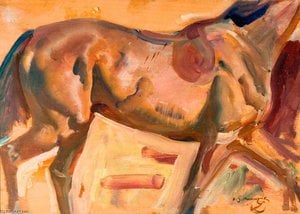
The Undefeated Asteroid (1864) af Edward Troye, håndmalet oliemalerireproduktion udført af en mesterkunstner
Se i rummet Se i AR Skift til printsalg Skift til digitalt billede Del som kort
Detaljer Guide Tilføj til favoritter Download Lignende værker Røntgenundersøgelse Diasshow Spørgsmål og svar Presentation Statistikker

The Undefeated Asteroid Håndmalet oliemalerireproduktion

Edward Troye’s "The Undefeated Asteroid" (1864) showcases astonishing anatomical detail of a bay horse meticulously groomed by enslaved men in antebellum Virginia, revealing a poignant social commentary through masterful realism and scientific observation – discover this significant equine artwork.

Edward Troye (1808-1874): Swiss artist famed for accurate horse paintings – American Great Plains & Southern thoroughbreds. Author of 'Race Horses of America'.

Håndlavet oliereproduktion

Håndmalet olie på lærred i din valgte størrelse og ramme, udført efter bestilling af vores kunstnere. ( Skift til printsalg Skift til digitalt billede)

Corner sample of the P118B picture frame: støbt polystyren, 5 cm wide and 3 cm thick
P118B Dkr10
Corner sample of the P118H picture frame: støbt polystyren, 5 cm wide and 3 cm thick
P118H Dkr10
Corner sample of the P118W picture frame: støbt polystyren, 5 cm wide and 3 cm thick
P118W Dkr10
Corner sample of the P438Z picture frame: støbt polystyren, 5.5 cm wide and 3.5 cm thick
P438Z Dkr10
Corner sample of the P508JH picture frame: støbt polystyren, 7 cm wide and 3.5 cm thick
P508JH Dkr12
Corner sample of the P508YH picture frame: støbt polystyren, 7 cm wide and 3.5 cm thick
P508YH Dkr12
Corner sample of the P805H picture frame: støbt polystyren, 5 cm wide and 3.5 cm thick
P805H Dkr10
Corner sample of the P805Z picture frame: støbt polystyren, 5 cm wide and 3.5 cm thick
P805Z Dkr10
Corner sample of the P919BZ picture frame: støbt polystyren, 7 cm wide and 3.5 cm thick
P919BZ Dkr10
Corner sample of the P919G picture frame: støbt polystyren, 7 cm wide and 3.5 cm thick
P919G Dkr10
Corner sample of the P919XJ picture frame: støbt polystyren, 7 cm wide and 3.5 cm thick
P919XJ Dkr10
Corner sample of the P959ZH picture frame: støbt polystyren, 5 cm wide and 3 cm thick
P959ZH Dkr10
Corner sample of the P968JZ picture frame: støbt polystyren, 6 cm wide and 4 cm thick
P968JZ Dkr12
Corner sample of the W106C picture frame: massivt træ, 5 cm wide and 3 cm thick
W106C Dkr8
Corner sample of the W218G picture frame: massivt træ, 5 cm wide and 3 cm thick
W218G Dkr10
Corner sample of the W218JH picture frame: massivt træ, 5 cm wide and 3 cm thick
W218JH Dkr8
Corner sample of the W218Y picture frame: massivt træ, 5 cm wide and 3 cm thick
W218Y Dkr10
Corner sample of the W307PJ picture frame: massivt træ, 6 cm wide and 3 cm thick
W307PJ Dkr10
Corner sample of the W316G picture frame: massivt træ, 6 cm wide and 3 cm thick
W316G Dkr10
Corner sample of the W316PJ picture frame: massivt træ, 6 cm wide and 3 cm thick
W316PJ Dkr8
Corner sample of the W316Y picture frame: massivt træ, 6 cm wide and 3 cm thick
W316Y Dkr10
Corner sample of the W398PJ picture frame: massivt træ, 5 cm wide and 3 cm thick
W398PJ Dkr8
Corner sample of the W4111J picture frame: massivt træ, 6.5 cm wide and 3.5 cm thick
W4111J Dkr10
Corner sample of the W500HY picture frame: massivt træ, 7 cm wide and 5 cm thick
W500HY Dkr15
Corner sample of the W500JH picture frame: massivt træ, 7 cm wide and 5 cm thick
W500JH Dkr15
Corner sample of the W692G picture frame: massivt træ, 8 cm wide and 4 cm thick
W692G Dkr12
Corner sample of the W849H picture frame: massivt træ, 5 cm wide and 3 cm thick
W849H Dkr8
Corner sample of the W940BG picture frame: massivt træ, 7.5 cm wide and 4.5 cm thick
W940BG Dkr15
Corner sample of the W953PJ picture frame: massivt træ, 6 cm wide and 3.5 cm thick
W953PJ Dkr8

Standardstørrelse
speciallavet
CM
INCH

Vælg mellem vores forudindstillede størrelser, der matcher kunstværkets originale proportioner.

bredde
højde

Indtast den bredde og højde, du har brug for, så det passer til din ramme eller din væg. Da dette er håndmalet, kan kunstneren ved en anden form på størrelsen male lidt mere rundt om billedet eller skære lidt væk — det er op til dig. Vi sender dig et digitalt mockup til godkendelse, før maleriet påbegyndes. Billedet, der vises på denne side, viser ikke det endelige resultat — det er kun mockuppet, der gør.

Eksempler på hvad der kan ændres: Udskift ansigt med kundens eget foto; Tilføj kæledyr (f.eks. udskift kat med hund); Inkluder en skjult besked i baggrunden; Ændr baggrundslandskab eller elementer.
Efter bestilling vil WahooArt.com team sende en e-mail til kunden for at indhente instruktioner og fremsende et udkast til gennemgang

Verdensomspændende levering () på 3-4 uger i stedet for de standard 5 uger. (5 november). Ingen kompromiser med kvaliteten.

Gratis ekspresforsendelse til hele verden
Lærred af linned i høj kvalitet
Fuld transportforsikring
Garanti for refusion af told og importafgifter
Garanti for præcis farvegengivelse
100 dages returret ved fabrikationsfejl
100% fuld returret
Mængderabat ved flere køb

Samlet pris

Dkr 1818

The Undefeated Asteroid

Reproduktionsmetode

Størrelse på reproduktion

-

Samlet pris

Dkr 1818

Hurtige fakta

  • Subject or theme: Horse Portraiture
  • Medium: Oil on Canvas
  • Influences: Genre Painting
  • Title: The Undefeated Asteroid
  • Artist: Edward Troye

The Undefeated Asteroid – A Portrait of Equestrian Dignity

Edward Troye’s “The Undefeated Asteroid,” painted in 1864, transcends mere equine representation; it embodies the spirit of a bygone era and speaks volumes about social dynamics within the American South during the antebellum period. This monumental canvas captures a pivotal moment – the meticulous grooming of a magnificent bay horse by two enslaved men—a scene meticulously rendered with unparalleled realism that continues to fascinate art historians and collectors alike.

A Masterclass in Anatomical Detail

Troye’s artistic prowess lies not just in capturing the beauty of the horse but in achieving an astonishing level of anatomical accuracy. Unlike many artists of his time who prioritized idealized forms, Troye relentlessly pursued truthfulness. He painstakingly dissected musculature, meticulously documented bone structure, and rendered every subtle nuance of equine anatomy with breathtaking precision. This dedication to scientific observation—a hallmark of animalier art—elevates “The Undefeated Asteroid” beyond a simple depiction of animals; it becomes a testament to Troye’s mastery of technique and his unwavering commitment to portraying subjects faithfully. The artist skillfully employed oil paints on canvas, layering thin glazes to build up tonal depth and creating textures that convincingly mimic the feel of horsehair and muscle fibers.

Historical Context: Racehorses and Slavery in Antebellum Virginia

The painting's significance extends far beyond its artistic merits. It exists within a complex sociohistorical framework—the burgeoning popularity of Thoroughbred racing in Virginia during the 1860s, coupled with the pervasive institution of slavery. The horse depicted is owned by John Minor Botts III, a wealthy planter and prominent figure in Richmond society. His stables employed enslaved men who cared for his horses, highlighting the intertwined roles of labor and leisure within the Southern economy. Troye’s portrayal isn't merely aesthetically pleasing; it serves as a visual record of this era—a poignant reminder of the human cost associated with economic prosperity. The inclusion of African American jockeys underscores the racial inequalities prevalent at the time, presenting them not as mere accessories to the horse but as integral participants in its care and success.

Symbolism: Resilience Amidst Oppression

“The Undefeated Asteroid” carries profound symbolic weight. The horse itself represents strength, nobility, and perseverance—qualities mirrored in the dignified postures of Botts’ attendants. Despite their subjugation under oppressive conditions, these men exhibit unwavering dedication to their craft and a palpable respect for their animal companion. Troye's deliberate framing—the stark contrast between the lush foliage surrounding the horse and the barren tree trunks—further amplifies this symbolism. It suggests that beauty and vitality can endure even in environments marked by hardship and deprivation. The gaze of Botts’ men, turned outward with thoughtful contemplation, speaks to a quiet dignity—a refusal to succumb to despair amidst adversity.

Emotional Impact: A Moment Frozen in Time

Ultimately, Troye's masterpiece evokes a powerful emotional response. It compels viewers to confront the uncomfortable realities of slavery while simultaneously appreciating the artistry and skill involved in its creation. The painting’s meticulous detail invites contemplation—encouraging us to consider not only the visual beauty but also the broader narrative it conveys about human dignity and resilience. “The Undefeated Asteroid” remains a hauntingly beautiful reminder of a specific historical moment, forever enshrined in oil paint on canvas as an enduring symbol of artistic excellence and social commentary.

Spørgsmål og svar

Hvordan forenes kunstretning og epoke i "The Undefeated Asteroid" af Edward Troye?

I "The Undefeated Asteroid" af Edward Troye mødes Contemporary Realism-stilen med 19th Century-æraen.

Er "The Undefeated Asteroid" af Edward Troye i portræt-, landskabs- eller kvadratformat?

"The Undefeated Asteroid" af Edward Troye har et Landscape format. Formatet beskriver kompositionens proportioner.

Kan jeg se en forhåndsvisning af "The Undefeated Asteroid" af Edward Troye, før jeg bestiller?

Siden Forhåndsvisning for "The Undefeated Asteroid" giver dig mulighed for at se en forhåndsvisning af kunstværket, før du bestiller.


Kunstnerbiografi

Edward Troye: A Life Dedicated to Equine Art

Edward Troye (1808-1874) was a Swiss-born artist who became celebrated for his remarkably accurate and detailed depictions of American horses, particularly those of the Great Plains and Southern thoroughbreds. His work provides invaluable insight into equine history during a period before widespread photography.

Early Life and Origins

Born in Lannes, Switzerland, in 1808, details regarding Troye’s early artistic training remain scarce. He eventually emigrated to the United States, establishing himself as an artist specializing in horses – a subject that would define his career.

Artistic Development and Style

Troye's style is characterized by its meticulous realism and attention to anatomical detail. He wasn’t concerned with romanticizing or idealizing his subjects; instead, he focused on capturing the true essence of each horse – their musculature, conformation, and individual character. His paintings served as both artistic representations and valuable records of breeding lines and physical traits.

Subjects and Themes

  • Thoroughbreds: Troye frequently painted Southern United States thoroughbreds before the American Civil War, documenting prominent racehorses and their lineages.
  • Great Plains Horses: He is equally known for his depictions of horses native to the American Great Plains, capturing their wild spirit and rugged beauty.
  • Portraits: While primarily a horse painter, Troye also created portraits, often incorporating horses into the composition.

Major Achievements and Rediscovery

Troye’s most significant achievement lies in creating a visual record of American equine history during a crucial period. He authored Race Horses of America (1867), further solidifying his commitment to documenting these magnificent animals.

Interestingly, Troye's work remained largely unknown outside a small circle until 1912. Since then, over 300 of his paintings have been rediscovered and photographed, revealing the breadth and depth of his artistic output.

Influences

Information regarding specific artistic influences on Troye is limited. However, his dedication to realism suggests an appreciation for earlier masters who prioritized accurate representation. His work also reflects a growing interest in scientific observation during the 19th century.

Historical Significance

Edward Troye’s paintings are invaluable historical documents. They provide researchers and enthusiasts with detailed visual information about horse breeds, conformation, and breeding practices of the 19th century. His work offers a unique glimpse into a bygone era, preserving the legacy of these magnificent animals for future generations.

Later Life and Legacy

Troye spent his later years residing in Kentucky, near his friend Keen Richards. He passed away from pneumonia on July 25, 1874, and is buried in Georgetown Cemetery with his wife and grandson. Today, his paintings are highly sought after by collectors and museums, ensuring that his artistic legacy continues to thrive.

Edward Troye

Edward Troye

1808 - 1874 , Switzerland

Kort om kunstneren

  • Name: Edward Troye
  • Movement: Animal painting, Historical art
  • Birth Date: 1808
  • Death Date: 1874
  • Birth Place: Lannes, Switzerland
  • Nationality: Swiss
  • Date Of Birth: 1808
  • Date Of Death: 1874
  • Notable Works: Race Horses of America, Portrait of John Hartwell Cocke II of Bremo, The Undefeated Asteroid
  • Place Of Birth: Lannes, Switzerland