GRATIS KUNSTRÅDGIVNING

x
Bestil maleri Bestil maleriKøb højopløseligt billede Køb højopløseligt billede DelDel
DetailsDetails Tilføj til favoritter Tilføj til favoritter DownloadDownload Lignende værkerLignende værker X-RayX-Ray DiasshowDiasshow

Portrait Head

Explore David Gauld's 'Portrait Head,' a stunning stained glass piece reflecting Glasgow Style and Pre-Raphaelite influences. Admire its serene composition and masterful craftsmanship at Art UK.

Discover David Gauld (1865-1936), a pivotal Glasgow Boys artist known for oil paintings & stained glass. Influenced by Japanese art & Pre-Raphaelites, his work foreshadowed Art Nouveau. Explore cows, mills, and portraits in Scottish galleries.

Giclée / Kunsttryk

Giclée- eller lærredstryk i museumskvalitet med hurtig produktion og fleksible muligheder for finish.

P118B $10
P118H $10
P118W $10
P438Z $10
P508JH $12
P508YH $12
P805H $10
P805Z $10
P919BZ $10
P919G $10
P919XJ $10
P959ZH $10
P968JZ $12
W106C $8
W218G $10
W218JH $8
W218Y $10
W307PJ $10
W316G $10
W316PJ $8
W316Y $10
W398PJ $8
W4111J $10
W500HY $15
W500JH $15
W692G $12
W849H $8
W940BG $15
W953PJ $8

Standard
custom
CM
INCH

Vælg mellem vores forudindstillede størrelser, der matcher kunstværkets originale proportioner.

bredde
højde

Du kan indtaste dine egne mål for at passe til en specifik ramme eller et bestemt område. Hvis den valgte størrelse ikke stemmer overens med det originale billedes proportioner, vil vi enten beskære kunstværket eller udvide billedet med en spejlet eller ensfarvet kant. En digital mockup vil blive sendt til din godkendelse, før produktionen påbegyndes.
Bemærk venligst, at forhåndsvisningen på skærmen ikke afspejler den faktiske beskæring eller udvidelse. Kun mockuppen vil nøjagtigt vise den endelige komposition.
Selvom specialmål er tilgængelige, anbefaler vi at vælge et mål fra den foruddefinerede liste for at bevare de originale proportioner.

Verdensomspændende levering () på 2 uger i stedet for de sædvanlige 4/5 uger. (2 juli)

why_choose_icon
Gratis ekspresforsendelse til hele verden
why_choose_icon
Lærred af linned i høj kvalitet
why_choose_icon
Fuld transportforsikring
why_choose_icon
Garanti for refusion af told og importafgifter
why_choose_icon
Garanti for præcis farvegengivelse
why_choose_icon
60 dages returret (kun ved fabrikationsfejl)
why_choose_icon
100% Tilfredshedsgaranti
why_choose_icon
Mængderabat tilgængelig

Samlet pris

-

reproduction

Portrait Head

Giclée / Kunsttryk

Størrelse på reproduktion

-

Samlet pris

-

Hurtige fakta

  • Location: Glasgow Life Museums
  • Artist: David Gauld
  • Movement: Glasgow Style
  • Year: 1893
  • Influences: Japanese prints
  • Title: Portrait Head
  • Notable elements or techniques: Japanese influence

Beskrivelse af samlerobjektet

David Gauld’s Portrait Head: A Window Into Glasgow Style and Artistic Vision

Glasgow Style, born in the late Victorian era, represents more than just an aesthetic; it's a profound reaction against academic art conventions and a fervent embrace of influences from across Europe and Asia. David Gauld (1865-1936), arguably the most prominent figure within this movement, achieved renown for his masterful oil paintings and particularly his groundbreaking stained glass commissions—works that continue to captivate audiences today. His “Portrait Head,” created circa 1893-1894, exemplifies the core tenets of Glasgow Style and offers a compelling glimpse into Gauld’s artistic sensibilities.

Subject Matter and Composition

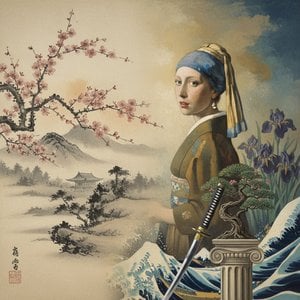
The painting depicts a woman's head in profile, bathed in soft light that illuminates her face with an understated dignity. Gauld eschews dramatic poses or elaborate ornamentation, prioritizing instead a serene stillness that invites contemplation. The subject’s gaze directs outwards, suggesting introspection and hinting at unspoken emotions—a characteristic feature of Glasgow Style’s preoccupation with psychological depth. Careful attention to detail—the subtle shading around the eyes and mouth, the delicate rendering of hair strands—underscores Gauld's meticulous approach to capturing human form.

Style and Technique: Embracing Japanese Influence

Gauld’s artistic journey began in lithography but swiftly pivoted towards a fascination with Japanese prints, specifically *ukiyo-e*, which profoundly impacted his visual vocabulary. This influence is palpable in “Portrait Head,” where Gauld employs flattened planes of color—a technique borrowed from Japanese woodblock printing—to create an illusionistic depth that transcends mere representation. The muted palette—dominated by earthy tones—further reinforces the painting’s contemplative mood and aligns seamlessly with the aesthetic principles championed by Glasgow Style artists.

Historical Context: Challenging Artistic Norms

Glasgow Style emerged as a defiant counterpoint to the prevailing artistic trends of Paris and London, where Impressionism reigned supreme. Artists like Gauld sought inspiration from diverse sources—Japanese art, Celtic mythology, and Pre-Raphaelite ideals—rejecting the rigid formalism of academic painting in favor of expressive color and nuanced observation. “Portrait Head” stands as a testament to this spirit of innovation, demonstrating Gauld’s commitment to forging new artistic paths while simultaneously honoring traditions of craftsmanship and visual storytelling.

Symbolism and Emotional Impact

The woman's gaze—looking towards the horizon—symbolizes ambition, aspiration, and perhaps even melancholy. It speaks to themes of solitude and contemplation, mirroring the broader emotional landscape explored by Glasgow Style artists. Gauld’s masterful use of light contributes significantly to the painting’s emotive power, creating an atmosphere of quiet beauty that lingers in the viewer's mind long after encountering it. The portrait transcends mere likeness; it conveys a profound sense of human experience—a hallmark of Gauld’s artistic legacy and a cornerstone of Glasgow Style’s enduring appeal.

Conclusion: A Legacy of Quiet Elegance

“Portrait Head” remains an exceptional example of David Gauld's contribution to Scottish art history, encapsulating the essence of Glasgow Style’s distinctive aesthetic. Its understated elegance, informed by Japanese influences and driven by a desire for psychological realism, continues to inspire admiration and serves as a poignant reminder of the transformative potential inherent in artistic experimentation. It exemplifies Gauld’s unwavering dedication to capturing beauty within simplicity—a principle that cemented his place among Scotland's most celebrated painters and stained glass artisans.

Lignende kunstværker


Kunstnerens biografi

David Gauld: Pioneer of Glasgow Style and Stained Glass Innovation

David Gauld (1865-1936) stands as a significant figure in Scottish art history, particularly recognized for his contributions to the Glasgow Boys movement and his distinctive approach to stained glass artistry. Born in Glasgow, he embarked on an artistic journey marked by meticulous craftsmanship and a profound engagement with diverse aesthetic traditions—Japanese prints and Pre-Raphaelite ideals—which profoundly shaped his oeuvre. Gauld’s formative years were spent honing his skills as a lithographer before enrolling at Glasgow School of Art in 1882, where he absorbed the burgeoning artistic currents of the era. His debut into public consciousness arrived in the late 1880s when he captivated audiences with a series of Japanese-influenced pen and ink drawings commissioned for *The Glasgow Weekly Citizen*, demonstrating an early fascination with Eastern visual culture. This collaboration cemented his association with William Stewart Macgeorge and Harrington Mann, establishing studios that fostered collaborative experimentation and artistic dialogue. During the period between 1891 and 1894, Gauld’s studio was situated in Kirkcudbright, where he undertook a pivotal project: designing stained glass windows for Guthrie and Wells. This undertaking showcased his mastery of color and texture, aligning with the stylistic ambitions of Art Nouveau—a movement characterized by organic forms and flowing lines—and foreshadowing its impact on subsequent artistic endeavors. The dissolution of his friendship with Mann in 1895 marked a turning point, prompting Gauld to relocate to new premises at 138 West George Street in Glasgow and continuing to reside in Kirkcudbright and North Berwick. Returning to Glasgow School of Art in 1889, Gauld pursued further artistic refinement alongside fellow artists from the Glasgow School, including William Shirreffs, who sculpted his portrait in 1896. He also spent time at Grez-sur-Loing, France—a renowned artist’s colony—immersing himself in the vibrant atmosphere of Impressionism and fostering connections with influential contemporaries. Gauld was elected an associate member of the Royal Scottish Academy in 1918 and ascended to full membership in 1924, solidifying his position within Scotland's artistic elite. Gauld’s artistic output spanned a diverse range of subjects—cattle, mills, and portraits—reflecting both his observational acuity and his willingness to explore stylistic experimentation. His works are prominently displayed in the Hunterian Art Gallery in Glasgow, offering visitors an opportunity to appreciate the enduring legacy of his artistic vision. Notably, pieces like *St Agnes* and *Music* exemplify his pioneering spirit, anticipating the aesthetic sensibilities of Art Nouveau and cementing his place as a cornerstone of Scottish art history.
David Gauld

David Gauld

1865 - 1936 , United Kingdom

Kort om kunstneren

  • Artistic Movement Or Style: Glasgow Boys; Art Nouveau; Pre-Raphaelites; Japanese influence
  • Artists Or Movements Influenced By This Artist: ['Japanese art']
  • Artists Who Influenced This Artist: ['William Stewart Macgeorge']
  • Date Of Birth: Glasgow, United Kingdom (1865)
  • Date Of Death: 1936
  • Full Name: David Gauld
  • Nationality: Scottish
  • Notable Artworks:
    • St Agnes
    • Music
  • Place Of Birth: Glasgow
Udforsk kunstværker organiseret efter temaer, stilarter og karakteristika.