The Entombment: A Masterpiece of Baroque Drama
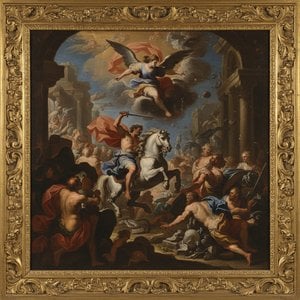
Caravaggio's "Entombment," painted in 1603-1604, stands as a pivotal work within the Baroque period and a testament to the artist’s revolutionary approach to religious painting. Commissioned for the chapel of Pietro Conti in Santa Prassede, Rome, this large canvas (300 x 203 cm) depicts the moment following Christ's crucifixion when his body is being lowered into the tomb. The scene is rendered with a raw realism and emotional intensity that was groundbreaking for its time, moving away from idealized depictions towards a more visceral portrayal of human grief and suffering.
Composition and Technique: Chiaroscuro at Its Finest
The painting's composition is striking in its dramatic use of chiaroscuro – the stark contrast between light and shadow. Caravaggio masterfully employs this technique to draw the viewer’s eye directly to the central figures, highlighting their expressions of sorrow and anguish. The dark background serves to isolate the mourners, intensifying the emotional impact of the scene. Christ's body is positioned diagonally across the canvas, creating a sense of movement and instability that reflects the profound loss being depicted. The artist worked rapidly, often directly onto the canvas without preliminary sketches, resulting in a spontaneity and immediacy evident in the brushwork.
Historical Context and Symbolism
Created during the Counter-Reformation, "Entombment" was intended to inspire piety and devotion among viewers. The Catholic Church sought art that could effectively communicate religious narratives and evoke emotional responses. Caravaggio’s realistic portrayal of biblical figures resonated with audiences who were increasingly seeking a more personal connection to their faith. Symbolically, the painting is rich in meaning. The stone slab partially visible at the top right represents the seal placed over Christ's tomb, signifying his death and resurrection. The figures surrounding Christ – Nicodemus, Joseph of Arimathea, Mary Magdalene, and the Virgin Mary – represent different aspects of faith and mourning. Their gestures—Nicodemus’s careful handling of Christ’s body, Mary Magdalene’s grief-stricken gaze, and the Virgin's outstretched arms—convey a profound sense of loss and reverence.
Emotional Impact: A Profound Expression of Grief
What truly distinguishes "Entombment" is its ability to evoke a powerful emotional response in the viewer. Caravaggio doesn’t shy away from depicting the raw, unfiltered grief of those present at Christ's entombment. The faces are contorted with sorrow, and their bodies seem burdened by the weight of their loss. This psychological realism was unprecedented in art at the time and profoundly influenced subsequent generations of artists. The painting transcends a mere depiction of a biblical event; it becomes a universal meditation on mortality, faith, and the enduring power of human emotion.
Legacy and Influence
"Entombment" is now housed within the Galleria Doria Pamphilj in Rome, Italy, continuing to captivate audiences with its dramatic intensity and artistic innovation. Caravaggio’s influence on Baroque art is undeniable, inspiring artists like Rubens and Rembrandt to explore similar themes of drama, realism, and emotional depth. The painting remains a powerful example of Caravaggio's genius and a cornerstone of Western art history.
Spørgsmål & svar
Hvad er den overordnede stemning i "Entombment" af Caravaggio?
Den overordnede stemning i "Entombment" af Caravaggio er Dramatisk. Stemningen beskriver værkets generelle atmosfære.
Hvilken størrelse og orientering anbefales til et print af "Entombment" af Caravaggio?
Størrelse Stor, Portrætformat orientering: dette er den anbefalede printopsætning til "Entombment" af Caravaggio.
Hvor meget lys ser farverne i "Entombment" ud til at reflektere?
Farverne i "Entombment" udviser en Mørkeste luminans.



 Se i rummet
 Bestil håndmalet reproduktion
 Send
Send Del
Del
 Detaljer
 Studieguide til kunstværker

 Download
 Lignende værker
 Røntgenundersøgelse
 Se diasshow
 Statistik


 Læs mere






































 Glasmulighed er kun tilgængelig i størrelser under 110 cm