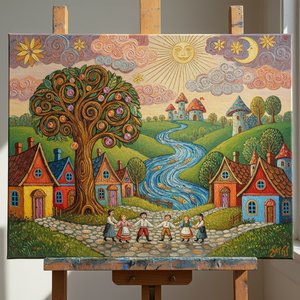
Untitled (2) af Blinky Palermo, håndmalet oliemalerireproduktion udført af en mesterkunstner
Se i rummet Se i AR Skift til printsalg Skift til digitalt billede Del som kort
Detaljer Guide Tilføj til favoritter Download Lignende værker Røntgenundersøgelse Diasshow Spørgsmål og svar Præsentation Statistikker

Untitled (2) Håndmalet oliemalerireproduktion

Blinky Palermo (1943-1977) was a German abstract painter known for his minimalist monochromatic canvases, 'fabric paintings,' and innovative use of materials like aluminum & steel. Inspired by Malevich, Newman, and Kelly, his work explores form, colo

Kunstværket vist på denne side er beskyttet af ophavsretsloven, hvilket betyder, at vi ikke lovligt kan skabe eller sælge en identisk reproduktion. Denne beskyttelse håndhæves i henhold til internationale aftaler som f.eks. den Bernerkonventionen og af nationale love, herunder de bestemmelser, der er fastlagt i Amerikansk ophavsretslov - Titel 17.

Som et respektfuldt og lovligt alternativ tilbyder vi skræddersyede, håndmalede kunstværker inspireret af originalen. Vores dygtige og professionelle kunstnere studerer omhyggeligt originalens stil, stemning og kunstneriske essens for at skabe et nyt, unikt værk, der fremkalder den samme følelse – samtidig med at det forbliver en original skabelse i egen ret.

Denne metode overholder fuldt ud ophavsretsreglerne, da den ikke indebærer kopiering eller duplikering af det beskyttede kunstværk. I stedet er der tale om en kreativ nytolkning – et nyt maleri, som er inspireret af det oprindelige, men ikke identisk med det.

Håndlavet oliereproduktion

Håndmalet olie på lærred i din valgte størrelse og ramme, udført efter bestilling af vores kunstnere. ( Skift til printsalg Skift til digitalt billede)


Standardstørrelse
speciallavet
CM
INCH

Vælg mellem vores forudindstillede størrelser, der matcher kunstværkets originale proportioner.

bredde
højde

Indtast den bredde og højde, du har brug for, så det passer til din ramme eller din væg. Da dette er håndmalet, kan kunstneren ved en anden form på størrelsen male lidt mere rundt om billedet eller skære lidt væk — det er op til dig. Vi sender dig et digitalt mockup til godkendelse, før maleriet påbegyndes. Billedet, der vises på denne side, viser ikke det endelige resultat — det er kun mockuppet, der gør.

Eksempler på hvad der kan ændres: Udskift ansigt med kundens eget foto; Tilføj kæledyr (f.eks. udskift kat med hund); Inkluder en skjult besked i baggrunden; Ændr baggrundslandskab eller elementer.
Efter bestilling vil WahooArt.com team sende en e-mail til kunden for at indhente instruktioner og fremsende et udkast til gennemgang

Verdensomspændende levering () på 3-4 uger i stedet for de standard 5 uger. (21 november). Ingen kompromiser med kvaliteten.

Gratis ekspresforsendelse til hele verden
Lærred af linned i høj kvalitet
Fuld transportforsikring
Garanti for refusion af told og importafgifter
Garanti for præcis farvegengivelse
100 dages returret ved fabrikationsfejl
100% fuld returret
Mængderabat ved flere køb

Samlet pris

Dkr 1816

Untitled (2)

Reproduktionsmetode

Størrelse på reproduktion

-

Samlet pris

Dkr 1816


Kunstnerbiografi

The Enigmatic Presence of Blinky Palermo

In the vibrant, often turbulent landscape of twentieth-century German abstraction, few names resonate with as much intrigue and stylistic purity as Blinky Palermo. Born Peter Schwarze in Leipzig in 1943, the artist’s very identity was a carefully constructed performance. Adopted as an infant alongside his twin brother, Michael, by the Heisterkamp family, he would later adopt a pseudonym that sounded more like a character from a noir film than a scholar of the fine arts. This moniker, taken from the American boxing promoter and mafioso Frank "Blinky" Palermo, signaled a departure from the traditional and an embrace of the provocative. During his formative years at the Kunstakademia Düsseldorf between 1962 and 1967, studying under luminaries such as Joseph Beuys and Bruno Goller, he began to strip away the unnecessary, seeking a visual language that relied on the raw power of color and spatial tension.

Palermo’s artistic evolution was marked by a relentless pursuit of the essential. Moving away from the heavy, gestural traditions of previous eras, he became a master of the minimalist gesture. His work often bypassed the conventional canvas entirely, opting instead for unconventional surfaces that challenged the viewer's perception of what constitutes a painting. He experimented with aluminum, steel, wood, paper, and even Formica, frequently utilizing tape to create precise, sharp lines that functioned as much as architectural elements as they did artistic marks. This fascination with the physical properties of his medium allowed him to explore the organized spatial relationship between form and color—a polarity that became the heartbeat of his entire oeuvre.

A Mastery of Form and Materiality

The true genius of Palermo lay in his ability to transform simple materials into profound aesthetic experiences. He is perhaps most celebrated for his "fabric paintings," a technique where lengths of colored material were meticulously cut, stitched, and stretched over frames. These works possessed a tactile, sculptural quality that bridged the gap between two-dimensional painting and three-dimensional object. His repertoire of shapes was equally daring; he moved beyond the rectangular confines of traditional art to embrace circles, triangles, cruciforms, and even totem-like vertical strips. One might look at his Untitled (Totem) from 1964 and see not just a piece of wood, but a primitive ladder of color, punctuated by white and blue elements that command the surrounding space.

His influences were as profound as they were diverse, drawing strength from the radical simplicity of Kazimir Malevich and the expansive color fields of Barnett Newman and Ellsworth Kelly. From these masters, he inherited a respect for the monochrome and a belief that a single, well-placed hue could evoke an entire universe of emotion. His work was never merely about decoration; it was an investigation into how light, color, and edge interact within a defined space. Whether working in the spare, monochromatic depths of his canvases or the bold, geometric precision of his tape-based works, Palermo maintained a sense of rhythmic balance that felt both modern and timeless.

A Legacy Cut Short

Despite a career that was tragically brief, Blinky Palermo left an indelible mark on the trajectory of contemporary abstraction. His life was marked by a restless movement—from the studios of Düsseldorf to the bustling energy of New York, and eventually to the quietude of Mönchengladbach, where he shared creative spaces with artists like Imi Knoebel and Ulrich Rückriem. However, this period of intense productivity was shadowed by personal struggles. His death in 1977, at the young age of 33 during a trip to the Maldives, remains a poignant moment in art history, often whispered about in the context of his turbulent lifestyle.

Today, Palermo is remembered not just as a figure of mystery, but as a pioneer of Minimalism and Conceptual art. His ability to find beauty in the most basic elements—a strip of cloth, a piece of tape, a single color—continues to inspire those who seek truth in simplicity. He remains a vital part of the Düsseldorf School's legacy, a painter who dared to redefine the boundaries of the frame and invited us to see the profound architecture hidden within the simplest of forms.

Blinky Palermo

Blinky Palermo

1943 - 1977 , Germany

Kort om kunstneren

  • Full Name: Peter Schwarze
  • Nationality: German
  • Date Of Birth: 1943
  • Date Of Death: 1977
  • Place Of Birth: Leipzig, Germany
  • Notable Artworks:
    • Untitled (Totem)
    • Flipper
    • Happier than the Morning Sun
  • Artistic Movement Or Style: Abstract, Minimalism, Color Field
  • Artists Who Influenced This Artist:
    • Kazimir Malevich
    • Barnett Newman
    • Ellsworth Kelly
    • Joseph Beuys