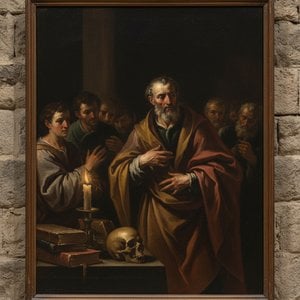
Saint Michael Triumphs over the Devil af Bartolomé Bermejo, håndmalet oliemalerireproduktion udført af en mesterkunstner
Se i rummet Se i AR Skift til printsalg Skift til digitalt billede Del som kort
Detaljer Guide Tilføj til favoritter Download Lignende værker Røntgenundersøgelse Diasshow Spørgsmål og svar Statistikker

Saint Michael Triumphs over the Devil Håndmalet oliemalerireproduktion

A dramatic display of Spanish Renaissance mastery, Bartolomé Bermejo's Saint Michael Triumphs over the Devil uses meticulous detail and light to capture a celestial battle, available as a stunning oil reproduction.

Bartolomé Bermejo (c. 1440-1501) was a pioneering Spanish Renaissance painter known for adopting Flemish techniques & detailed altarpieces. Explore his masterful portraits, religious scenes, and unique style that bridged Gothic & Early Renaissance ar

Håndlavet oliereproduktion

Håndmalet olie på lærred i din valgte størrelse og ramme, udført efter bestilling af vores kunstnere. ( Skift til printsalg Skift til digitalt billede)

Corner sample of the P118B picture frame: støbt polystyren, 5 cm wide and 3 cm thick
P118B Dkr10
Corner sample of the P118H picture frame: støbt polystyren, 5 cm wide and 3 cm thick
P118H Dkr10
Corner sample of the P118W picture frame: støbt polystyren, 5 cm wide and 3 cm thick
P118W Dkr10
Corner sample of the P438Z picture frame: støbt polystyren, 5.5 cm wide and 3.5 cm thick
P438Z Dkr10
Corner sample of the P508JH picture frame: støbt polystyren, 7 cm wide and 3.5 cm thick
P508JH Dkr12
Corner sample of the P508YH picture frame: støbt polystyren, 7 cm wide and 3.5 cm thick
P508YH Dkr12
Corner sample of the P805H picture frame: støbt polystyren, 5 cm wide and 3.5 cm thick
P805H Dkr10
Corner sample of the P805Z picture frame: støbt polystyren, 5 cm wide and 3.5 cm thick
P805Z Dkr10
Corner sample of the P919BZ picture frame: støbt polystyren, 7 cm wide and 3.5 cm thick
P919BZ Dkr10
Corner sample of the P919G picture frame: støbt polystyren, 7 cm wide and 3.5 cm thick
P919G Dkr10
Corner sample of the P919XJ picture frame: støbt polystyren, 7 cm wide and 3.5 cm thick
P919XJ Dkr10
Corner sample of the P959ZH picture frame: støbt polystyren, 5 cm wide and 3 cm thick
P959ZH Dkr10
Corner sample of the P968JZ picture frame: støbt polystyren, 6 cm wide and 4 cm thick
P968JZ Dkr12
Corner sample of the W106C picture frame: massivt træ, 5 cm wide and 3 cm thick
W106C Dkr8
Corner sample of the W218G picture frame: massivt træ, 5 cm wide and 3 cm thick
W218G Dkr10
Corner sample of the W218JH picture frame: massivt træ, 5 cm wide and 3 cm thick
W218JH Dkr8
Corner sample of the W218Y picture frame: massivt træ, 5 cm wide and 3 cm thick
W218Y Dkr10
Corner sample of the W307PJ picture frame: massivt træ, 6 cm wide and 3 cm thick
W307PJ Dkr10
Corner sample of the W316G picture frame: massivt træ, 6 cm wide and 3 cm thick
W316G Dkr10
Corner sample of the W316PJ picture frame: massivt træ, 6 cm wide and 3 cm thick
W316PJ Dkr8
Corner sample of the W316Y picture frame: massivt træ, 6 cm wide and 3 cm thick
W316Y Dkr10
Corner sample of the W398PJ picture frame: massivt træ, 5 cm wide and 3 cm thick
W398PJ Dkr8
Corner sample of the W4111J picture frame: massivt træ, 6.5 cm wide and 3.5 cm thick
W4111J Dkr10
Corner sample of the W500HY picture frame: massivt træ, 7 cm wide and 5 cm thick
W500HY Dkr15
Corner sample of the W500JH picture frame: massivt træ, 7 cm wide and 5 cm thick
W500JH Dkr15
Corner sample of the W692G picture frame: massivt træ, 8 cm wide and 4 cm thick
W692G Dkr12
Corner sample of the W849H picture frame: massivt træ, 5 cm wide and 3 cm thick
W849H Dkr8
Corner sample of the W940BG picture frame: massivt træ, 7.5 cm wide and 4.5 cm thick
W940BG Dkr15
Corner sample of the W953PJ picture frame: massivt træ, 6 cm wide and 3.5 cm thick
W953PJ Dkr8

Standardstørrelse
speciallavet
CM
INCH

Vælg mellem vores forudindstillede størrelser, der matcher kunstværkets originale proportioner.

bredde
højde

Indtast den bredde og højde, du har brug for, så det passer til din ramme eller din væg. Da dette er håndmalet, kan kunstneren ved en anden form på størrelsen male lidt mere rundt om billedet eller skære lidt væk — det er op til dig. Vi sender dig et digitalt mockup til godkendelse, før maleriet påbegyndes. Billedet, der vises på denne side, viser ikke det endelige resultat — det er kun mockuppet, der gør.

Eksempler på hvad der kan ændres: Udskift ansigt med kundens eget foto; Tilføj kæledyr (f.eks. udskift kat med hund); Inkluder en skjult besked i baggrunden; Ændr baggrundslandskab eller elementer.
Efter bestilling vil WahooArt.com team sende en e-mail til kunden for at indhente instruktioner og fremsende et udkast til gennemgang

Verdensomspændende levering () på 3-4 uger i stedet for de standard 5 uger. (4 november). Ingen kompromiser med kvaliteten.

Gratis ekspresforsendelse til hele verden
Lærred af linned i høj kvalitet
Fuld transportforsikring
Garanti for refusion af told og importafgifter
Garanti for præcis farvegengivelse
100 dages returret ved fabrikationsfejl
100% fuld returret
Mængderabat ved flere køb

Samlet pris

Dkr 1815

Saint Michael Triumphs over the Devil

Reproduktionsmetode

Størrelse på reproduktion

-

Samlet pris

Dkr 1815

Hurtige fakta

  • Subject or theme: Battle between good and evil forces
  • Notable elements or techniques: Detailed realism, dramatic light and color
  • Movement: Spanish Renaissance
  • Title: Saint Michael Triumphs over the Devil

A Celestial Conflict Captured in Gold and Shadow

In the grand theater of the Spanish Renaissance, few works command the viewer's attention with such visceral intensity as Bartolomé Bermejo’s Saint Michael Triumphs over the Devil. This masterpiece serves as a breathtaking window into a period where the spiritual and the physical collided through the tip of a blade. The composition is anchored by the radiant, armored figure of Saint Michael, whose presence radiates an almost tactile divinity. Standing poised above the fallen adversary, the Archangel embodies the ultimate victory of light over darkness. Every inch of the canvas vibrates with the tension of this cosmic confrontation, as Bermejo utilizes a dramatic interplay of light and shadow to pull the observer into the heart of a sacred battle.

The artistry on display is a testament to Bermejo’s unique position as a bridge between the meticulous traditions of Flemish realism and the burgeoning expressive power of the Iberian Renaissance. His technique is nothing short of extraordinary, characterized by an obsessive attention to detail that breathes life into cold steel and heavy velvet alike. One can almost feel the weight of the Saint's shield and the sharp, lethal edge of his sword. The artist’s mastery of light creates a sense of three-dimensional depth, making the figures appear to emerge from the panel into our own space. This level of realism was revolutionary for the 15th century, offering a sensory experience that transcends mere religious iconography to become a profound study of texture and form.

Symbolism and the Triumph of the Soul

Beyond its technical brilliance, the painting functions as a complex tapestry of theological symbolism. The central motif—the subjugation of the devil beneath the feet of Saint Michael—is a powerful allegory for the triumph of virtue over vice, and the soul's struggle against temptation. The armor worn by the Archangel is not merely protective gear; it represents the spiritual fortitude required to navigate the perils of the human condition. The vibrant red of his cape serves as a striking visual metaphor for divine passion and the blood of sacrifice, standing in stark contrast to the darker, more chaotic elements of the composition that represent the encroaching forces of evil.

For the discerning collector or interior designer, this work offers much more than historical significance; it provides an emotional anchor for any space. The painting’s ability to evoke feelings of awe, strength, and moral clarity makes it a profound choice for those looking to curate an environment of contemplation and power. Whether displayed in a private gallery or as a centerpiece in a sophisticated study, a high-quality oil reproduction of this piece brings with it the weight of history and the enduring beauty of the Renaissance spirit. It is an invitation to witness a moment of eternal victory, captured forever in the masterful strokes of a Spanish master.

Spørgsmål og svar

Hvilken lysstyrke har "Saint Michael Triumphs over the Devil" af Bartolomé Bermejo?

"Saint Michael Triumphs over the Devil" af Bartolomé Bermejo har en luminans på Soft Shadow. Luminans beskriver, hvor meget lys farverne ser ud til at reflektere.

Hvordan passer "Saint Michael Triumphs over the Devil" ind i Bartolomé Bermejos temaer og stil?

"Saint Michael Triumphs over the Devil" er et værk fra Bartolomé Bermejos Spanish Renaissance-periode, hvis gennemgående temaer inkluderer flemish painting techniques, spanish renaissance style, good versus evil struggle, religious triumph theme, masterful realism, pioneering spanish altarpieces.

Hvad forestiller "Saint Michael Triumphs over the Devil" af Bartolomé Bermejo, og hvilken stemning formidler det?

"Saint Michael Triumphs over the Devil" af Bartolomé Bermejo skildrer man in armor, sword, shield, red cape, kneeling person, armor, figures i en Dramatic stemning. Motiv og atmosfære beskriver tilsammen værket.


Kunstnerbiografi

A Flemish Echo in Spanish Renaissance

Bartolomé Bermejo stands as a pivotal figure in the transition between Gothic and Early Renaissance art, particularly within the Iberian Peninsula. His distinctive style—characterized by meticulous detail, dramatic lighting, and masterful realism—earned him recognition as one of the foremost painters of his era and cemented his legacy as a pioneer who successfully assimilated Flemish painting techniques into Spanish artistic traditions. While biographical details remain somewhat elusive due to sparse documentation, scholars agree that he flourished primarily in Valencia, Daroca, Zaragoza, and Barcelona during the latter half of the fifteenth century.

The early life and training of this master remain shrouded in a certain historical mystery. Precise information regarding Bermejo’s birthplace—Córdoba—is debated, with recent research questioning its certainty. However, his artistic activity centered around four key Spanish cities: Valencia (1468), Daroca (1474), Zaragoza (1477–84) and Barcelona (1486–1501). The exact origins of his training remain unknown, yet the exceptional command of oil glazing—a technique perfected by Flemish masters—strongly suggests direct exposure to the artistic innovations originating in Bruges and Ghent. This profound connection to the North allowed him to bring a level of technical sophistication to Spain that was previously unseen.

Mastery of Light and Texture

Bermejo’s oeuvre comprises numerous altarpieces, demonstrating his mastery of large-scale retables with multiple panels. His technique embodies the spirit of Flemish painting, prioritizing meticulous observation and rendering textures with remarkable accuracy. He skillfully employed glazing techniques—applying thin, transparent layers of oil paint—to achieve a luminous depth that seems to glow from within. This method allowed him to capture the sheen of silk, the cold hardness of jewels, and the soft warmth of human skin with an almost tactile quality.

Among his most celebrated achievements are works that showcase both his religious devotion and his technical ambition:

  • St Dominic Enthroned in Glory: Completed in 1474, this monumental altarpiece exemplifies the fusion of Flemish painting techniques with Spanish artistic traditions. It features a regal depiction of St. Dominic surrounded by ornate furnishings and vibrant colors, demonstrating Bermejo's unparalleled skill in capturing texture and luminosity.
  • Death of the Virgin: Executed around 1460, this work exemplifies the Hispano-Flemish style. Drawing inspiration from masters like Hugo van der Goes, it features meticulous realism and symbolic elements—a poignant depiction of Mary's passing within a richly ornamented chapel setting.
  • Pietà of Canon Luis Desplá: This poignant Pietà embodies Flemish realism blended seamlessly into Spanish Renaissance aesthetics. It presents a masterful depiction of Mary cradling Jesus amidst a dramatic mountainous landscape, inviting viewers into a moment of profound sorrow and timeless beauty.

Legacy and Historical Significance

The historical significance of Bartolomé Bermejo lies in his role as a bridge between eras and cultures. Through his monumental triptych of the Virgin of Montserrat in València and his unfinished high altar retables in Santo Domingo de Silos and Santa Anna in Barcelona, he demonstrated an unparalleled skill and ambition that pushed the boundaries of Spanish art. He did not merely copy Northern styles; he synthesized them with a local sensibility to create something entirely unique.

By integrating the intense realism and symbolic depth of the Flemish tradition into the religious landscape of the Iberian Peninsula, Bermejo helped pave the way for the subsequent flowering of the Spanish Renaissance. His ability to manipulate light and shadow to evoke emotion remains a testament to his genius, ensuring that his name continues to resonate with art historians and admirers of fine art alike.

Bartolomé Bermejo

Bartolomé Bermejo

1440 - 1500 , Spain

Kort om kunstneren

  • Artistic Movement Or Style: Hispano-Flemish, Early Renaissance
  • Artists Or Movements Influenced By This Artist: ['Spanish Renaissance']
  • Artists Who Influenced This Artist: ['Flemish masters']
  • Full Name: Bartolomé de Cárdenas
  • Nationality: Spanish
  • Notable Artworks:
    • St Dominic Enthroned in Glory
    • Pietà of Canon Luis Desplá
    • Death of the Virgin
    • Resurrection of Christ
    • Christ Leading the Patriarchs to Paradise
  • Place Of Birth: Cordoba, Spain
  • Date Of Birth: 1440
  • Date Of Death: 1500