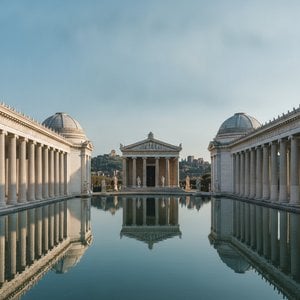
Philosophy by Antonio Zucchi
Antonio Zucchi’s “Philosophy,” painted in 1769, stands as a testament to the Neoclassical aesthetic's preoccupation with reason and contemplation—themes central to Enlightenment thought. Executed on canvas measuring 50 x 50 cm, this artwork embodies the meticulous craftsmanship characteristic of Zucchi’s oeuvre, reflecting his mastery of oil paint and masterful rendering of light and texture.
The painting depicts a seated figure – likely a woman – bathed in diffused natural illumination. Her drapery flows gracefully around her form, mirroring the elegance favored by artists of the era and emphasizing the importance of idealized beauty within artistic representation. The artist’s deliberate use of muted earth tones—ochre, umber, and ivory—creates an atmosphere of serenity and timelessness, transporting viewers back to a pivotal moment in European intellectual history.
Zucchi's technique is notable for its subtle gradations of color and shading, achieved through painstaking layering of paint. He skillfully captures the contours of the figure’s body with remarkable accuracy, conveying both physical presence and psychological depth. The gaze directed off to the side suggests a profound engagement with inner thought—a reflection of the philosophical inquiries that defined the period.
Beyond its formal beauty, “Philosophy” resonates with symbolic significance. The pose itself – seated in repose – represents intellectual stillness amidst turbulent times, mirroring the pursuit of wisdom and understanding as championed by philosophers like Voltaire and Rousseau. The inclusion of a book symbolizes knowledge and erudition—essential components of Enlightenment ideals.
This artwork’s enduring appeal lies in its ability to evoke feelings of tranquility and contemplation. It serves as an exquisite reminder of the power of art to communicate complex ideas and inspire viewers to consider fundamental questions about human existence. “Philosophy” remains a captivating exemplar of Neoclassical artistry, demonstrating Zucchi's commitment to capturing both visual splendor and intellectual nuance.
- Artist: Antonio Zucchi
- Year: 1769
- Size: 50 x 50 cm
- Style: Neoclassical
- Medium: Oil on Canvas
Further exploration into Antonio Zucchi’s artistic journey reveals collaborations with luminaries like Robert Adam, shaping the decorative landscape of English estates. His dedication to capturing psychological realism and mastering light—a hallmark of his style—solidifies his position as a cornerstone of Enlightenment art.



 Se i fuld skala
 Skift til print
 Del
Del Del
Del
 Detaljer

 Download
 Lignende værker
 Røntgenundersøgelse
 Diasshow
 Statistik


 Se mere






































 Glasmulighed er kun tilgængelig i størrelser under 110 cm