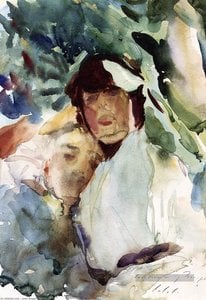
The Peacock Feather (1875) af Antonio Mancini, håndmalet oliemalerireproduktion udført af en mesterkunstner
Se i rummet Se i AR Skift til printsalg Skift til digitalt billede Del som kort
Detaljer Guide Tilføj til favoritter Download Lignende værker Røntgenundersøgelse Diasshow Spørgsmål og svar Presentation Statistikker

The Peacock Feather Håndmalet oliemalerireproduktion

Dimensioner
81.0 x 60.0 cm

Discover 'The Peacock Feather' by Antonio Mancini – an evocative 1875 Impressionist portrait of a musician. Explore its loose brushwork & atmospheric style.

Antonio Mancini: Italiensk Verismo-maler, der indfanger rørende scener fra Napolis gadeliv, cirkusartister og børn. Udforsk hans livlige impasto-stil!

Håndlavet oliereproduktion

Håndmalet olie på lærred i din valgte størrelse og ramme, udført efter bestilling af vores kunstnere. ( Skift til printsalg Skift til digitalt billede)

Corner sample of the P118B picture frame: støbt polystyren, 5 cm wide and 3 cm thick
P118B Dkr10
Corner sample of the P118H picture frame: støbt polystyren, 5 cm wide and 3 cm thick
P118H Dkr10
Corner sample of the P118W picture frame: støbt polystyren, 5 cm wide and 3 cm thick
P118W Dkr10
Corner sample of the P438Z picture frame: støbt polystyren, 5.5 cm wide and 3.5 cm thick
P438Z Dkr10
Corner sample of the P508JH picture frame: støbt polystyren, 7 cm wide and 3.5 cm thick
P508JH Dkr12
Corner sample of the P508YH picture frame: støbt polystyren, 7 cm wide and 3.5 cm thick
P508YH Dkr12
Corner sample of the P805H picture frame: støbt polystyren, 5 cm wide and 3.5 cm thick
P805H Dkr10
Corner sample of the P805Z picture frame: støbt polystyren, 5 cm wide and 3.5 cm thick
P805Z Dkr10
Corner sample of the P919BZ picture frame: støbt polystyren, 7 cm wide and 3.5 cm thick
P919BZ Dkr10
Corner sample of the P919G picture frame: støbt polystyren, 7 cm wide and 3.5 cm thick
P919G Dkr10
Corner sample of the P919XJ picture frame: støbt polystyren, 7 cm wide and 3.5 cm thick
P919XJ Dkr10
Corner sample of the P959ZH picture frame: støbt polystyren, 5 cm wide and 3 cm thick
P959ZH Dkr10
Corner sample of the P968JZ picture frame: støbt polystyren, 6 cm wide and 4 cm thick
P968JZ Dkr12
Corner sample of the W106C picture frame: massivt træ, 5 cm wide and 3 cm thick
W106C Dkr8
Corner sample of the W218G picture frame: massivt træ, 5 cm wide and 3 cm thick
W218G Dkr10
Corner sample of the W218JH picture frame: massivt træ, 5 cm wide and 3 cm thick
W218JH Dkr8
Corner sample of the W218Y picture frame: massivt træ, 5 cm wide and 3 cm thick
W218Y Dkr10
Corner sample of the W307PJ picture frame: massivt træ, 6 cm wide and 3 cm thick
W307PJ Dkr10
Corner sample of the W316G picture frame: massivt træ, 6 cm wide and 3 cm thick
W316G Dkr10
Corner sample of the W316PJ picture frame: massivt træ, 6 cm wide and 3 cm thick
W316PJ Dkr8
Corner sample of the W316Y picture frame: massivt træ, 6 cm wide and 3 cm thick
W316Y Dkr10
Corner sample of the W398PJ picture frame: massivt træ, 5 cm wide and 3 cm thick
W398PJ Dkr8
Corner sample of the W4111J picture frame: massivt træ, 6.5 cm wide and 3.5 cm thick
W4111J Dkr10
Corner sample of the W500HY picture frame: massivt træ, 7 cm wide and 5 cm thick
W500HY Dkr15
Corner sample of the W500JH picture frame: massivt træ, 7 cm wide and 5 cm thick
W500JH Dkr15
Corner sample of the W692G picture frame: massivt træ, 8 cm wide and 4 cm thick
W692G Dkr12
Corner sample of the W849H picture frame: massivt træ, 5 cm wide and 3 cm thick
W849H Dkr8
Corner sample of the W940BG picture frame: massivt træ, 7.5 cm wide and 4.5 cm thick
W940BG Dkr15
Corner sample of the W953PJ picture frame: massivt træ, 6 cm wide and 3.5 cm thick
W953PJ Dkr8

Standardstørrelse
speciallavet
CM
INCH

Vælg mellem vores forudindstillede størrelser, der matcher kunstværkets originale proportioner.

bredde
højde

Indtast den bredde og højde, du har brug for, så det passer til din ramme eller din væg. Da dette er håndmalet, kan kunstneren ved en anden form på størrelsen male lidt mere rundt om billedet eller skære lidt væk — det er op til dig. Vi sender dig et digitalt mockup til godkendelse, før maleriet påbegyndes. Billedet, der vises på denne side, viser ikke det endelige resultat — det er kun mockuppet, der gør.

Eksempler på hvad der kan ændres: Udskift ansigt med kundens eget foto; Tilføj kæledyr (f.eks. udskift kat med hund); Inkluder en skjult besked i baggrunden; Ændr baggrundslandskab eller elementer.
Efter bestilling vil WahooArt.com team sende en e-mail til kunden for at indhente instruktioner og fremsende et udkast til gennemgang

Verdensomspændende levering () på 3-4 uger i stedet for de standard 5 uger. (5 november). Ingen kompromiser med kvaliteten.

Gratis ekspresforsendelse til hele verden
Lærred af linned i høj kvalitet
Fuld transportforsikring
Garanti for refusion af told og importafgifter
Garanti for præcis farvegengivelse
100 dages returret ved fabrikationsfejl
100% fuld returret
Mængderabat ved flere køb

Samlet pris

Dkr 1818

The Peacock Feather

Reproduktionsmetode

Størrelse på reproduktion

-

Samlet pris

Dkr 1818

Hurtige fakta

  • Subject or theme: Solitary musician playing violin
  • Artist: Antonio Mancini
  • Artistic style: Impressionistic
  • Dimensions: 81 x 60 cm
  • Medium: Oil on canvas

Kunstquiz

Der er kun ét korrekt svar på hvert spørgsmål.

Spørgsmål 1:
What artistic style is most evident in the description of 'The Peacock Feather'?
Spørgsmål 2:
Which emotion or theme is suggested by the subject matter of a solitary musician lost in his art?
Spørgsmål 3:
The description mentions that the technique used involves layering thin washes of paint to build up color and texture. This technique is characteristic of:
Spørgsmål 4:
Antonio Mancini, the artist associated with this piece, was renowned for his focus on depicting:
Spørgsmål 5:
What element contributes to the dynamic feel of the composition, according to the description?

A Moment Suspended in Song

To gaze upon this depiction of a musician lost in his art is to witness time itself slowing down. The scene captures a young man utterly absorbed by the resonance of his violin, an act so deeply personal it seems to exist outside the clamor of the surrounding world. It is not merely a portrait; it is an immersion into the very spirit of creation. The artist has masterfully rendered this fleeting moment, allowing the viewer to feel the vibration of the bow against the strings and the profound solitude that accompanies true artistic passion. This piece speaks directly to the universal human experience of finding solace and expression through melody.

Impressionistic Brushwork and Atmosphere

The technical brilliance of this work lies in its commitment to capturing an atmosphere rather than merely recording a likeness. The style leans heavily into late 19th-century Impressionism, evident in the visible, expressive brushstrokes that give life to every patch of color. Observe how the background dissolves into a dense, swirling tapestry of foliage—a vibrant, almost palpable curtain of greens and shadows. This is not a sharply defined backdrop; rather, it is an emotional echo chamber created through layered washes of paint. The artist prioritizes the interplay of light and shadow, using soft, diffused illumination to gently sculpt the contours of the musician’s face and the rich texture of his attire. It is this masterful handling of *sfumato* effect within a looser framework that gives the painting its dynamic, breathing quality.

The Echoes of Italian Mastery

Created in 1875, this work situates itself within a vibrant period of artistic transition, echoing the observational spirit championed by masters like Monet and Renoir. While the subject matter evokes the romanticism often associated with Parisian Impressionism, the underlying dedication to capturing human drama connects it to the profound realism found in Italian art traditions. The artist’s ability to blend vigorous technique with an almost lyrical sensitivity suggests a deep understanding of both formal structure and emotional spontaneity. It is a testament to the power of observation filtered through a highly skilled hand.

Symbolism of Introspection and Nature

The symbolism woven into this canvas is rich and multilayered. The solitary musician represents introspection—the necessary withdrawal required for profound self-discovery or artistic breakthrough. His focus suggests a dialogue between man and art, a communion that requires shutting out the external world. Juxtaposed against this intense inner life is the enveloping natural setting. The foliage acts as both a beautiful enclosure and a visual metaphor for the subconscious mind—lush, complex, and sometimes overwhelming. It invites contemplation on themes of passion, melancholy, and the enduring power of art to connect us to something deeper than ourselves.

Bringing the Masterpiece Home

For collectors or designers seeking an artwork that transcends mere decoration, this piece offers narrative depth. Its vibrant color palette and palpable sense of movement make it a captivating focal point for any room. Owning a reproduction allows one to bring home not just paint on canvas, but a carefully preserved moment of pure artistic feeling—a whisper of late 19th-century passion rendered with modern appreciation for its evocative power.

Spørgsmål og svar

Hvilken farvepalette og hvilken følelse forener "The Peacock Feather"?

I "The Peacock Feather" ledsages en Passionate følelse af Earthy farver.

Hvornår er "The Peacock Feather" af Antonio Mancini skabt?

"The Peacock Feather" stammer fra 1875. Datoen placerer værket i Antonio Mancini's karriere og dets tidsalder.

Hvilken følelsesmæssig tone ledsager Impressionism-stilen i "The Peacock Feather"?

Den Passionate stemning i "The Peacock Feather" ledsager dens Impressionism stil.


Kunstnerbiografi

Antonio Mancini: Et liv dedikeret til Verismo og observation

Antonio Mancini (1852-1930) var en berømt italiensk maler, anerkendt for sine rørende skildringer af hverdagslivet, med et særligt fokus på de marginaliserede samfund i Napoli. Mancini blev født i Rom, Italien, og udviste et bemærkelsesværende kunstnerisk talent fra en tidlig alder. Allerede som tolvårig blev han optaget på Accademia di Belle Arti i Napoli, hvor han studerede under de indflydelsesrige skikkelser Domenico Morelli og Filippo Palizzi. Disse formative oplevelser prægede hans kunstneriske bane dybt og lagde grundstenen til hans karakteristiske stil, der var solidt forankret i Verismo.

Tidlig udvikling og indflydelser: Fra Napoli til Paris

Mancinis tidlige karriere var præget af en hurtig udvikling under Morellis vejledning, som lagde vægt på dramatisk chiaroscuro og energiske penselstrøg. Palizzi forfinede yderligere Mancinis færdigheder ved at opmuntre til et fokus på realistisk observation. Allerede i 1872 havde han udstillet sine værker på Parissalonen, hvilket demonstrerede et spirende talent, der blev anerkendt langt uden for Italiens grænser. Hans kunstneriske sansbarhed blev betydeligt påvirket af hans møder med impressionisterne Edgar Degas og Édouard Manet under hans ophold i Paris. Venskabet med John Singer Sargent, som berømt erklærede Mancini for "den største nulevende maler", cementerede yderligere hans ry i den europæiske kunstscene.

Verismo-stilen og de signaturprægede motiver

Mancini blev en ledende skikkelse i Verismo-bevægelsen, en italiensk reaktion på det 19 ​​århundredes realistiske æstetik. Denne kunstneriske filosofi prioriterede at skildre livet, som det var, uden idealisering eller romantik. Mancinis motiver blev ofte hentet fra gaderne i Napoli: fattige børn, unge cirkusartister og musikere. Hans mest berømte værker, såsom Il Saltimbanco (1877-78), indfanger en følelse af skrøbelighed og sårbarhed i hans portrætteringer af marginaliserede individer. Han benyttede en slående impasto-teknik på lærredet, hvilket skabte teksturerede overflader, der tilføjede dybde og realisme til hans malerier. Hans brug af pasteller var ligeledes mesterlig og udviste en dristig beherskelse af farve og form.

Udfordringer og de senere år: Modstandskraft og kunstnerisk sindsro

Mancinis liv tog en udfordrende drejning i 1881, da han blev ramt af en invaliderende psykisk sygdom. Han flyttede til Rom i 1883 og senere til Frascati, hvor han boede indtil 1918, ofte konfronteret med perioder med fattigdom og afhængig af støtte fra venner og kunstmæcener. På trods af disse svårheder fortsatte Mancini med at male. Efter Første Verdenskrig stabiliserede hans omstændigheder sig, hvilket førte til en periode med fornyet kunstnerisk sindsro, som afspejles i hans senere værker. Han døde i Rom i 1930 og blev begravet i Basilica Santi Bonifacio e Alessio på Aventinerhøjen.

Eftermæle og historisk betydning

Antonio Mancinis bidrag til italiensk kunst ligger i hans urokkelige engagement i Verismo og hans evne til at indfange essensen af hverdagslivet med en bemærkelsesværdig følsomhed og dygtighed. Hans malerier, herunder The Poor Schoolboy (udstillet på Salon i 1876 og nu indlemmet i Musée d'Orsay), tilbyder et kraftfuldt indblik i de sociale realiteter i det 19. århundredes Italien. Hans arbejde er repræsenteret i prestigefyldte samlinger såsom Galleria Nazionale d’Arte Moderna e Contemporanea i Rom og Museo Civico-Galleria d’Arte Moderna i Torino. Den første amerikanske udstilling dedikeret udelukkende til hans værk på Philadelphia Museum of Art (2007-2008) cementerede yderligere hans plads i kunsthistorien og introducerede hans rørende vision for et bredere publikum.

  • Vigtige værker: Il Saltimbanco, The Poor Schoolboy, Allegra Canzone, Standard Bearer of the Harvest Festival, Prevetariello in Preghiera
  • Indflydelser: Domenico Morelli, Filippo Palizzi, Edgar Degas, Édouard Manet
  • Bevægelse: Verismo
  • Teknikker: Impasto, Pastel
Antonio Mancini

Antonio Mancini

1852 - 1930 , Italien

Kort om kunstneren

  • Bemærkelsesværdige Værker:
    • Il saltimbanco
    • Den fattige skoledreng
    • Lo scungizzo
    • Il malatino
    • Fanebærer
    • Prevetariello in preghiera
    • Allegra canzone
  • Dødsdato: 1930
  • Fulde Navn: Antonio Mancini
  • Fødested: Rom, Italien
  • Fødselsdato: 1852
  • Kunstnere Der Påvirkede Denne Kunstner:
    • Domenico Morelli
    • Filippo Palizzi
  • Kunstnerisk Bevægelse Eller Stil: Verismo
  • Nationalitet: Italiensk