Se i rummet Se i AR Skift til printversion Skift til digitalt billede Send
Detaljer Studieguide til kunstværker Tilføj til favoritter Download Lignende værker Røntgenundersøgelse Se diasshow Statistik

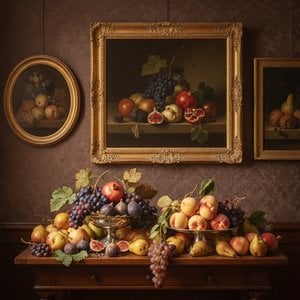
Fruit litho

Alphonse Maria Mucha Early artistic talent evident from childhood. Brno Czech Republic 1860 1897 1939 A captivating Art Nouveau lithograph by Alphonse Mucha, featuring a woman adorned in a green dress and holding an abundance of vibrant fruit. This piece showcases Mucha's signature flowing lines, organic forms, and rich color palette – a testament to his mastery of the style. The Slavonic

Alphonse Mucha (1860-1939) var en tjekkisk kunstner kendt for sin smukke Art Nouveau stil og plakater med idealiserede kvinder. Han skabte det monumentale "Slav Epic" og samarbejdede med Sarah Bernhardt – en kunstnerisk legende!

Håndlavet oliereproduktion

Håndmalet olie på lærred i din valgte størrelse og ramme, udført efter bestilling af vores kunstnere. ( Skift til printversion Skift til digitalt billede)

Corner sample of the P118B picture frame: støbt polystyren, 5 cm wide and 3 cm thick
P118B Dkr10
Corner sample of the P118H picture frame: støbt polystyren, 5 cm wide and 3 cm thick
P118H Dkr10
Corner sample of the P118W picture frame: støbt polystyren, 5 cm wide and 3 cm thick
P118W Dkr10
Corner sample of the P438Z picture frame: støbt polystyren, 5.5 cm wide and 3.5 cm thick
P438Z Dkr10
Corner sample of the P508JH picture frame: støbt polystyren, 7 cm wide and 3.5 cm thick
P508JH Dkr12
Corner sample of the P508YH picture frame: støbt polystyren, 7 cm wide and 3.5 cm thick
P508YH Dkr12
Corner sample of the P805H picture frame: støbt polystyren, 5 cm wide and 3.5 cm thick
P805H Dkr10
Corner sample of the P805Z picture frame: støbt polystyren, 5 cm wide and 3.5 cm thick
P805Z Dkr10
Corner sample of the P919BZ picture frame: støbt polystyren, 7 cm wide and 3.5 cm thick
P919BZ Dkr10
Corner sample of the P919G picture frame: støbt polystyren, 7 cm wide and 3.5 cm thick
P919G Dkr10
Corner sample of the P919XJ picture frame: støbt polystyren, 7 cm wide and 3.5 cm thick
P919XJ Dkr10
Corner sample of the P959ZH picture frame: støbt polystyren, 5 cm wide and 3 cm thick
P959ZH Dkr10
Corner sample of the P968JZ picture frame: støbt polystyren, 6 cm wide and 4 cm thick
P968JZ Dkr12
Corner sample of the W106C picture frame: massivt træ, 5 cm wide and 3 cm thick
W106C Dkr8
Corner sample of the W218G picture frame: massivt træ, 5 cm wide and 3 cm thick
W218G Dkr10
Corner sample of the W218JH picture frame: massivt træ, 5 cm wide and 3 cm thick
W218JH Dkr8
Corner sample of the W218Y picture frame: massivt træ, 5 cm wide and 3 cm thick
W218Y Dkr10
Corner sample of the W307PJ picture frame: massivt træ, 6 cm wide and 3 cm thick
W307PJ Dkr10
Corner sample of the W316G picture frame: massivt træ, 6 cm wide and 3 cm thick
W316G Dkr10
Corner sample of the W316PJ picture frame: massivt træ, 6 cm wide and 3 cm thick
W316PJ Dkr8
Corner sample of the W316Y picture frame: massivt træ, 6 cm wide and 3 cm thick
W316Y Dkr10
Corner sample of the W398PJ picture frame: massivt træ, 5 cm wide and 3 cm thick
W398PJ Dkr8
Corner sample of the W4111J picture frame: massivt træ, 6.5 cm wide and 3.5 cm thick
W4111J Dkr10
Corner sample of the W500HY picture frame: massivt træ, 7 cm wide and 5 cm thick
W500HY Dkr15
Corner sample of the W500JH picture frame: massivt træ, 7 cm wide and 5 cm thick
W500JH Dkr15
Corner sample of the W692G picture frame: massivt træ, 8 cm wide and 4 cm thick
W692G Dkr12
Corner sample of the W849H picture frame: massivt træ, 5 cm wide and 3 cm thick
W849H Dkr8
Corner sample of the W940BG picture frame: massivt træ, 7.5 cm wide and 4.5 cm thick
W940BG Dkr15
Corner sample of the W953PJ picture frame: massivt træ, 6 cm wide and 3.5 cm thick
W953PJ Dkr8

Standardstørrelse
speciallavet
CM
INCH

Vælg mellem vores forudindstillede størrelser, der matcher kunstværkets originale proportioner.

bredde
højde

Indtast den bredde og højde, du har brug for, så det passer til din ramme eller din væg. Da dette er håndmalet, kan kunstneren ved en anden form på størrelsen male lidt mere rundt om billedet eller skære lidt væk — det er op til dig. Vi sender dig et digitalt mockup til godkendelse, før maleriet påbegyndes. Billedet, der vises på denne side, viser ikke det endelige resultat — det er kun mockuppet, der gør.

Eksempler på tilpasningsmuligheder: Udskift ansigt med kundens eget foto; Tilføj kæledyr (f.eks. udskift kat med hund); Inkluder en skjult besked i baggrunden; Ændr baggrundslandskab eller elementer.
Efter bestilling vil WahooArt.com team sende en e-mail til kunden for at indhente instruktioner og fremsende et udkast til gennemgang.

Levering i hele verden () på 3-4 uger i stedet for de standard 5 uger. (25 oktober). Ingen kompromiser med kvaliteten.

Gratis ekspresforsendelse til hele verden
Lærred af linned i høj kvalitet
Komplet transportforsikring
Garanti for refusion af told og importafgifter
Garanti for autentisk farvegengivelse
100 dages returret ved fabrikationsfejl
100% fuld returret
Mængderabat ved flere køb

Samlet pris

Dkr 1784

Fruit litho

Reproduktionsmateriale

Reproduktionsstørrelse

-

Samlet pris

Dkr 1784

Kort om værket

  • Notable elements: Fruit abundance
  • Year: 1897
  • Artistic style: Organic forms, flow
  • Title: Fruit litho
  • Dimensions: 44 x 66 cm

Kunstquiz

Der er kun ét korrekt svar på hvert spørgsmål.

Spørgsmål 1:
Which artistic movement is most closely associated with Alphonse Mucha’s style, as exemplified by this ‘Fruit Litho’?
Spørgsmål 2:
The painting prominently features a woman holding fruit. What is a common characteristic of Mucha’s depictions of women?
Spørgsmål 3:
In what year was this artwork created?
Spørgsmål 4:
The color palette of the ‘Fruit Litho’ is characterized by which of the following?
Spørgsmål 5:
Alphonse Mucha’s early artistic education took place at:

A Moment of Abundance: Mucha’s ‘Fruit Litho’ – A Window into Art Nouveau

This exquisite 1897 lithograph by Alphonse Maria Mucha, measuring 44 x 66 cm, offers a captivating glimpse into the heart of Art Nouveau. More than just a depiction of fruit, it's an embodiment of the movement’s core tenets – a celebration of natural forms, flowing lines, and a profound sense of romanticism. The painting portrays a woman, elegantly dressed in a vibrant green gown, surrounded by a profusion of apples. These aren’t merely scattered objects; they are carefully arranged to create a visual symphony of color and texture, dominated by rich reds, oranges, yellows, and greens that evoke the bounty of autumn and the idealized beauty Mucha so often sought to capture.

The Artist's Vision: Mucha and the Prague Studio

Born in Brno, Czech Republic, in 1860, Alphonse Maria Mucha’s artistic journey began with a traditional education at the Academy of Fine Arts in Prague. However, he quickly recognized the limitations of academic constraints, seeking instead to forge his own path. His relocation to Paris in 1887 proved pivotal, allowing him to immerse himself within the burgeoning Parisian art scene and ultimately develop his signature Art Nouveau style. Mucha’s work was frequently commissioned for posters and decorative panels, reflecting a desire to integrate art into everyday life – a key principle of the movement. His studio became a hub for talented artisans, including illustrators and designers, contributing to the widespread dissemination of his aesthetic.

Symbolism and Technique: A Dance of Line and Color

Mucha’s technique is immediately recognizable through its fluid lines and meticulous attention to detail. The lithograph showcases a masterful use of shading and texture, creating an almost tactile quality within the image. Notice how the apples themselves are rendered with a delicate realism, yet possess an inherent sense of movement – a hallmark of Art Nouveau's fascination with natural forms in motion. The woman’s pose is deliberately graceful, echoing the flowing drapery so characteristic of Mucha’s work and reflecting the influence of artists like Pierre-Auguste Renoir. The bowl of fruit isn’t simply a still life; it represents abundance, fertility, and perhaps even a subtle allusion to classical themes of plenty – frequently explored in Art Nouveau.

Historical Context: A Flowering of Style

Created in 1897, ‘Fruit Litho’ sits squarely within the peak of Mucha's artistic prominence. This period coincided with the success of his 'Salon des Cent' exhibition in 1898, which catapulted him to international fame and solidified his reputation as a leading figure in Art Nouveau. The piece reflects the broader cultural trends of the late 19th century – a reaction against industrialization and a renewed interest in decorative arts and craftsmanship. It’s a testament to Mucha's ability to synthesize classical influences with modern sensibilities, creating an image that is both timelessly beautiful and deeply rooted in its historical context. This lithograph offers a tangible connection to a pivotal moment in art history, inviting viewers to experience the elegance and enchantment of Alphonse Maria Mucha’s vision.

Spørgsmål & svar

Fra hvilken epoke stammer "Fruit litho"?

"Fruit litho" tilhører 19th Century-æraen.

Er "Fruit litho" typisk for det, som Alphonse Mucha normalt skabte?

Alphonse Muchas gennemgående temaer inkluderer czech art nouveau influence, idealized feminine beauty, symbolic fruit imagery, salon des cent style, recurring female figures; "Fruit litho" fokuserer på fruit abundance, woman figure, art nouveau style, color palette, mucha artwork, still life scene, idealized woman.

I hvilket år og inden for hvilken stilart blev "Fruit litho" skabt?

"Fruit litho" af Alphonse Mucha er dateret 1897 og tilhører Art Nouveau.


Om kunstneren

Alphonse Mucha: En Art Nouveau-legende fra Prag

Alphonse Maria Mucha, en kunstner hvis navn er synonymt med elegance og dekadens, blev født i den lille tjekkiske by Ivanačice i 1860. Hans barndom var præget af en stærk kærlighed til musik – han var en talentfuld fløjtenist – og et tidligt engagement i kunstnerisk udtryk. Selvom hans familie ikke havde råd til at finansiere en formel uddannelse, viste Alphonse fra ung alder en evne til at tegne og male, der hurtigt fangede opmærksomheden hos lokale handelsfolk. Denne tidlige anerkendelse førte til et tilbud om at studere på kunstakademiet i Prag, hvor han dog snart blev skuffet over de traditionelle metoder og besluttede at søge sin egen vej mod Paris, centrum for den spirende Art Nouveau-bevægelse.

Paris og Sarah Bernhardt: En Karrierestart

I 1887 ankom Alphonse Mucha til Paris, en by fuld af muligheder og inspiration. Han begyndte at arbejde som assistent i et teaterdesignfirma, men det var hans samarbejde med den berømte skuespillerinde Sarah Bernhardt, der virkelig satte gang i hans karriere. I 1894 designede han plakaten til hendes forestilling *Gismonda*, og denne plakat blev en øjeblikkelig sensation. Dens flydende linjer, overdådige blomstermotiver og den idealiserede kvinde i centrum tiltrak opmærksomhed fra alle kanter, og Mucha blev hurtigt anerkendt som en af de mest lovende Art Nouveau-kunstnere i Frankrig. Denne succes førte til et langvarigt samarbejde med Bernhardt, hvor han skabte plakater til hendes mange forestillinger, hvilket cementerede hans stil og popularitet.

Art Nouveau’s Æstetik: Blomster, Kvinder og Bevægelse

Mucha’s kunst er karakteriseret af en unik blanding af elementer fra Art Nouveau-bevægelsen. Han var kendt for sine elegante plakater, der ofte fremstillede idealiserede kvinder omgivet af blomster og andre organiske former. Hans stil var præget af flydende linjer, pastelfarver og en følelse af bevægelse – et forsøg på at fange den skønhed og harmoni, der findes i naturen. Han blev også kendt for sine dekorative paneler, der prydede bygninger og interiører, og for sine illustrationer til bøger og tidsskrifter. Hans arbejde var ikke blot æstetisk tiltalende, men også en form for social kommentar, hvor han ofte fremhævede de traditionelle værdier i det tjekkiske folk.

Det Slaviske Epos: Et Nationalt Monument

I 1912 begyndte Mucha et af sine mest ambitiøse projekter: *Det Slaviske Epos*. Dette monumentale værk bestod af tyve store symbolistiske malerier, der fortalte historien om alle de slaviske folk i verden. Projektet blev støttet af Charles Richard Crane, en amerikansk filantrop, og det var et udtryk for Mucha’s patriotisme og hans ønske om at fremhæve den slaviske identitet. *Det Slaviske Epos* er ikke blot et kunstværk, men også en vigtig historisk dokumentation over de slaviske folks rige kulturarv. Det blev anset som en af Mucha’s mest betydningsfulde bidrag til kunsten og har siden været udstillet i hele verden.

Arvet og Indflydelse

Alphonse Mucha døde i Prag i 1939, men hans kunst fortsætter med at inspirere kunstnere og designere over hele verden. Hans unikke stil har haft en enorm indflydelse på Art Nouveau-bevægelsen og har bidraget til at forme den moderne æstetik. Han er stadig kendt for sine elegante plakater, der er blevet ikoniske symboler på skønhed og elegance. Muchos arbejde er et vidnesbyrd om hans talent, hans passion og hans evne til at fange essensen af det menneskelige sind og sjæl. Hans kunst er en levende påmindelse om den tjekkiske kunstners betydning for kunsten og designet i det 20. århundrede.
Alphonse Mucha

Alphonse Mucha

1860 - 1939 , Tjekken

Hurtige fakta

  • Artistic Movement Or Style: Art Nouveau
  • Artists Or Movements Influenced By This Artist: ['Prokopcová']
  • Artists Who Influenced This Artist:
    • Renoir
    • Moreau
  • Date Of Birth: 15. juli 1860
  • Date Of Death: 14. juli 1939
  • Full Name: Alphonse Maria Mucha
  • Nationality: Tjekkisk
  • Notable Artworks:
    • Slavisk Opstand
    • Salon des Cent
    • De slaviske episoder
  • Place Of Birth: Brno, Tjekkiet