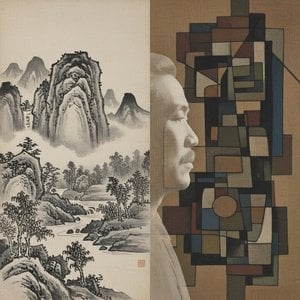
ro su-hyoun, born in Uljin, South Korea in 1899, emerged from a period of profound cultural transformation within Korea—a nation grappling with the pressures of Western influence while striving to preserve its traditions. Precise details regarding her formative years remain elusive, reflecting the limitations of archival records during that era. However, it is understood that she possessed an innate fascination for art and pursued formal training at Bunka Gakuin University in Tokyo, where she honed her skills in oil painting—a deliberate choice aligning with prevailing artistic trends of the time. This education provided her with a foundational understanding of Western techniques and aesthetics, which would subsequently inform her distinctive approach to Korean landscape painting.Note: The biography is based on the provided information and may not be a comprehensive or entirely accurate account of ro su-hyoun’s life and career.
A Singular Vision: Landscape Painting on Folding Screens
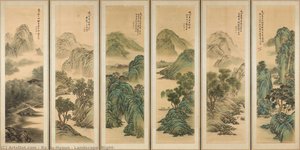
ro su-hyoun distinguished herself from her contemporaries through her unwavering dedication to the medium of folding screens—a practice remarkably rare in Korean art history. These intricately crafted wooden panels, traditionally used for ceremonial purposes and displaying calligraphy or paintings, became her favored canvas. Her artistic vision centered on capturing the essence of Korean landscapes with meticulous realism and subtle brushstrokes—a stylistic hallmark that resonated deeply with the sensibilities of her time.
She skillfully employed layering techniques to create depth and dimensionality, immersing viewers in scenes of serene mountainsides and flowing rivers.
The deliberate choice of folding screens wasn’t merely stylistic; it served as a powerful symbol of Korean cultural heritage—a tangible representation of artistic tradition.
Her work was recognized for its ability to evoke emotion and convey profound spiritual insight.
Technique and Style
ro su-hyoun's technique embodied the spirit of Korean painting traditions. She favored a meticulous approach, painstakingly blending pigments with painstaking attention to detail.Specifically, she utilized wet-on-wet brushwork—a technique that allowed for gradual tonal shifts and subtle gradations of color—resulting in landscapes imbued with atmospheric luminescence.This method ensured that the textures of rocks, trees, and water surfaces were rendered with remarkable accuracy. Furthermore, her compositions often incorporated asymmetrical arrangements—a stylistic element characteristic of Korean art—creating visual balance while subtly emphasizing the grandeur of the natural world.
Legacy and Recognition
ro su-hyoun’s contribution to Korean landscape painting extends beyond her individual artworks.
Her pioneering use of folding screens elevated the medium's artistic potential, establishing a precedent for future generations of artists.
She served as an inspiration to female Korean painters who sought to forge their own paths in a male-dominated field.
Her paintings are held in prestigious collections, including those of the Korean Art Museum Association and the British Museum, cementing her place among Korea’s most celebrated artistic figures.
Further Exploration
To delve deeper into ro su-hyoun's oeuvre and artistic influence, explore these resources:
Landscape (Left): Admire her masterful depiction of Korean scenery.
Landscape (Right): Discover another captivating portrayal of Korean landscapes.
ro su-hyoun: Explore her biography and artistic journey.
WahooArt.com: View more of ro su hyoun’s artworks.
Redakce WahooArt.com
Otestujte svůj zrak
U každé otázky je pouze jedna správná odpověď.
Otázka 1:
Where was Ro Su-hyoun born?
Otázka 2:
What medium did Ro Su-hyoun primarily utilize in her artwork?
Otázka 3:
Ro Su-hyoun’s paintings often depicted:
Otázka 4:
What role did Ro Su-hyoun play in preserving Korean cultural heritage?
In 1911, Marc Chagall used Cubist fragmentation to reconstruct the lost textures of Vitebsk, turning a rural landscape into a psychological dreamscape.
Explore the captivating world of Yi Eungro (Lee Ungno), a pivotal figure in Korean modernism. Discover his unique fusion of Eastern and Western artistic traditions, abstract masterpieces, and lasting legacy. A must-read for discerning art collectors.