

Obrazem, díky němuž se Peter Bonde stal slavným, je The Landscape around Sorø (1986); visí v Statens Museum for Kunst v místě Kodaň. Boys: ball (1987) a Kritisch Leben (1989) následují v srdcích sběratelů i návštěvníků muzeí. Z 7 děl umělce Peter Bonde v našem katalogu je těchto 7 nejoblíbenějších, z nichž každé je uvedeno s datem vzniku, muzeem a unikátními rysy.
Seřazeno podle našeho skóre popularity, které kombinuje počet vyhledávání, návštěv a objednávek u každého díla. Aktualizováno listopad 2026.


Muzeum s největším počtem obrazů na této stránce.
| Muzeum | Město | Díla autora Peter Bonde | Obrazy z tohoto seznamu |
|---|---|---|---|
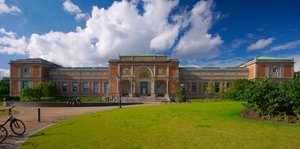 Statens Museum for Kunst |
Kodaň | 7 | The Landscape around Sorø, Boys: ball, Kritisch Leben |
Celých deset let malování, od 1986 až po 1996, bylo pro Peter Bonde vším, čím byla: zde jsou její díla, rok po roce.


The Landscape around Sorø (1986), Statens Museum for Kunst, Kodaň. Následují Boys: ball (1987) a Kritisch Leben (1989).
28 let: dílo The Landscape around Sorø pochází z roku 1986 a Peter Bonde se narodil/a v roce 1958.
Náš katalog obsahuje 7 děl autora Peter Bonde z let 1986 až 1996.
Většina z nich se nachází v Statens Museum for Kunst (Kodaň). V tabulce výše jsou jednotlivé muzea uvedeny postupně.
V období 1989: 2 z 7 děl na této stránce pochází z tohoto období, z nich Kritisch Leben.
Nejstarší dílo na této stránce pochází z The Landscape around Sorø (1986), nejnovější z Untitled (1996).
The Landscape around Sorø, Boys: ball a Kritisch Leben patří mezi 7 děl na této stránce, která má v zastarání Statens Museum for Kunst, Kodaň.
Peter Bonde enters the scene in 1958, born in Copenhagen, Denmark. His formative years lead him directly into the heart of the Danish art scene. Between 1976 and 1982, he undergoes rigorous training at the Royal Danish Academy of Art in Copenhagen. This period marks more than just formal education; it is a time of intense development within the studio walls of the Academy.
The early 1980s bring a shift in the Danish landscape. Bonde becomes a prominent figure within "De Unge Vilde," or The Wild Youth. This movement defines a specific era of energetic, expressive practice. He moves through these years not as a solitary observer, but as a participant in a collective surge of creativity that challenges established norms. The Academy provides the foundation, but the movement provides the momentum.
The transition from student to educator occurs within the halls of the Royal Danish Academy of Art. After completing his studies there in 1982, Bonde returns to the institution in a different capacity. He takes up a position as a professor at the Royal Danish Academy of Arts’ painting school, a role he holds from 1996 to 2005. This period marks a significant era of institutional influence, where his presence in the painting school aligns with his active participation in the contemporary art scene.
Before his long tenure at the Royal Academy, his academic path leads him to Odense, Denmark. Between 1994 and 1996, he serves as a professor at the Fuenen Art Academy. This brief, intense period of teaching in Odense acts as a bridge between his early years of formation and his later, more established academic standing in Copenhagen. His movement between these institutions reflects a career deeply embedded in the pedagogical structures of the Danish art system.
Bonde’s practice operates at the intersection of Abstract Expressionism and Conceptual Art. He moves beyond the traditional boundaries of the medium, often replacing the standard blank canvas with ultra-reflective mirror foil. When he applies oil paint to these surfaces, the brushstrokes do not merely sit on a plane; they interact with the space and the viewer. The reflection incorporates the surrounding room and the person observing it into the work itself, creating a dynamic interplay where the painted motif appears to float weightlessly. This approach challenges the notion of the image as a mere representation, treating the reflection as a physical object in its own right.
His compositions frequently engage with the mechanics of mass-circulated imagery and the fragility of memory. He achieves this through a layered process involving assemblage, collage, and the use of canvases featuring pre-printed photographs. By layering archival and personal references, he explores how images function within a broader cultural context. The work often oscillates between the physical and the digital, utilizing the installation of video screens directly onto the canvas to expand the definition of painting. These experiments extend into the realm of sculpture and installation, where the boundaries between the material residue of a gesture and the conceptual framework of the image become blurred.
The 1990s mark a significant expansion of Bonde's reach beyond the Danish landscape. In 1990, he held a solo exhibition at Galerie Sophia Ungers in Cologne. This period of international engagement reached a peak in 1999 when he represented Denmark at the Venice Biennale, collaborating with Jason Rhoades. His presence in Venice resurfaced decades later, as his works were featured within Danh Vo’s installation during the 58th Venice Biennale in 2019.
His exhibition history continues to span diverse geographies and contemporary settings. In 2011, he brought his practice to David Pestorius Projects in Brisbane, Australia. More recently, his work has been the subject of exhibitions at Galerie Barbara Thumm in Berlin, with presentations occurring in both 2023 and 2024. These appearances reflect a career that maintains a consistent dialogue with international art centers.
The 1980s in Denmark see the emergence of "De Unge Vilde" (The Wild Youth). Within this movement, Peter Bonde distinguishes himself as one of its most significant representatives. His presence in the group marks a period of intense, raw activity that defines a specific era of Danish contemporary art.
Institutional recognition follows the momentum of his practice. In 2003, he receives the Eckersberg Medal. This honor acknowledges his established standing within the Danish art community. Decades later, the trajectory continues with the receipt of the Thorvaldsen Medal in 2026.
The physical presence of Peter Bonde’s work extends across major institutional landscapes in Denmark. His pieces are held within the collection of The Danish National Gallery. This presence continues through ARoS and the Trapholt Museum for Moderne Kunst. In Esbjerg, the Esbjerg Art Museum maintains his works within its permanent holdings.
The reach of his practice moves beyond Danish borders into broader European and international contexts. In Germany, his work is part of the Kunstmuseum Wolfsburg. His reach extends further east to the Elgiz Collection in Turkey. These locations mark the geographic spread of his visual output, from Nordic institutions to private and public collections across Europe and beyond.