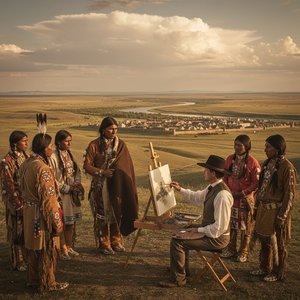
The Chronicler of a Vanishing Era
Elbridge Ayer Burbank stands as a singular figure in the annals of American art, recognized primarily for his meticulous and emotionally resonant depictions of Native Americans during the late 19th and early 20th centuries. Born on April 10, 1858, in Harvard, Illinois, to Anna Maria and Abner Jewett Burbank, his life’s work became a profound bridge between two worlds. While his roots were firmly planted in the American Midwest, his artistic soul was forged in the prestigious studios of Europe. This unique blend of American subject matter and European academic rigor allowed him to approach his subjects with a level of technical sophistication that elevated portraiture from mere documentation to high art.
Burbank’s artistic journey began with formal training at the Chicago Academy of Design, but it was his decision to travel to Germany in his thirties that would profoundly shape his stylistic approach and intellectual grounding. Studying at the Düsseldorf Kunstakademie under masters such as Anton Melbye, he absorbed the tenets of Realism and the burgeoning influences of Impressionism. These European currents instilled in him a commitment to capturing the subtle interplay of light and atmosphere—a technique he would later skillfully adapt to portray the vast landscapes and sacred ceremonies of Native American communities across the American frontier.
A Legacy of Direct Observation
Upon returning to the United States, Burbank dedicated himself wholeheartedly to documenting the lives and traditions of indigenous peoples. He embarked on extensive expeditions across the Plains states and the Southwest, driven by a mission that was as much ethnographic as it was artistic. His dedication was unparalleled; he is credited with sketching and painting more than 1,200 portraits from over 125 different tribes. This monumental undertaking required not only immense physical stamina but also a deep sense of empathy and respect for the individuals who sat before his easel.
Burbank’s artistic method was rigorously disciplined yet imbued with a profound humanity. He famously employed a technique known as direct observation, painstakingly rendering his subjects from life without the use of preparatory sketches or studies. This approach demanded unwavering attention to detail—capturing the subtle expressions, the intricate textures of beadwork, and the nuanced colors of traditional regalia that conveyed not merely physical likeness but also psychological character. His canvases are distinguished by their remarkable ability to capture the intensity and dignity of his subjects, making him perhaps the only artist believed to have painted the legendary war chief Geronimo from life.
Historical Significance and Artistic Impact
The significance of Burbank’s work extends far beyond the aesthetic beauty of his oil paintings. His portfolio serves as an invaluable historical document, providing a visual record of prominent chiefs, elders, and tribal members at a pivotal moment in American history. Through his eyes, we witness the strength, resilience, and cultural richness of Native American communities during a period of immense transition. Works such as One Star (1903) and Ne i so meh (1904), both housed in the Smithsonian American Art Museum, exemplify his ability to draw the viewer into an intimate connection with the subject's gaze.
As a pioneer of Native American portraiture, Burbank’s influence remains palpable in the study of American frontier art. His life, which concluded in 1949, left behind a legacy that transcends simple biography. He was more than a painter; he was a witness to history. His ability to blend the technical precision of the German academies with the raw, spiritual essence of the American West ensures that his portraits remain timeless, offering a window into a world that continues to command our respect and fascination.