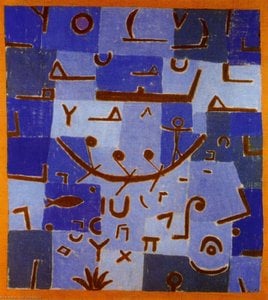
A Poetic Dialogue: Joan Miró’s “Mujer y Pájaro 1”
Joan Miró's "Mujer y Pájaro 1" is more than just a depiction of a woman and a bird; it’s an immersion into the vibrant, dreamlike world of one of the 20th century’s most influential artists. Painted in Barcelona during his prolific career – roughly between 1930-1940 - this artwork embodies Miró's signature style: a captivating blend of abstraction and recognizable imagery, rooted deeply in Catalan folklore and personal symbolism. The painting immediately draws the eye with its bold color palette—a joyous explosion of reds, blues, yellows, and whites – colors that evoke both the warmth of the Mediterranean sun and the cool depths of the subconscious. The woman, rendered with simplified forms and a sense of serene contemplation, appears to be engaged in an intimate exchange with the bird perched delicately on her shoulder. This interaction isn’t literal; it's a projection of emotion, a visual representation of the artist’s fascination with the connection between humanity and nature.
- Subject Matter: The central figures – woman and bird – represent fundamental themes in Miró’s work: fertility, freedom, and the cyclical rhythms of life.
- Style: This piece exemplifies Miró's mature style, moving further away from overtly representational forms towards a more purely abstract expression of feeling and intuition.
Technique and Materials – A Masterful Approach
Miró’s technique in “Mujer y Pájaro 1” is characterized by its layered approach. He began with an underpainting, often using tempera or oil, which was then built upon with thin washes of color applied through a process he termed ‘grattage’. This involved scraping away layers of paint to reveal the underlying tones and create textured surfaces – a technique that adds significant depth and dynamism to the composition. The use of collage elements, incorporating fragments of paper and other materials, further enhances this textural richness. The artist’s meticulous attention to detail is evident in the precise placement of each element, contributing to the overall sense of balance and harmony. He employed a palette knife extensively, creating bold strokes and expressive marks that contribute significantly to the painting's energetic feel.
Symbolism and Context – Echoes of Catalonia
The symbolism within “Mujer y Pájaro 1” is rich and layered, deeply rooted in Catalan tradition. The bird, a frequent motif in Miró’s work, represents freedom, spirituality, and the connection to the natural world. Its placement on the woman's shoulder suggests protection and nurturing. The woman herself embodies fertility and grace, echoing ancient matriarchal figures within Catalan culture. Furthermore, the painting reflects the broader artistic context of the time – the rise of Surrealism, which embraced the power of dreams and the subconscious mind. Miró’s work aligns with this movement while retaining his unique, deeply personal vision. The influence of Antoni Gaudí's organic architectural forms is subtly present in the flowing lines and biomorphic shapes that characterize the entire composition.
Emotional Impact – A Window to the Soul
"Mujer y Pájaro 1" possesses a profound emotional impact, inviting viewers into a realm of quiet contemplation. The painting’s vibrant colors and dynamic brushwork evoke a sense of joy, wonder, and perhaps even melancholy. It's a piece that speaks to our innate desire for connection – with nature, with ourselves, and with the mysteries of existence. This artwork is not merely a beautiful image; it’s an invitation to engage in a dialogue with the artist’s soul, a testament to Miró’s ability to translate his innermost thoughts and feelings into a visual language that continues to resonate with audiences today.



 Náhled
 Přepnout na tisk
 Sdílet
 Sdílet
 Podrobnosti o díle

 Stáhnout
 Podobné položky
 Rentgenové snímky
 Slideshow
 Statistiky

 Zobrazit více






































 Skleněná varianta je dostupná pouze u rozměrů menších než 110 cm