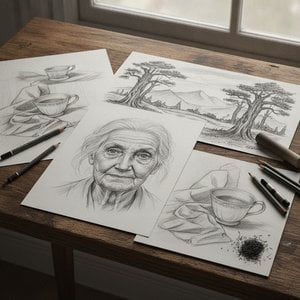
The Sculptural Lyricism of Hugo Robus
In the grand tapestry of twentieth-century American art, few figures possess the quiet, transformative power of Hugo Robus. Born in Cleveland, Ohio, in 1885, Robus embarked on a creative odyssey that would see him traverse the boundaries between the two-dimensional world of painting and the tactile, three-dimensional realm of sculpture. His journey was not merely one of changing mediums, but an evolution of spirit—a movement from the structured, fragmented perspectives of Cubism toward a deeply personal, lyrical abstraction that sought to capture the very essence of human emotion through form.
Robus’s artistic foundation was built upon rigorous classical training. His early years at the Cleveland School of Art and the National Academy of Design in New York City provided him with a disciplined command of technique, yet it was his time in Paris that truly ignited his avant-garde sensibilities. Immersed in the vibrant atmosphere of the Académie de la Grande Chaumière under the guidance of Emile Carlsen, Robus breathed in the revolutionary air of European modernism. This exposure to the radical shifts of the era allowed him to experiment with the geometric complexities of Picasso and Braque, yet he possessed an innate drive to move beyond purely intellectual exercises toward something more visceral and emotive.
A Transition from Canvas to Bronze
The 1920s marked a profound metamorphosis in Robus’s career. While he began his professional life as a painter, the limitations of the flat surface eventually gave way to a fascination with volume, weight, and the interplay of light upon physical form. This transition was not an abandonment of his earlier explorations but a refinement of them. The fragmented logic of Cubism found a new, more fluid expression in his sculptural work, where he began to masterfully balance positive and negative space—a technique that would later echo the profound influence of Surrealist masters like Henry Moore.
As a sculptor, Robus developed a signature style characterized by serene elegance and sinuous contours. His works often feature stylized figures with polished surfaces that invite the eye to dance along their curves. He possessed a unique ability to render the human form not as a rigid anatomical study, but as a vessel for movement and feeling. Whether through the rhythmic lines of a bronze figure or the delicate tension in a pencil drawing, his work consistently sought to embody fundamental themes of domesticity, grace, and the quiet rhythms of life.
Legacy and the New City Colony
Beyond his individual masterpieces, Robus played a vital role in the communal fabric of American modernism. In 1918, alongside contemporaries such as Henry Varnum Poor and Martha Kantor, he co-founded an influential art colony in New City, New York. This enclave became a sanctuary for creative experimentation, fostering a community where the boundaries between different artistic disciplines could blur and evolve.
The enduring significance of Hugo Robus is etched into the permanent collections of the world's most prestigious institutions. His ability to bridge the gap between the structural rigor of early modernism and the expressive freedom of lyrical abstraction ensures his place in art history. Today, his works serve as poignant reminders of a period when American art was finding its unique voice—a voice that Robus helped shape through bronze, stone, and an unwavering commitment to the beauty of the human spirit.
- Notable Sculptural Works: Woman Washing Her Hair, Girl Reading, Mother With Child, and Torso in Flight.
- Key Artistic Influences: Cubism (Picasso, Braque), Surrealism (Henry Moore), and the classical training of Emile Carlsen.
- Institutional Recognition: The Whitney Museum of American Art, The Museum of Modern Art (MoMA), and the Metropolitan Museum of Art.



 Zobrazit v interiéru
 Přepnout na tiskové verze
 Odeslat
 Sdílet
 Podrobnosti
 Průvodce

 Stáhnout obrázek
 Podobné kousky
 Rentgenové snímky
 Slideshow
 Statistiky
 Přečíst si více






































 Skleněná varianta je dostupná pouze u rozměrů menších než 110 cm