
Cubism · 1920
Composition е творба на Фернан Леже (1881–1955). Датира от 1920. Това произведение принадлежи към движението Cubism. Изработено от Oil On Canvas.

Fernand Léger's Composition, painted in 1920, isn’t a depiction of recognizable objects; it’s an immersion into the very *feeling* of modernity. Born amidst the rural landscapes of Argentan, Normandy, Léger possessed a unique perspective – one forged by his early life working with his father on the farm, juxtaposed against the burgeoning industrial world of Paris. This duality informs every facet of this work, creating a visual language that simultaneously celebrates and critiques the dynamism and fragmentation inherent in the machine age. The painting immediately commands attention not through narrative, but through its sheer geometric density: overlapping rectangles, circles, and subtly curved lines coalesce into an ambiguous spatial field, inviting the viewer to navigate a world where perspective is deliberately distorted.
The grayscale palette, punctuated by strategic bursts of yellow and red, isn’t merely decorative. The muted tones emphasize the flatness of the picture plane, pushing back against traditional notions of depth and realism. These vibrant accents – reminiscent of factory lights or signal flares – inject a vital energy into the composition, hinting at the underlying rhythms of industrial life. Léger masterfully employs angular lines to create a sense of fractured movement, mirroring the jarring yet compelling experience of navigating a rapidly changing urban landscape. The deliberate lack of strong shadows further contributes to this flattened effect, reinforcing the painting’s focus on form and structure rather than illusionistic representation.
Composition firmly establishes Léger as a pivotal figure in the development of Cubism, specifically within his own distinctive style known as “Tubism.” Rejecting the purely representational aims of earlier Cubists like Picasso and Braque, Léger sought to distill the essence of modern life – its mechanical forms, its streamlined shapes, and its relentless forward momentum – into a simplified visual vocabulary. The dominant geometric motifs—cylinders, cones, and cubes—are not merely abstract shapes; they are echoes of factory machinery, automobiles, and other symbols of industrial progress. This isn’t simply an aesthetic choice; Léger was deeply fascinated by the mechanics of the modern world, believing that art should reflect its underlying structure.
The painting's influence extends beyond Cubism, foreshadowing elements of Pop Art with its embrace of everyday objects and industrial imagery. Léger’s approach to color – a restrained palette punctuated by bold accents – anticipates the later work of artists like Andy Warhol. The deliberate simplification of forms, combined with a focus on texture (though subtly rendered through variations in tone), creates an image that is both visually arresting and intellectually stimulating. It's a testament to Léger’s ability to capture the spirit of his time—a period of unprecedented technological advancement and social transformation.
Examining the technique reveals a meticulous attention to detail. Léger employed precise brushwork, layering paint with remarkable control to achieve the desired tonal variations and create a sense of depth through overlapping forms. The use of oil paints on canvas lends a richness and durability to the work, ensuring its longevity. The composition’s seemingly flat appearance belies this careful construction; each shape is precisely defined, contributing to the overall sense of order within the chaotic arrangement.
Léger's legacy extends far beyond his own artistic output. He profoundly influenced subsequent generations of artists, particularly those interested in exploring the relationship between art and technology. His work continues to resonate today, offering a compelling meditation on the complexities of modernity and the enduring power of abstraction. Reproductions of Composition provide an accessible gateway into Léger’s world—a world where form, color, and movement converge to create a truly unforgettable visual experience.

Обществено достояние: художникът е починал през 1955 г.
Други размери, кадриране и цитиране →Фернан Леже, Composition (1920). Обществено достояние
Подготвено от по-голямо изображение от нашата база данни, а не от каталожното, така че да достигне поне 300 DPI. Дигитален експерт проверява цветовете спрямо оригинала и ретушира файла, запазвайки автентичността на мазките на художника.
Придобийте изображение с висока резолюция"Composition" датира от 1920. Тази дата поставя произведението в контекста на кариерата на Фернан Леже и неговата епоха.
Фернан Леже е използвал/а техниката Oil On Canvas за „Composition“. Тази техника определя материалната природа на оригиналното произведение.
Обектите на "Composition" са geometric abstraction, modern composition, cubist forms, grayscale palette, industrial design, abstract shapes, 20th century art.
„Composition“ на Фернан Леже е в в обществено достояние – авторското право е изтекло. Този статус определя как може да бъде репродуцирано изображението на произведението.
Художникът зад "Composition" е Фернан Леже. Произведението е каталогизирано под името на Фернан Леже.
Творческото направление, свързано с „Composition“ на Фернан Леже, е Cubism. Тази класификация поставя произведението сред съответните автори и художествени творби.
"Composition" представлява Mature Period на Фернан Леже.
Когато „Composition“ е създадена през 1920, Фернан Леже – роден/а през 1881 – е бил/а на 39 години.
„Composition“ на Фернан Леже е в в обществено достояние – авторското право е изтекло. Срокът на авторско право се изчислява от годината на смъртта на творца, а Фернан Леже почина през 1955.

1881–1955, Франция
Животът на Фернан Леже Историята на Фернан Леже започва в селото Аржантан, разположено в регион Орн в Долна Нормандия. Той се явява на този свят на 4 февруари 1881 г. като единствено дете. Ранните му години са оформени от тишината на френската провинция и присъствието на майка му, Мари-Адел Доно.
Пълната колекция Фернан Леже, ръчно рисувана по поръчка → Пълната страница на художника Шедьоври на Фернан Леже
 25 Must-See Masterpieces at Centre Pompidou, Paris: A Modern Art GuideExplore 25 iconic masterpieces from Centre Pompidou. Discover the stories behind modern art legends. Explore the full collection online at …
 Steel & Soul: 10 Powerful Artworks That Capture the Industrial VibeExplore 10 iconic artworks that define the industrial aesthetic. From gritty urban landscapes to metallic textures, discover the stories be…
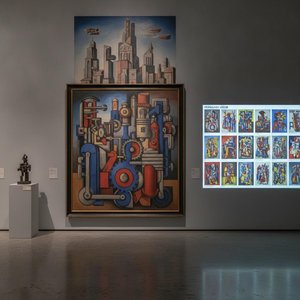 Mastering the Machine Age: The 25 Best Artworks by Fernand LégerImmerse yourself in the vibrant world of Fernand Léger. Explore 25 iconic masterpieces of Cubism and Tubism, from bold geometric forms to m…
 Преглед в реален мащаб

 Принтиране
 Изпрати
 Сподели
 Информационен лист


 Изтегляне
 Подобни артикули
 Рентгенова снимка
 Слайдшоу
 Въпроси и отговори

 Статистика
 Градът1919
 Механикът1920
 Три жени1921
 Нюди в гората1910
